Photo Source: Jill Steinberg
"Bigger Than Life" belongs to that genre of intense and lurid '50s melodrama perfected by Ray and Douglas Sirk in movies like "Rebel Without a Cause" and "Written on the Wind." The plot is derived from a nonfiction article in "The New Yorker." It has schoolteacher and loving husband and father Fred Avery, already working a second job as a cab driver due to monetary woes, without his middle-class wife's knowledge, waylaid by a rare and fatal disease of inflammation of the arteries. His only hope is a new miracle drug: cortisone. The drug alleviates his symptoms, but Avery takes too much of it and soon begins a downward spiral into paranoia and manic depression, resulting in the conviction that he must murder his young son and wife and then kill himself.
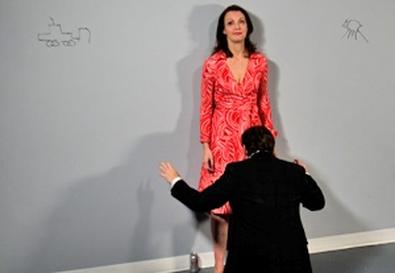
Ryan and Rouner are terrific partners as they play subtext as text, often taking emotions to their loud and soft extremes, and contribute a bracing and brave physicality. There's no attempt whatsoever to invoke the performances of James Mason, Barbara Rush, Christopher Olsen, and Walter Matthau (as a family friend), because it would be out of place. I'm not sure how much of the proceedings will make sense if you've never seen the film, but I was surprised that the story cohered with reasonable success. One imaginative touch is Fish's choice to have Ryan speak the text of a '50s TV commercial that James Mason made for Thunderbird wine every time Avery takes a cortisone pill (you can catch the commercial on YouTube). The myriad ways Ryan finds to say the words serve as indicators of the character's mental and emotional state, succinctly charting his decline. And though I did miss David Raksin's wonderfully florid musical score, Fish makes judicious musical choices of his own that are undoubtedly more in keeping with his deconstructive vision.
"X-ray" is probably as good a term as any to describe this piece. After all, x-rays are used to diagnose ills and reveal flaws we sense but can't see. Though the talented Fish, Ryan, and Rouner command attention, I can't say that their x-ray reveals anything particularly surprising, which makes "Tom Ryan Thinks He's James Mason…" more for those for whom style is an end in itself.
Presented by Incubator Arts Project at St. Mark's Church in-the-Bowery, 131 E. 10th St., NYC. Jan. 9–16. Tue., Thu.–Sun., 8 p.m. (212) 352-3101, (866) 8111-4111, www.theatermania.com, or www.incubatorarts.org.