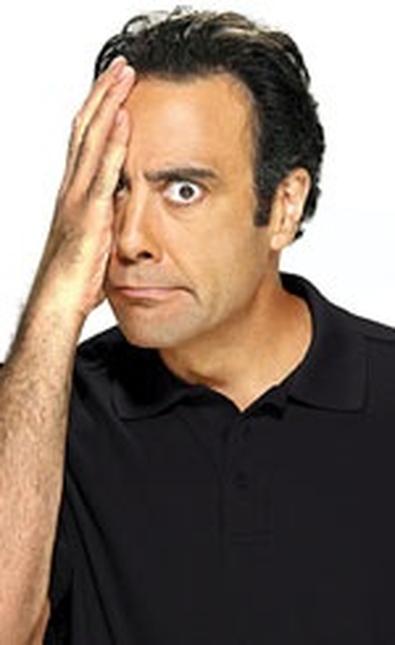
Moving beyond his last series, Brad Garrett welcomes the uncertainty of new challenges. Next up: 'Til Death.
For nine seasons, Brad Garrett was a welcome presence in America's homes as Robert Barone, the sad-sack elder brother of Ray Romano's title character on the CBS sitcom Everybody Loves Raymond. It was a breakthrough for the standup comic, who began performing at open mikes at age 18 and won the grand prize in the comedic category on Star Search in 1984. Garrett knew how to make Robert's obsessive-compulsive, downtrodden Everyman sympathetic without being annoying. "There's a very fine line of being vulnerable and not being dumb," Garrett notes. "The writers really knew how to pepper him and make him relatable. We wanted him hurt and flawed, but a guy that accepted he would be second. There is a favorite in every family, whether they tell you or not. And there are more Roberts out there than Raymonds."
While on the hit sitcom, Garrett remained active in other projects, lending his distinctive voice to characters in films such as Finding Nemo and Garfield and taking a SAG Award-nominated turn as Jackie Gleason in the 2002 TV biopic Gleason. And when Raymond left the air in 2005, Garrett was left with three Emmy Awards for outstanding supporting actor and new clout in the television industry. After more movie roles (The Moguls, The Pacifier) and a turn in the Broadway revival of The Odd Couple, Garrett found himself being drawn back to television with the new Fox comedy 'Til Death. In the sitcom, Garrett plays Eddie Stark, a loudmouthed polar opposite of Robert Barone who has been married for 25 years to wife Joy (Joely Fisher). Their life is contrasted with that of the newlywed couple (played by Eddie Kaye Thomas and Kat Foster) who move in next door.
Back Stage: You're returning to television despite having an active film and theatre career. Is TV your first love?
Brad Garrett: I think it's not only the medium that I'm best suited for, and I love the live audience because that to me is the best of both worlds; I love theatre. Also, I'm a daddy of two young kids, and it keeps me in town -- that's a huge thing, too. I'm a very hands-on pop, and I came up with TV, I'm a fan of TV, and it seems to be my best fit. As far as my film career goes, I'm picky and not in demand. I find that to be troubling.
Back Stage: I would think that after your last series, you would have your pick of projects on television.
Garrett: I'll be candid: I wasn't looking to run back into TV, especially following such a pedigree like Raymond. But as any good actor knows, it's about the writing. This was a project that wasn't written for me, but they sent me the pilot, and when I read it, I realized the character is closer to me than anything I've ever played. I'm a lot like Eddie as far as I'm a little sarcastic and I believe a well-run marriage is close to a perfect hostage-crisis scenario. Also, if I was going to go back to TV, I wanted to do something that was as far from Robert as I could get. This guy is very out in front, very forward, kind of an in-your-face individual. But it's only because deep down inside, he knows that he's not the guy he wishes he was. He's a very flawed man; he's a big loser at the end of the day. I love playing characters like that. He doesn't understand that women run the world.
Back Stage: Do you worry about the so-called "Seinfeld curse," in which actors who create an iconic character on a hit show seem to have trouble with other parts?
Garrett: The thing I'm worried about, actually, is the Diff'rent Strokes curse. I'm afraid I'm going to become a tiny black man.
I think people who come off big shows are watched a lot more than people who don't. It looks like a curse because when you come off a show that was such a hit, they compare everything to it. It's tough to spin off a character; it's just as tough to re-create yourself. But this is a business where you have to be able to re-create yourself. It's like an athlete who follows a World Series season or a Superbowl, or a singer that has an amazing album: They've got to do the next one. All you can do is go with your instinct. This pilot made me laugh out loud, which was the only one I was sent that really made me do that, and I believe in the cast and the writers. Are people going to watch? I don't know. If not, it's not the end of the world. I'm blessed and grateful to have been on Raymond, I realize what a rarity that was, and as far as the curse, this is a business that's full of curses. It's a tough gig, but it's the only gig. Rules are made to be broken, and so are curses.
All I know is that I'm at a network where I'm happy to be; they're very collaborative, it's all about the product. If a writer is more money or a camera is more money, they go for it. They understand at the end of the day it's about the show. They get the funny over at Fox, they really do. You can push the envelope a little bit and do things that are a little outside of the box. That's what attracted me to the whole project.
Back Stage: Is that also the appeal of taking on a role such as Jackie Gleason, a part you wouldn't seem to be the natural choice for?
Garrett: That was something that people didn't get out of the gate. I was not the network's first choice, by any stretch of the imagination. I had to fight diligently to play that role. But it was something I felt I could do that was in me. It wasn't just a dream of me to play that guy; it also ended up really helping me as far as being looked at as an actor. I love it when people say, "It can't be done," or "You're following a curse," or this or that.
Back Stage: There was talk for a long time of a Raymond spinoff centered on your character, and you seemed to be interested. What happened?
Garrett: Very simple: The only way I was going to do the spinoff was if we were able to get the Raymond writers. The bottom line is, especially coming from standup, I know how important writing is -- even if my act doesn't reflect that. It made no sense to do a spinoff without the writers who wrote this guy for the last nine years. Robert is a very definitive guy. Instead of going into a spinoff with different writers, I'd just as soon do a different show with different writers. CBS didn't step up to the plate and secure the writers; they just didn't make it happen. I told them, "You're going to lose these guys, especially coming off a show like Raymond." These writers were so gracious; they wanted to do the spinoff, they literally waited months for CBS. It wasn't a money thing as much as CBS just making the gesture. They didn't, and everyone has families to feed, and we all moved on. I was doing Broadway and a film and was fine and content, when my manager called and said, "You gotta read this pilot. This guy is you." I read it, and here we are.
Back Stage: 'Til Death is an ensemble show, but all the promotion for it is selling you as the star. Is that a strange situation to be in?
Garrett: Well, they're being very kind. I came off a big comedy. But the ensemble is the key. If you look at any great sitcom, it was an ensemble. I may have the name that's in the forefront right now, but believe me, when we cast these people, we knew how important it was. We literally cast Joely Fisher on a Sunday afternoon and went to work on Monday. I knew how great the wife had to be, how she had to go toe-to-toe with me. She had to have bravado and courageousness, and if I don't have the right actor, I'm going to look like a bully as opposed to a flawed guy. You know, the louder you yell, the more wrong you usually are. When Joely walked in and we read the scene, we knew in 10 minutes she was Joy. Just like with Eddie and Kat. It's an ensemble piece, and we want it to be.
Back Stage: You're also a producer on this show. Did you have casting approval?
Garrett: I was able to throw my hat in the ring. I wasn't the end all be all, but I was able to say what I felt was working. The good news is, I got my choice in every instance. I've never really been a lead in anything before, and I'm wearing a producer hat on this show just so I can have a vote. I'm lucky to be around people who have the same sensibility as I do.
Back Stage: That must be a nice change from 10 years ago when you were auditioning for Raymond.
Garrett: It is. It's been a 25-year road, and it's nice to be here. It's better than the days when Ray looked at me and said, "Why don't you go upstairs and pretend you have clout?"
Back Stage: Still, it seems you've worked pretty steadily since starting your acting career.
Garrett: I've been very fortunate. Since my days waiting at TGI Friday's, I've never looked back. Standup was my first love, and I'm back out doing it. I work the Mirage in Vegas every other month, and Ray and I did 10 cities together a few months back. That's my roots, and I took a lot of time off from doing standup when I got Raymond. Believe it or not, Ray got me back in it. I guess he thought if I did my act, he'd just look that much stronger. I've had a lot of luck, and when the time came, I was prepared. You need both. You need the breaks. They don't remember a great audition, but they remember the ones you suck at.
Back Stage: A lot of standup comedians have tried to launch acting careers and not fared so well. How did you avoid this pitfall?
Garrett: I think, with acting, a lot of it has to be innate. You can't teach timing; I don't care how many classes you go to. And to make the transition from standup to actor, you have to be an actor. Even though I did standup, I look at myself as an actor first; I think that's my strength. I was at the Strasberg Institute when I was 18 years old. I went from high school to six weeks at UCLA and said, "This isn't me; I'm not college material." I went to the Lee Strasberg Theatre one day and took those classes, which for an 18-year-old were very intense. I studied out here with Adam Hill, and I still train to this day with Larry Moss, who's just a genius of our time. He got me where I needed to be for Gleason.
You can never stop training; you have to keep growing. A lot of the scripts I was sent after Raymond were Robert clones: the mopey, downtrodden loser. So to play Eddie was a lot more challenging. It's easy to fall into that thing. Being stereotyped is a double-edged sword. It's a blessing because you're being recognized as someone. You've hit a character the world has related to. But as an actor, I get bored easily.
For a standup to go to the transition as an actor, it takes a lot of trust. And standups aren't really trustful; that's why we're standups. The one thing I really had to learn when I took acting after doing standup was to listen, because standups are afraid to listen; we don't want to hear silence. We're always talking.
Back Stage: Was there a particular philosophy or piece of advice that kept you going during the leaner years?
Garrett: What really kept me going was, I was doing what I loved. I didn't always make a living at it or have people telling me I was good, but I knew that I had to do what I loved. All I can tell you is: Train as much as you can. If you want to direct, take a writing course. If you want to write, take an acting course. It's being ready and prepared and knowing you're going to blow the majority of auditions. It's a numbers game. You have to remember, it takes one person to say no and 15 to say yes. There's going to be a time when you're going to be at a network and you'll get a comedy note from an accountant. And you'll want to pull your hair out. But it happens.
People get bitter because you're so beaten by the time you get there. You gotta have a life outside of your craft. When I had kids, I saw this was really the big deal. You gotta have a life. If show business is your life, you're doomed.
Back Stage: Is there any role or project you're hoping to tackle?
Garrett: I'd love to go back to the theatre eventually. I'd love to do something dramatic in theatre. Really, I want to do -- anything that scares me is important to do. And there's a lot that scares me. I'm 6-foot-8, 46 years old, and I have a nightlight. Although, that's not because I'm scared: I'm just addicted to shadow puppets.