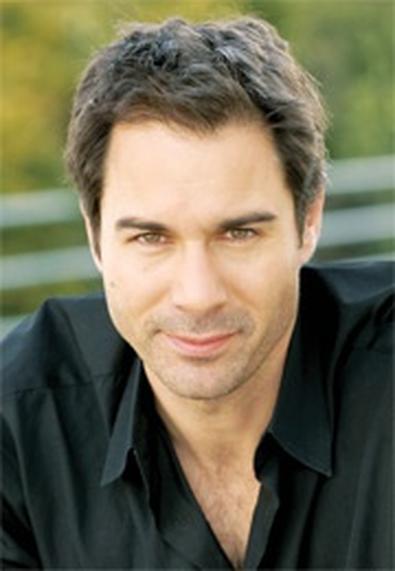
Eric McCormack will be the first to call himself lucky. "Last Christmas, I celebrated 20 years since my last regular job," he reveals. "I've been able to support myself as an actor since 1985." The last eight years have been particularly good for the charismatic Canadian, who became a household name with the pop culture phenomenon known as Will & Grace. As reliable but unlucky-in-love lawyer Will Truman, McCormack created an original television character: the gay straight man. Of the four main characters, Will was always the steadfast voice of reason, the most "together" of the dysfunctional bunch given life by Debra Messing, Sean Hayes, and Megan Mullally. Which is not to say Will was ever boring; as played by McCormack, the character was clever, flawed, and endearing.
It was also a role McCormack seemed destined for, despite his classical training and initial resistance to taking on the part. When McCormack was performing in high school plays such as Godspell and Pippin, he set a goal for himself: attend theatre school at Ryerson University in Toronto and eventually join the Stratford Festival of Canada. He did both, spending five years at Stratford, from 1985 to 1989. McCormack wasn't invited back after '89. "The English woman who was about to run the place said, 'Eric, I don't have an offer for you next year. I don't like the way you play lovers; there's something very modern about them. Have you thought about doing situation comedy?'" he says. "Nine years later she was absolutely right. What she was seeing was just a modern, urban physicality. I was discovering a different side of me--a more urban side. I'd been so classically trained, but ultimately my mannerisms were more Woody Allen than Laurence Olivier."
After leaving Stratford, McCormack was a regular on TV series such as Street Justice and Lonesome Dove, and in 1998 he starred alongside William Shatner in the cult movie Free Enterprise. But he is most associated with his role in the breakthrough sitcom Will & Grace. Now, after one Emmy, eight years of fat jokes at his expense, and scenes with countless big-name guest stars, McCormack will say goodbye to Will & Grace as it leaves the airwaves. Yet the actor isn't about to start collecting unemployment checks. On June 8, McCormack will open Off-Broadway at the Lucille Lortel Theatre in the Neil LaBute play Some Girl(s), now in previews. He plays a character known only as "Man" who visits four women from his past (Judy Reyes, Brooke Smith, Fran Drescher, and Maura Tierney) on the eve of his wedding. It's a challenging role for the actor, whose last stage work was in The Music Man on Broadway in 2001. In addition, McCormack is actively involved with his production company, Big Cattle, which will premiere its improvisational comedy series Lovespring International June 5 on the Lifetime network. He is also at work developing several other shows, as well as a script he wrote and plans to direct. Its title, What You Wish For, is apt for the actor who admits he's "living the dream."
Back Stage: How did the role in Some Girl(s) come your way? Were you seeking out a theatre project?
Eric McCormack: I was ready to do theatre, and this kind of thing would have been my dream. But I was actually getting a lot of musical offers. A few weeks ago, one of the four women in the play was offered to Debra Messing, but she couldn't do it. She said to me, "If there's a role I could wish you would play upon finishing Will Truman, it would be this." I said, "Well, let me read it." But even before she'd given me the script, I had thrown my name in the ring and said to my managers, "I wonder if they've cast it yet." I had an offer two days later. I went back to Debra and said, "Okay, you got your wish: I'm playing this part."
Back Stage: LaBute is known for writing polarizing--some would say misogynistic--male characters. Does Man fall into that category?
McCormack: No. In the first scene, you get a sense this guy is trying to do something. He's a little altruistic; he hasn't figured out why he's doing it, but he really wants to make good with some of the girls in his past. But as it goes on, the women one by one start calling him on his shit. It's almost a mystery for the audience: They're not sure, just as he's not sure, "Why is he doing this thing? Why is he meeting with these old girlfriends? What is he trying to accomplish?"
I think it's a really interesting play. It's not your typical Neil LaBute male: He's not an overt asshole; he's not a woman basher. His crimes against women are the crimes of every man. He's someone who's looking back at his life and trying to right a wrong but actually committing more wrongs in the course of doing it.
In this play, each of the women are incredibly strong--maybe the best roles [LaBute has] written for a strong actress to shine in. All four are going to really shine. And the Man, he doesn't come in and steal the show; it's more of an endurance test for him. I have to see if I can endure.
Back Stage: Is it true you originally turned down the role on Will & Grace?
McCormack: I wouldn't say turned down; I took myself out of the running for a while. That sounds like semantics, but early in the process--it was December, which in pilot season is an early time to commit to something--I would say I got cold feet. I hadn't read any scripts, and you worry if the show is going to be "the one." And I think it got misconstrued as me not wanting to play gay, which was never a problem with me; I'd played a dozen gay roles before that. It was just a matter of: Is this the one? Is this the one that I'm going to take a bullet for over the next seven years? You always have to enter any pilot thinking that.
I went through Christmas and New Year's and then woke up one morning in early January and said to my wife, "I made a mistake, didn't I?" She said, "Yep. But you had to come to that decision yourself." I phoned them, they hadn't cast it yet, and I was back in.
Back Stage: Where did these reservations come from?
McCormack: When you're doing pilot season, you're not just trying to get some work, you're looking for that thing that is going to make you the next Sam Malone or the next Archie Bunker. And be careful what you wish for. That's the thing about pilot season, because it could be Full House that you get. No offense to them, but that's a perfect example of three guys who could have had other pilots. They could have been Sam Malone, they could have ended up on Friends, and that's the one they got. It affects how you are perceived by the business. I'm lucky that what I ended up committing to was a show that is respected and loved throughout the industry as well as by the audience. And I did get my Sam Malone: Will Truman is my Sam Malone. And I don't feel like I have to live it down or bury it or run from it. I get to embrace it and be proud of it. But it could have gone another way. If the show hadn't been as well-written, if it had been what certain people call "a gay minstrel show," it could have been bad. But it's been nothing but good.
Back Stage: When did you realize you were going to be okay with the show?
McCormack: I think the moment I committed I knew that. It was just my own weird fear. I listened to the wrong voice; I listened to the devil on my shoulder. Once I phoned back and said I wanted back in, I don't think I ever looked back.
Back Stage: Were you at a point in your career where you could afford to be picky?
McCormack: Well, I'd done two years on a series called Lonesome Dove, a spinoff of the miniseries, so on a financial level I was doing well. I could coast another pilot season if I had to. But I didn't take it because I needed the money. I took it because I wanted to do a show I could be proud of. I could afford to be a little picky. I was turning stuff down--not offers, but auditions--because I knew they weren't the shows I wanted to be in for five years. Some people gamble in pilot season. They'll say, "I'll make the pilot and take the money; they'll never pick this up." And they get stuck.
Back Stage: Much has been made of the show's ensemble nature. Was the chemistry instantaneous?
McCormack: Pretty much. Debra and I, it was instantaneous for sure. And I'd read with 20 Graces at that point, and she was the last. They already had their sights on her, but she had commitments elsewhere. She was the first one where we really interacted like Will and Grace, not like two people trying to be funnier than each other. Sean just kind of came in as Jack from Moment One--he had it and was funny to everyone. And Megan found Karen shortly. We're all very different people and we work very differently, but we all have the same sense of humor. It's smart and it's dirty. That makes for a good rapport.
Back Stage: Have you ever been in a position where the chemistry wasn't there?
McCormack: Lonesome Dove is an example. I met my wife on that show; she was an A.D. I had great chemistry with the crew. Everyone in that show, they were all good actors and nice people. And my experience up to that point was, that's what a show was. I wasn't going to go home and have dinner with any of those people; it was work. So I don't think I ever really expected such chemistry. I'd certainly had it in theatre; I always made great, great, close friends in theatre. But in a television show, I never looked for it, I never anticipated it, I'd never had it before. Will & Grace was truly gravy.
Back Stage: Why do you think theatre breeds that camaraderie?
McCormack: For one thing, people go into television for different reasons. Everyone goes into theatre for the same reason: You're an actor and you're on the stage because you love it. People go into television because it's a springboard to something else or they want to be in movies or they were a model. On Street Justice, one of the guys was a kickboxer. We weren't all on the same planet. Quite frankly, you can not be a very good actor and still get a television show, whereas it's rare in theatre.
Back Stage: Do you have a preference?
McCormack: I really have the best of both worlds. Someone said to me the other day, "Going from a sitcom back to the theatre, that's huge." It's not huge. I've been performing in front of 300 people every Tuesday for eight years. We do a play. We have a studio audience; they're listening and laughing--or not laughing. This audience is going to be the same size. It's actually a logical transition for me. The harder transition is adjusting to film, because you're sitting in the trailer for six hours while they light something; you show up and it's not about you. It's about extras and the light and the dolly and whether the car drives through the shot at the right time--you're the last consideration. That's not the case with a sitcom or theatre.
Back Stage: Have you dealt with the end of Will & Grace yet, or are you in denial?
McCormack: I think neither. I'm certainly not in denial, but I don't think I'll really deal with it for a while. We're used to the show ending at this time of the year. We've said goodbye seven times before this; it's just that we always come back. I don't think it will be until August or September when it hits me. But it's okay. It's just the right time for this to happen. To use a death metaphor: I don't want the show to suffer. I want to go out on top. And the only way to do that is to make this decision. When a show gets pulled or just sort of dribbles away, it's because you stayed too long.
Back Stage: There are a lot of jokes made at Will's expense on the show, including Jack remarking on your weight and hairline. When did that begin? Do you ever take it personally?
McCormack: It started in the pilot. I was kicking Jack out of the apartment and he makes a fat joke and I remember at the time kind of stopping and playing with it. I thought the audience needed to understand this is something men do with each other: The best way to hurt a gay man is to tell him he's looking puffy or he's gained weight or his hair's thinning. But for years, my mother would call and say, "Why does he do that?" I'd say, "Mom, it's the character." I think the fact that I'm neither [fat nor balding] makes it funny. Jack sees what he wants to see.
Back Stage: There have also been some very pointed jokes directed at famous people. Was there anything you hesitated to say?
McCormack: We usually have about a dozen of those at the table read, and they'll get sort of culled as the week goes on. In the first season, we could make fun of anybody. Now, we know them all. We've been to awards shows with them. There'll be a joke about somebody, and someone will say, "You can't say that; she's a friend of mine." We had a Kim Cattrall joke a few weeks ago, and I said, "Guys, she's the one that handed me my Emmy." So now the group of people we can make fun of is very small.
There's been a couple of jokes that have bounced from season to season; they were cut out of the show, and we would try them again. Sometimes there will be some vicious joke at the table read, and we'll all read it and go, "Whoa!" And it's like, "We got her!" It's as if you asked to be famous, you asked for a Will & Grace joke. I had a vicious Heather Graham joke a few years ago, and then I met with her about a film she was co-executive-producing and starring in, and she was so lovely. I kept wondering if she'd ever seen the episode.
Back Stage: Has it been a challenge keeping the character fresh?
McCormack: I've never had that problem because you're not saying the same words--that's where it gets to be a problem for me. I realized when I was doing theatre one day that I like creating better than I like re-creating. I was getting a little bored of myself in the art and started to play too much. And certain directors and certain theatres don't want you to change what you're doing. So that sort of drove me away for a while.
With Will, I'm never saying the same thing. I'm not even saying the same thing for five days in a row, because we change our scripts every day. Things get rewritten and thrown out, so I've never had a chance to get bored. The only time it's been different is the two live episodes. We agreed we couldn't do a live episode and keep changing it; we needed the chance to memorize the stuff in ways that we never worried about before. So three days before, we would lock the script in, no more changes. Which for us was so boring. I'm going to have to re-embrace that side of me.
Back Stage: And now you've become involved with producing, forming your own production company. What projects are you working on?
McCormack: We're in production on a Lifetime show airing in June, and we ended up selling, like, six pitches this year to a number of networks. I made a joke at the upfronts yesterday; I was telling everyone about my first play in second grade and how the teacher said, "You did really good, Eric; you're a good little actor." And I told her, "Thank you, but what I really want to do is executive-produce." I like being in control; I like having some power. I've never liked being the actor who just worked on my motivation and sat in my trailer. I like to know what's going on. I'm the first person to go to an A.D. and say, "Where are we in the schedule?" I want to direct and write and shove creative people forward.
Back Stage: Is there anything you think actors starting out should know?
McCormack: There's a lot of things I see actors doing that make me crazy. One is putting all of their focus on classes and gurus. I had a friend once who literally blew off a commercial audition because she had class. I was like, "Wait a minute. You're paying them to act? Don't you want to get paid to act?" I think sometimes people get a little bit turned around in that way.
My only piece of advice to young actors is: Be content to be starving in your 20s and do lots of theatre. Yes, you can be really good-looking and go out and get a show on The WB, but then what? Sure, take classes, but don't make them be the end all be all. Mount plays. Mount plays that show you off. Show the world what you can do--so that eventually when success comes you're old enough and experienced enough and you have a résumé.
I was lucky, too, to come from Canada, because so much American stuff shoots up there and the talent pool is smaller and they have to hire us to do the five-line roles. So by the time I came here, I had a good reel with good scenes. They weren't all on good shows--they weren't NYPD Blue. But at least I had tape.
Back Stage: You have a reputation for being a nice guy in an industry that doesn't always encourage niceness. Why do you think you have that reputation?
McCormack: I'm often amazed that there's so many actors who don't care what other people think, when that's really what our job is. Partly it's being Canadian; we're nice people and we're self-aware and self-deprecating. Part of it is being married to my wife, who would kill herself before she'd be rude to someone and would never have allowed me to even slightly change. There are certain clichés that stick with me, and one of them is: You catch more flies with honey than vinegar. There's so many favors that, now that I want to be a director, I can call those in. And I didn't do it for that cynical reason. But it's nice to be well thought of.