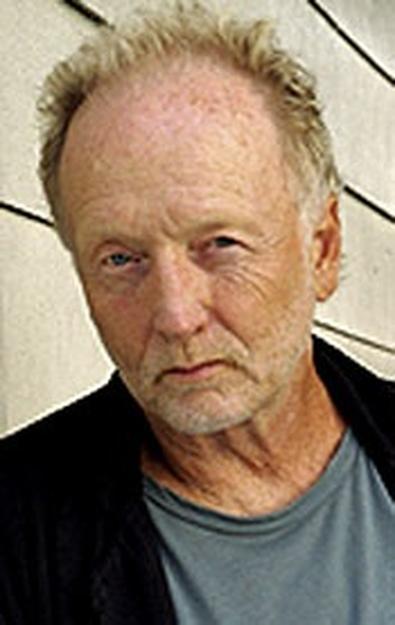
Tobin Bell was a working actor studying at the Actors Studio in New York, under the likes of Lee Strasberg and Ellen Burstyn, when a director first suggested he pay a visit to the dark side. "She said, 'Tobin, what's going on with your career?'" Bell recalls. "I'd been in New York for 20 years doing Off-Off-Broadway plays and keeping myself alive in every imaginable job, like painting the undersides of stairwells in apartment houses. She said, 'You ought to go to Hollywood and play bad guys; I'm getting that feel from you.' I just thought, 'Me?'"
About a week later, Bell went to his agent and told him what the director said. "He said, 'Maybe she's right. Maybe that would work for you,'" Bell continues. "It was strange. I always saw myself playing the sensitive, romantic parts, so I didn't understand it. I let it sit for a while." Shortly thereafter, Bell was cast in his first movie, 1988's Mississippi Burning, by director Alan Parker. In the film, Bell plays an FBI agent brought in to "get down and dirty" and terrify suspects with his questionable methods. "It wasn't a big part, but the film turned on it," Bell notes. Indeed, almost 20 years later, his chilling performance as the threatening authority figure still resonates.
These days, Bell is best known to movie audiences as Jigsaw, the brilliant but twisted madman in the Saw franchise. When Saw opened in 2004, it was a gritty, independent thriller with no name stars and a budget rumored to be around $1 million. After grossing more than $50 million domestically, the film spawned two sequels: last year's Saw II, and Saw III, opening Oct. 27. In the first Saw, Bell was heard but hardly seen; he spent most of the film lying face down in a room or hiding under a cloak. But after he was revealed as the killer, the character of Jigsaw became central in the sequels, in which he continues his practice of forcing his victims to participate in horrible games — finding a key in a hole full of hypodermic needles, crawling through barbed wire to escape an air-locked room — or be killed.
Bell has played villains before to great effect: He made a sympathetic death row killer in an episode of Chicago Hope, portrayed "Unabomber" Ted Kaczynski in a TV movie, and cut a menacing figure in big-budget studio fare such as The Firm. After several decades in the business, he is most recognized from his role in a low-budget horror film in which he isn't really seen until the last five minutes. Still, Bell didn't hesitate to take the role. "I found out a long time ago that it's not the size of your role, it's the importance of how the story turns on the character," he says, citing his role in Mississippi Burning as a perfect example. "If I'm drawn to the material, I just want to be part of the piece."
And the classically trained Bell has no qualms about associating himself with the horror genre, a field that doesn't always get respect from critics. He puts as much time and research into a role like Jigsaw as he would any other. "When I was approached about Saw II, I didn't hesitate, because I felt there was opportunity there to enrich the script and the character," he explains. "As long as the character continues to grow, and as long as the working relationship with the directors, writers, and producers is positive, I'm generally up for anything."
The Saw films may be unapologetic gorefests, but there's more to them than your standard horror fare. They are well-shot, smart, and often darkly funny. And with Bell, they have tapped into an oddly sympathetic villain — a man dying of cancer who only endangers those who don't appreciate the gift of life — who projects an effortless menace and gravitas. The voice helps: Bell possesses a distinctive calm yet unsettling growl that is terrifying enough on its own. But he still isn't quite sure why people — such as that director so many years ago — think he would make such a good villain. "I don't know what it is," he says. "Maybe it's my eyes, which seem to get mentioned a lot. Maybe it's because my face has a certain absence of definition to it, because my eyebrows and eyelashes are so light. Maybe it's because if people don't know what you're thinking and you tend to be low-key, they read something bad into it."
Something Lurking
Perhaps no one embodies that quiet malevolence more than Bell's Saw co-star Michael Emerson, a charismatic if benign-looking actor who has mastered the art of terrorizing people in a soft-spoken manner. After winning an Emmy for guest actor in a drama series — besting Oliver Platt and Patrick Dempsey — for playing murderous accountant William Hinks on The Practice, Emerson had a memorable turn in Saw as Zep, one of Jigsaw's puppets. Though one could argue that Zep was only carrying out orders to save his own life and thus was not a villain, he certainly seemed to relish his assignment.
Currently, Emerson is bringing his brand of unassuming menace to the hit television show Lost, in which he plays the mastermind of the "Others," the group of islanders who have been terrorizing the castaways for the last two seasons. Technically, whether or not his Ben (formerly known as Henry Gale) is evil is still up for grabs; but with Emerson in the role, there certainly seems to be a degree of maliciousness at play. Asked why he's been tapped to portray so many bad guys, the actor has several theories. "I'm not really sure, except that I guess I'm able to usually bring whatever level of intensity to a character that the director requires," he says. "Also, I think, for a lot of storytelling, they want the villain to look unlike a villain. I'm the right package for a kind of surprising villainy because I look like a mild and civilized person."
Emerson, who has played characters ranging from Mozart to Oscar Wilde onstage, also believes there is a taste in America for articulate villains. "I'm a theatre guy and a language player," he continues. "Americans prefer action and distrust talkers. They like doers. So it sort of reaffirms that American prejudice that villains be good talkers." He cites characters in Harold Pinter plays as perfect examples. "I love their ambiguity," he notes. "The way Pinter writes them, the terror and the intrigue is between the lines and in the pauses, the things that are implied. The character on Lost feels a lot like that."
When Emerson was offered the role on Lost, it was set to be a three-episode gig. Not unlike his turn on The Practice — in which his one-shot character returned for three more appearances — Emerson brought something to the role of Henry/Ben that made his employment more permanent. "As the producers began to enjoy the character and see possibilities for spinning the story, they began to do more," he says. "They would say, 'Let's make it six [episodes]. Let's make it 10.' Then I was a regular." As is often the case on the secretive show, the actor wasn't told specifically whether his character was good, bad, or somewhere in between. "My instinct was to play him neutral and keep people guessing," Emerson says. "That's a strategy I learned from the stage, as well. Something that delights me in theatre is a sort of smooth veneer with a lurking suggestion of violence or danger underneath. So I wanted to embody that."
Like Bell, Emerson believes that a certain detachment helps project villainy. "People are scared of anyone who's chilly," he says. "Americans refuse to acknowledge it, but we're a sentimental people, and we like our stuff a little mushy. When you're confronted with someone who has a sort of frostiness, it makes people nervous. And I'm happy to be the person who provides that nervousness."
Villains Are People, Too
Indeed, being bad can often be fun. Ask Louise Fletcher, who's played her share of miscreants during her prolific career in films such as Flowers in the Attic and Invaders From Mars. And of course, there was her Oscar-winning turn as the iconic Nurse Ratched — recently ranked the No. 5 villain in the American Film Institute's "100 Years of the Greatest Screen Heroes and Villains" — in One Flew Over the Cuckoo's Nest. "Oh, it's the most fun to be the baddie," she asserts. "Very often, they're the best roles."
Fletcher believes the key to playing Nurse Ratched was in not perceiving her as the enemy. "To play a villain, you have to play that person as a real person," she notes. "We knew very little about Nurse Ratched and her background, even in the book. So I made up in my mind that she was someone who was convinced she was doing the best thing for these people. She thought of herself as a goodie. But, in fact, she was not. And how many people do we know like that, who think they're doing good?" In later years, Fletcher would find herself pursued for bad-guy roles by those who didn't understand this philosophy. She adds, "Directors who weren't nearly as talented [as Cuckoo's Nest director Milos Forman] would ask me to 'do the villain thing.' And they didn't understand that the lady next door who you see in the supermarket and looks perfectly normal to you could have somebody tied up in the basement. It's the person you let into your house because they've convinced you they're one person and then turn on you that's the scariest thing in the world."
She cites as an example her work in Flowers in the Attic, the film adaptation of the cult V.C. Andrews book in which Fletcher played the wicked grandmother who forces her grandchildren to be raised in the attic of her home. "That was a horrible experience for me, because I didn't want to make her the character I played," she says. "I wanted to make her more human. To me, she was a cutout character. That hair and black dress were not my choice. We had to reshoot one scene I don't know how many times because I could never be mean enough for [director Jeffrey Bloom]. Because everything in me said this was not how to make her scary. I wanted to make her nice and say those awful things. I found it very difficult to play that part. They'd have to pay me a whole lot more money today, I'll tell you that."
Haunting Roles, Haunted Careers?
There can also be a certain freedom in embracing the dark side. Ted Levine, a busy character actor currently appearing as Captain Stottlemeyer on the USA show Monk, found his experience portraying the unforgettable serial killer Jame Gumb, aka "Buffalo Bill," in 1991's The Silence of the Lambs a chance to explore territory he never had before. "It's sort of easier to play the evil and crazy people because there's nobody to tell you what's right or wrong," he says. "It's like building a hot rod: You can just bolt crap on, and it has less to do with function than with form and flash. Jame Gumb had pierced nipples and tattoos, and you could raise all kinds of strange questions. It was very freeing to play somebody who was...nuts."
However, Levine's superb turn in Lambs raises a troubling question for actors: When you create a character so etched in audiences' minds, can you ever break free of that role? If you're too good at scaring people, will they ever see you any other way? Levine had been a working actor for years, a member of the Remains Theatre Ensemble and Steppenwolf Theatre Company, when he was tapped to play the serial killer making a suit from the skin of his female victims. His Lambs co-star Anthony Hopkins managed to forge a nice career for himself and still revisit his iconic Hannibal Lecter from time to time. For Levine, it was more difficult. "I got a lot of bad press for gay-bashing for some reason," he says. "The press was bad. It scared people from me for a while, from hiring me."
For years after Lambs, Levine became the go-to guy for villains. "I had a lot of offers for evil white supremacists. Or if the role required someone to hit a woman, they would call me," he remarks. "I made a deliberate effort to turn away from that sort of thing; I had to turn down a bunch of stuff." Though it can be hard for an actor to turn down a role, two factors helped Levine. First, he wants to be passionate about his roles. "You need to feel comfortable in the skin of the character you're playing," he says. "If not, you're better off not doing it." Second, he didn't allow money to enter the equation. "I've been really fortunate that I've never really lived beyond my means to begin with, and I still don't," he says. "I'm basically a hippie on a bicycle. That's given me a certain amount of freedom in my choices."
It wasn't until Levine played the kind husband in 1995's Georgia — a role he describes as "someone a lot closer to myself" — that things began to turn around. "I auditioned three times for Georgia," he notes. "Again, the producers and everybody seemed really reticent, so I had to read a number of times. I worked really hard to get it. But I think when you get a part, rather than just an offer, you get a whole lot of work done during the audition process, and you get a lot of validation when you're cast."
Fletcher also found herself turning down roles to prevent typecasting. "At one point I thought, 'Gosh, I'm only going to get villains,'" she recalls. "I turned down a few things, and I regret a couple of those. Big-time." As an example, she mentions the role that finally went to Piper Laurie in the horror classic Carrie. Still, Fletcher has been able to strike a nice balance during her career. "Other roles would always come along, like Brainstorm, where I wasn't a baddie," she notes. And the actor revisited villainy again in several films, along with a superb turn on Star Trek: Deep Space Nine as a wicked politician. "That was so much fun," she says with a laugh. "I thought of her as an evil pope in space."
In addition to his role on Monk, Levine will play lawmen in two high-profile films: American Gangster and The Assassination of Jesse James by the Coward Robert Ford. But he admits he wouldn't mind revisiting a "fun bad guy." He notes, "I don't care what it is as long as the script is good and the people are good. I'm more into telling the story. To think in terms of who you'd like to play is kind of limiting."
Emerson agrees that typecasting is a concern, but not one he can allow to limit his choices when the roles are good. "I don't worry too much about micromanaging my own career," he says. "The TV medium has such reach and power, it does give you pause sometimes. When you think that more people will see a single episode of Lost than will ever see me in all my stage performances put together, that's a long reach. But I don't know what to do about it; you have to keep moving forward and taking parts. And I take parts that seem like good parts." He concedes he might not say yes to very many serial killer types in the future. "I think I've sort of exhausted that," he notes. "I would like to have a change of pace for the next thing I do on film or television. It would be nice to sort of mix things up as I go along if it's going to be a long game."
It's a sentiment echoed by Bell. "Every actor is aware of typecasting," he says. "Does it occur to me? Yes. Am I worried about it? No. The most important thing for any actor is to be seen as anything. One percent of actors work gainfully — make a living at it. So if they'll see you as anything, you're already ahead of the game." According to Bell, it's up to the actor to change people's perceptions of them. "Nicole Kidman could have been stuck playing pretty girls with nice clothes, but she's been determined and believed in herself and turned what could have been a lackluster career into Academy Award performances," he continues. "And every actor has that responsibility. You can't blame anybody else."
Many actors have learned to embrace their typecasting and use it to their advantage. After years of chafing at being Norman Bates, Anthony Perkins chose to play the role in three sequels to Psycho. "I have definitely made peace with it," he said in an interview for Psycho III. "Once Mad magazine has done you and Saturday Night Live has done you and you've been anthologized in everything and your sequences are shown to film schools, you're just part of the national grain, that's all." It's something Levine can understand; 15 years after The Silence of the Lambs, his lines and performance are part of the national lexicon, parodied on South Park and in Clerks II. "I guess imitation is the best form of flattery," Levine says.
Emerson points out that perfectly respectable careers have been built on being the bad guy forever. "One could do worse than to be the Peter Lorre of one's time," he notes. "And it would be more fun to be Peter Lorre than Tyrone Power. I sort of have a philosophical attachment to showing the dark side of the human experience. I think people have secret greeds and lusts and do bad things that create moral and ethical dilemmas in their lives. I think when we watch villains, we're watching ourselves. I don't know who identifies with John Wayne. I think more people are scurrying around in the shadows with Peter Lorre."