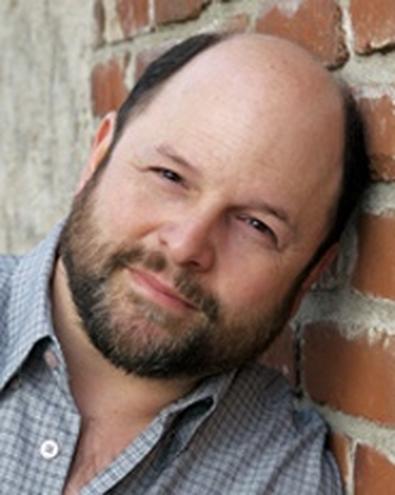
After nine seasons and plot lines that had his character eating out of the garbage, caught masturbating to Glamour magazine, and streaking in a bodysuit through Yankee Stadium, Jason Alexander might understandably be confused with said Seinfeld alter ego, George Costanza. Known for his graciousness and good humor, the actor doesn't even mind when people slip and call him by his character's name. "It's fine," he says. "I'm George to most of the world." It's a testimony to Alexander's talent that he was able to turn such an unapologetically selfish glutton into one of the greatest TV characters of all time, earning seven Emmy nominations in the process.
Alexander grew up wanting to be a magician -- he still performs occasionally at L.A.'s Magic Castle -- and got into acting when, as a teenager, he realized, "I was never going to be as good a magician as I wanted to be and had too much respect for the people who were good to screw it up." Getting on the stage for his first time in high school, he decided theatre was the ultimate illusion and switched his focus to acting.
Following a cattle call audition conducted by Joanna Merlin, Hal Prince's casting director, Alexander made his Broadway debut in 1981 in Stephen Sondheim's Merrily We Roll Along. Though the show closed after 16 performances, it opened doors for the young actor. Alexander then appeared in the Kander and Ebb musical The Rink and Neil Simon's Broadway Bound, winning a Tony Award at age 29 for his multiple roles in Jerome Robbins' Broadway. His success on stage and frequent auditions led to roles in film and TV, but it wasn't until 1990 that the one-two punch of Pretty Woman and Seinfeld turned him into, if not a household name, definitely a household face.
Following Seinfeld's run, Alexander attempted two more series: ABC's Bob Patterson and CBS's Listen Up. Neither made it beyond its first season. Still, the actor has kept a high profile with work onstage (he starred opposite Martin Short in the L.A. run of The Producers) and frequent TV appearances, including commercials for KFC. He has also been active behind the scenes; last year he directed the L.A. premiere of Sam Shepard's The God of Hell at the Geffen Playhouse. And this month has another George on his mind: the title character in Sondheim's Sunday in the Park With George, which Alexander is directing for Reprise! Broadway's Best at the UCLA Freud Playhouse, starring Tony nominees Manoel Felciano (Sweeney Todd) and Kelli O'Hara (The Pajama Game, The Light in the Piazza). A musical retelling of the life of pointillist painter Georges Seurat, the show tackles complex themes about art and obsession. The Sondheim musical is an ambitious undertaking for any director, not the least at Reprise!, where the rehearsal schedule in essence amounts to a week of rehearsal and a week of tech. Still, little seems to ruffle the low-key Alexander, who has always stood out among the Seinfeld alums as the most unlike his character.
Back Stage: Was Sunday in the Park With George a show you had been dying to do?
Jason Alexander: Yes and no. You give me anything with Stephen Sondheim and I'll show up with bells on. I never would have thought of Sunday in the Park for Reprise! because their mandate is that they tend to want to look at shows that have some recognition factor for the audience and have a serviceable score with a great book, or no book with memorable songs. Sunday has great songs that came out of that score, but it's not an easy score by any stretch of the imagination. It's not a typical piece of musical theatre. And until I started to wrap my head around how to do it, I thought, "They can't afford to do it. They can't re-create the painting."
The first meeting I went to with [producing director] Jim Gardia, I said, "Can we fly the trees in and out and bring things in and out?" He said, "We don't have tracks and can only afford one fly guy." I asked, "What about the period costumes with pointillistic details?" He said, "I don't know that we can do that, either." I was like, "Why the hell are we doing this show? If you can't do it and you're not doing it as a concert, how is it going to work?" It was only when I finally came up with the approach on how to do it that the flower kind of opened, and I went, "You know what? This particular necessity breeding a beautiful mother to invention, there's actually something very right and, I think, new and exciting about the way we're going to physically do the production." But you never would have said, "Hey, let's do it this way," if you didn't have to. I used to laugh at them when they said they're going to do Sunday, and then they invited me. And there was no way I was going to say no to a Sondheim piece.
Back Stage: Can you let us in on what you're doing?
Alexander: I had to go back to my theatre history training, to the ancient Greeks. The Greeks came up with a thing called periactoids. They are nothing more than three flats nailed together in a triangular cylinder. There's a different piece of scenery on each side. If you put enough of them side by side and they all show the same side, you've created a set. The interesting thing about periactoids is, when one side is flat to the audience, for the most part, the other two sides are invisible. So by using a series of periactoids that are mobile and we can keep moving around the stage, we can create Seurat's park, we can create the modern park, we can create a variety of spaces.
This gets into real thematic thinking, but as you look at the play, the problem the Seurat character has in the play at the beginning is that what he sees, no one else can relate to. He keeps saying to people, "Look. See. I don't have words." He is so passionate about creating this vision that he sees. So it's kind of like if someone was colorblind, how would you explain blue? You couldn't. So basically, the entire first act, until the character of Seurat creates his finished painting, is all white. Shades of white and off-white, because we can't see what he sees. Once he finishes his creation, it blooms into a world of color and stays there. So that solved a lot of our problems.
I didn't know this, but apparently a concert production was also done with the notion of using white. I saw a still photograph, so I can't claim it as a totally original idea, although I wasn't aware of it when I thought of it. The periactoids and shifting things around and starting in white were all concepts that were born of, "How do we do this with our limitations?"
Back Stage: Do you have a specific method you use as a director from project to project, or does it change for each piece?
Alexander: No, I think different projects demand different things. When I directed God of Hell at the Geffen last spring, that was photo-real. I said, "I need to make this house real," and everything I ever asked for, they gave me. We added tons of things that were not indicated by the script, without changing lines. They thought they were doing an easy, three-wall, four-character show, and I kept saying, "We need this, we need this." It's an absurd piece, and we would have actors standing there in rehearsal going, "What the hell am I doing? What does this mean?" We would have to create a reality for ourselves. I can't tell you that you would watch that show and know exactly what we were thinking, but you would know we know what we're talking about. Believe me, in an absurd play, that's a lot.
It was a lot of time doing work with actors that is really actors' work: What can we do? What can we come up with so that we're never standing there faking it? That's where you'd really want an actor's director. A lot of what we're doing with Sunday is almost choreographic. The characters, with the exception of George and Dot, don't have great swatches of time to go very deep. They make their impressions in very short scenes that are not done linearly. The show has a pointillistic construction; one moment doesn't necessarily make chronological sense from the one before or the one after. The idea was, when it was all done, you would step back and the pieces would form a new whole for you. Well, that's great on paper; it's a living nightmare for actors. Most of the characters in the show, with the exception of the two leads, don't need a great deal of in-depth work on the characters and what they mean and what their background is and what their intention is. What they need to do is sound the right notes in the right places at the right time. So it is a little bit more of a stage management job in some ways. I'm working much more as a designer-director than as an actor-director on this one.
Back Stage: As an actor, what do you hope for in a director?
Alexander: To me, a great director is someone who has a very particular vision for a piece and a great deal of understanding about a piece and creates a vision that is flexible enough to actually be collaborative. You want to be surprised; I want my actors to come in and do something I never anticipated and have to adjust to make that glorious thing they're doing a part of the whole. Same thing with the designers: I want them to surprise me.
I don't want to ever be in a position to go, "I have no idea. Just do something wonderful." A good director needs to be conversant enough in every department to be able to really collaborate with designers and actors and writers. And they should have an understanding of the actors' process and the audience's process. And to be able to take all those disparate elements and make a more beautiful whole than any of the individual elements would be on their own. That's all it is. I haven't worked with many that I think do all of that. I've worked with directors that really understand text and are really great conceptualists, but get them into a conversation about the moment-to-moment work of an actor or a character and they don't know what the hell you're talking about. Or vice versa: They're great with character, but they can't make a picture on a stage to save their lives, and the designers are working in a vacuum. Or in a new text, they can't tell a story. So you have a writer who needs some help, and the director can't guide that process because he's not articulate about what's wrong with the storytelling? When you get somebody who can handle all those elements, they're a star. Those are the Mike Nichols of the world.
Back Stage: After nine seasons on a hit TV show, playing such a distinctive character, did you ever worry about being typecast?
Alexander: It was not an issue during Seinfeld; it's an issue now. It wasn't an issue during Seinfeld because my career was probably as hot as it could get: Seinfeld and Pretty Woman appeared simultaneously, so there were two very different impressions at the same time. And the stuff I kept getting during Seinfeld was usually very different from George. It was only since the series went off the air and I've had two series go into the can that what the world has really seen of me these days is Seinfeld -- five times a day. So now I think what's happened on the television side is, people are going, "Well, he's had two shows where he was the featured lead, and they didn't quite take off, so maybe we need to let it simmer for a while." But I understand that. And on the film side, they're all going, "Well, the minute he comes on the screen, everybody's going to go, 'George!'" Now that's true, but if everybody's doing their job right, they'll get into the story. What makes me a little crazy is, nobody worries when they hire Tom Hanks that, when he comes on the screen, people are going to go, "Hey, it's Forrest Gump!" It's a little arbitrary. So during Seinfeld, it was never an issue, but it is a little bit now as I try and figure out what the next stage for me as an actor is going to be.
Back Stage: When did you realize it was an issue?
Alexander: About two years ago. I did Shallow Hal, and everybody liked what I did; the movie was very successful. That's the last major film I've done. Then I did Listen Up, which was a show that was doing fine and had a solid audience but not solid enough for where CBS wanted to go. That didn't help, having a second one go down.
Back Stage: A character like George did a lot of outrageous, humiliating things. Is there anything you wouldn't do for comedy?
Alexander: Oh, sure. There's a point where my vanity steps in. It may not be clear to the rest of the planet, but it is certainly clear to me how different George and I are. So when I'm in George's skin, Jason's having the same experience as the audience. I'm watching what happens to this character, and if it's making me laugh, I'm totally up for performing it. Even if that includes using my body in unflattering ways or playing despicable elements of this character and trying to find a way to make it other than totally despicable.
Sometimes comedy gets to a very desperate place, and within that desperation it can get ugly. We've seen a recent example of that. Comedy isn't so important to me that I would allow myself to go to that depth for it. I think if your intention is good, almost anything is fair game. I don't think it's a problem for people to use racial epithets that can hurt if their intention is not to hurt. I heard Artie Lange, Howard Stern's sidekick, tell a story where he uses the n-word that is funny and nobody could be offended. He got involved in a pickup basketball game where he was the only white [guy in the] game. All the black guys were yelling, "Over here, N! Over here, N!" and nobody was giving him the ball, and he gets caught up in the moment and goes, "I'm open, N!" and suddenly 12 black guys go, "Excuse me?" That's a joke about being a stupid white guy who gets caught up in the moment. It's really about intention.
Back Stage: I'm sure people are wondering why, after a successful and moneymaking run on Seinfeld, you would want or need to do something like become the KFC pitchman.
Alexander: First of all, let me tell you, I have far less money than people think I have. I'm not going to plead poverty, but I don't have Jerry Seinfeld money. I began in commercials. I got into this business doing commercials; I have nothing on them. And if you're looking for me to be in your commercial, it's probably a very different kind of commercial; it's going to have something fun to it. And, hey, [KFC] is a product I certainly have enjoyed.
But I understand: There are many actors who look down on actors who do commercials, and I guess there's a segment of the audience who wonders why someone would do them if you didn't have to. I've always enjoyed them. And given the right commercial at the right price and the right campaign, I'd do it again. They're little pieces of film. If they're funny, they're funny. And they were offering ungodly amounts of money. I thought, "What am I, stupid? This is my children's lives. I'm here to make a living." If someone wants to throw money at me to do what I do, and it's not demeaning or stupid, I have nothing on it. I don't have anything on doing game shows; I think they're fun. I did them all during Seinfeld; I won on Jeopardy! on a question about nuclear physics. Why shouldn't I have fun? If you think you're not going to be able to watch me in my next dramatic role because I was on the Pyramid, screw you. It doesn't make any sense to me. Maybe that's why they're not looking at me for films. If it is, I'm the victim of my own naivetĂŠ. But I don't want to live my life thinking they're going to judge me if I make a KFC commercial.
Back Stage: You've managed to maintain a reputation as one of the nicest guys in an industry that doesn't seem to encourage niceness. How have you kept your sense of self through the highs and lows?
Alexander: It's not hard. Most of it is due to I had good parents and an amazing wife, and I've been doing this for so long. And my fantasy of success was really not what I've got. I grew up wanting to be a real actor on Broadway. That was all I wanted: to work in the theatre. People who dream of that career are not really thinking, "I'm going to be a big star." So when all this other stuff happened, it was a lovely surprise and gave me a great life and opportunities I've never dreamed of. But it was not my dream come true. I had already been doing my dream come true: I was working on Broadway; I had a Tony Award. That, to me, was crazy. I thought, when I was 70, if I had done enough shows, they might throw me a bone and give me a "well, he was a nice guy" Tony. But to actually get one in my 20s was bizarre.
And when your background and history and training are in the theatre, you value your community. There are one-man shows, but even in a one-man show you've got your stage manager in the wing, you know your follow-spot guy, you got your dresser -- you're not a one, really. I think you kind of become a people person. To me, it's always about the work, not the result of the work-though if the result is good, great. When I was a kid, I was all about, "Screw rehearsals; I just want to open and get that applause." But as I started to understand more and more about acting and love it more and more, I was so excited about rehearsal that opening was almost the afterglow. The orgasms were during rehearsal when you were making these discoveries and forming these relationships. So the "nice" reputation comes from having a real interest in the people around me and who they are and what they can do.
Back Stage: You mentioned your interest in politics. Do you mean unions or do you mean more-global politics?
Alexander: What the artistic unions do have to do, and it's something I would very much like to pursue. I'm interested in getting more involved with the Screen Actors Guild in order to do the following: I don't want to create any mergers; I want to create an alliance between SAG, AFTRA, the WGA, and the DGA. An alliance of creative artists that only does two things: One, they merge their health plans to give us greater buying power to buy better health coverage because all our individual plans are starting to suffer. Second, I want those unions to come up with a formula for DVD, Internet, and new technology, and as a singular force go out to the world and say, "Here's the line in the sand. We're not going to rape you, but here's the minimal protections we need for our members and our artists." It's insane. If I make a movie you release on videotape, there's a formula in place for how you have to compensate me. But if you burn a DVD of it, there's no formula in place. That should end, and I don't think it will end by every one of these unions piecemealing. So I would love to lead the charge on that kind of alliance.
Back Stage: Have you thought about running for SAG president?
Alexander: I would if I knew that the WGA and the DGA were willing to pursue this in a really serious way. I would probably run for SAG under that mantle. We're so fractured. It's like I say about the United States: We are no longer the United States; we're red states and blue states and agenda states. But I like it much better when we're the United States, and there's no reason we can't be. That's one of the reasons [Sen. Barack] Obama is getting so much attention: He talks about these things. Our union is not a singular entity anymore, and it needs some critical care. If I thought the WGA and the DGA really wanted to pursue this kind of investigation into, "Can we form this alliance legally and spiritually?" I would absolutely run.
Back Stage: You speak a lot at universities and offer advice to actors going out into the world. What do you tell them?
Alexander: Some of it is consistent to what I've said for years, and some of it is pretty brand-new. If you want a career in the artistic elements of this business-writing, directing, acting-you have to earn it. It is an art; it's not a science. If you want to be an artist, you have to understand the history and techniques of your art form. Studying your craft is essential, and it's not easy, because it's not a science and there are all kinds of bad teachers. You've got to kind of move around and find people whose work you admire, find out what their training is, explore their teachers, see what you can do. But there's a teacher for everybody out there who has value. Mine is Larry Moss. Larry was really the guy who gave me an understanding of what it is I do and how to do it.
That's the first part. The second part is: It used to be that you needed permission to do what you want to do. If you wrote a screenplay and a studio didn't make it, that was it; there was nothing you could do. The means of production was beyond the average person's capability. And the studios controlled the portal in and the portal out, which was distribution. They don't anymore. We have a democracy in our business. The means of production is imminently affordable. Digital cameras, even high-def, are not exorbitantly expensive. I've got iMovie on my Apple, and I can edit a motion picture with that. And I could put it on YouTube or another site. Plus, every town has its own film festival. There are ways of getting your product and yourself seen. All the 99-Seat theatres-to hell with that, 39-seat theatres-for a thousand dollars, you can put on a pretty damn good production. There is no reason for anyone to not to be doing what they want to do. The only thing that doesn't come with this arrangement is fabulous wealth. If the fantasy of being an artist is, "I'm going to be rich and famous," well, fame is fairly easy.
If you're going to pursue a career in the arts, it has to be because it is your passion and your love and your heart's desire and the thing that fulfills you. If you do it because you have the fantasy of having-for lack of a better [example]-my career, I don't know how to get my career. I stepped in the right puddle, and I went for the ride. You can't plan that. You can't send out mailers for that. The right headshot isn't going to get you Seinfeld. It's an accident, a glorious, happy accident, when it happens, and God willing, if you're as good as you can be and you get yourself in harm's way, you can have that experience. But if you're doing it because you love it and it's a passion, I believe the pursuit of good work is the best shot you have of having a successful career.
I talk to students all the time at universities and say, "We have an hour. You can ask me anything you want." The questions are almost always about, "Should I go to New York or L.A.? Should I do theatre or TV? How do I get an agent?" I try to answer them as best I can, and at the end of it I say, "It is fascinating to me that I've given you an hour to ask anything you want, and all your questions are about how to succeed as opposed to how to be really good. The only way I know to guarantee success is to be better than everyone else. So your emphasis is on the wrong question. Make your emphasis, 'How do I become the best at what I do?' " If I'm as good an actor as I can be and I go out on the Third Street Promenade with all those street performers and I start doing Shakespearean monologues and I'm as good as I can be, about four weeks in some assistant to an assistant is going to say, "You know, there's this guy down on the Third Street Promenade and he's doing Shakespeare, but he's great." And I'll get an appointment. There's no magic to it, there's just being good and wanting it for the right reasons.
Sunday in the Park With George, presented by Reprise! Broadway's Best, runs Jan. 30-Feb. 11 at the UCLA Freud Playhouse in Westwood, Calif. For more information, go to www.reprise.org.