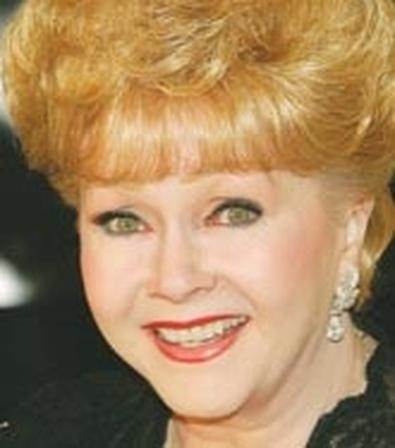
During the 1950s heyday of Debbie Reynolds' film career, the radiant actor-singer-dancer earned the nickname "America's sweetheart." Throughout her six-decade career, she has built upon her natural charm while sharpening her skills to master a wide acting range and demonstrating exemplary musical abilities. On July 9, the gracious 76-year-old veteran opens a two-week engagement in Debbie Reynolds — American Icon: An Evening of Music and Comedy at the El Portal Theatre in North Hollywood, Calif.
She explains, "I was in the Valley visiting my brother, and I decided I would like to play my neighborhood. This is where I was raised. I used to ride my bicycle to the El Portal, and I went to the Magnolia Theatre and the Magnolia Bowling Alley. I used to give plays in my backyard, so I'm really coming back to put on my little show. It's a variety show: singing and comedy and dancing. And I have film clips and tell stories about my career. Before they started calling this sort of thing a one-woman show, it was called vaudeville."
An Early Start
Born Mary Frances Reynolds in Texas and raised in Southern California, she was spotted by talent scouts when she won the Miss Burbank beauty pageant at age 16. She was given a screen test and immediately signed to a $65-per-week contract by Warner Bros. She switched to MGM after a year and a half, at $300 a week. In her early films, the renamed Debbie Reynolds excelled in ingĂŠnue roles in such comedies and musicals as Susan Slept Here, The Tender Trap, and Three Little Words. She believes that being spotted by the scouts at such a young age was a lucky break: "They usually looked in Iowa or Ohio or New York. The Junior Chamber of Commerce at Burbank had the foresight to go to Warner Bros. and ask their scouts to attend." She continued her studies at John Burroughs High School in Burbank while attending the studio school three hours a day.
In the years when studio contracts were the rule, promising youngsters were groomed for stardom. "It was all different then from what we have now," Reynolds says. "You had bosses, and you were given assignments. They would say, 'Here's a book I just bought. I want you to write a script for Kim Novak' or 'for John Wayne.' Sidney Sheldon was one of the writers, and he has gone on to write 60 hit novels. He was under contract to MGM, and they owned everything he wrote. They would give books to him and tell him to adapt them into screenplays. And if they wanted you in a picture, they told him to write you in. MGM wanted me to play two little parts in other films before I did Singin' in the Rain, so he wrote them in for me."
She remarks, "I think Doris Day and Jane Powell and I and others at that time were kind of the same. We all came from musicals and comedy. We were lovable — the girl next door. Under our contracts at MGM, we were given roles that were all alike, but I was lucky because I was put into very big movies." Reynolds' breakthrough film was 1952's Singin' in the Rain. At age 19, she held her own opposite superstars Gene Kelly and Donald O'Connor. Following a string of frothy hits such as Tammy and the Bachelor, Reynolds' reputation as a versatile actor took a quantum leap with her bravura performance as the never-say-die titular character in the 1964 musical The Unsinkable Molly Brown. Over the years, she has reasserted her versatility many times in such films as Divorce American Style (1967), What's the Matter With Helen? (1971), and Mother (1996) and in her Emmy-nominated role on TV's Will and Grace. She remains a popular live entertainer in Las Vegas and across the nation.
Steering Her Ship
Reynolds says that during the making of Singin' in the Rain she had no clue that it would become a classic. "I didn't have the life of show business at that time," she says. "I was this average schoolgirl who went to the movies, which cost a dime in those days. No one in my family was in show business. You would never think of being a movie star. I was just very blessed and very fortunate. The talent scouts were looking for young girls who were sort of silly and had a good sense of humor and who they could train."
In her 1988 autobiography, Debbie: My Life, co-authored with David Patrick Columbia, Reynolds described the three grueling months of training for the dances in Rain, under the severe scrutiny of perfectionist Kelly (who co-directed with Stanley Donen). She worked so hard that her feet bled; "Singin' in the Rain and childbirth were the hardest things I ever had to do in my life," she wrote.
Twelve years later, she again had to prove herself in Molly Brown. She campaigned tirelessly to convince MGM to hire her for this plum role, based on a real-life Titanic survivor, which had earned Tammy Grimes a Tony Award on Broadway. During filming, Reynolds struggled to win the approval of skeptical director Charles Walters, who had wanted Shirley MacLaine for the role. Reynolds ultimately won Walters over, and the film, one of the last big MGM musicals, opened to critical acclaim and huge box office returns. "That was such a physically demanding role," she says. "But it made me very happy to do it. And I was really pleased to earn an Oscar nomination." The best actress award went to Julie Andrews for Mary Poppins, but Molly Brown was a boost for Reynolds' career.
In the Albert Brooks comedy Mother, Reynolds earned critical raves and a Golden Globe nomination. "That was my first film in 15 years," she notes. "And it was a great role."
Playing a character whose charm came with an edge, Reynolds gave a sparkling performance, which led to other good work, such as playing the mother of Kevin Kline's character in In & Out. Reynolds has done a lot of television work, including the well-reviewed 1969 NBC sitcom The Debbie Reynolds Show. She has had several stage successes on Broadway and in national tours of such shows as Irene, Annie Get Your Gun, and Woman of the Year. She reteamed with Molly Brown film co-star Harve Presnell in a 1980s revival of that show, which originated at the now-defunct Long Beach Civic Light Opera.
Nowadays, Reynolds enjoys live performing for occasional short gigs, forgoing the rigorous commitment of eight-show-a-week stage musicals. She notes, "I like live performing more than doing film or TV. There's not all that waiting around, and with the audience right there, you feel the love." She continues with other interests she has maintained for years, such as her work with the charitable Thalians organization and her ongoing efforts to open a museum in Tennessee to showcase a wealth of MGM studio memorabilia she purchased many years ago.
Through a life that includes failed marriages and career ups and downs, Reynolds has been known as a survivor. "You have to keep going or fall down and die," she says. "You can fall down and a car runs over you, or you can keep running ahead of the train and keep going like the Energizer Bunny. You have to keep praying and trying hard. I take great joy in my career. Performing gives me tremendous strength and happiness and joy. I'm going to keep doing it until the good Lord takes me."
Debbie Reynolds — American Icon: An Evening of Music and Comedy runs July 9-20 at the El Portal Theatre, 5269 Lankershim Blvd., North Hollywood, Calif. (818) 508-4200 or (866) 811-4111. www.elportaltheatre.com.
Outtakes
Film debut was in the 1948 comedy June Bride, starring Bette Davis, with whom she reteamed in the 1956 drama The Catered Affair
Her 1969 television sitcom, The Debbie Reynolds Show, was prematurely canceled by NBC because Reynolds objected to cigarette commercials accompanying the show
Joined Elizabeth Taylor, Shirley MacLaine, and Joan Collins in the 2001 telefilm These Old Broads