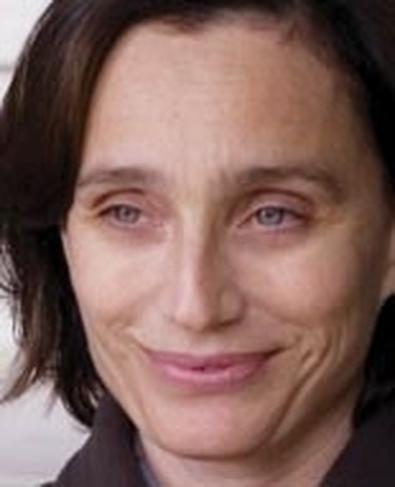
You'll recognize the hair before you recognize the shell-shocked face of Kristin Scott Thomas as she plays Juliette in I've Loved You So Long. Her eyes are ravaged from seeing something no one should have to see. Her mouth is almost desiccated from lack of something — the chance to talk, enjoyment of life, perhaps even nourishment? As the story unfolds, we watch Juliette slowly return to a hint of daily normalcy after 15 years in prison, while we start to guess, and then learn, what she did to her child to land herself there.
Some of us have indeed loved Scott Thomas so long. Perhaps it has been since The English Patient, in which she played the roiling-beneath-the-icy-surface Katharine. Perhaps our admiration grew out of Four Weddings and a Funeral, when she stole our hearts as the poshly quippy friend who didn't get the guy. Or, if you noticed her work in Under the Cherry Moon — the Prince black-and-white cine that featured her breakout screen role — perhaps you'll recall the skilled actor somewhat younger but just as mesmerizing as now. But she may have achieved acting perfection in writer-director Philippe Claudel's new film.
Scott Thomas says of that role, "I liked the idea of exploring abandonment and solitude and all these really miserable things." She was eager to develop a character who doesn't want to deny what she's done, who indeed lays claim to it, "as if this is a secret she can keep that no one else can get at, that's hers, that's the only thing left of her child." And then there's the subtle emerging of Juliette's spirit, "just the beginning of the rebirth," Scott Thomas says. "And I loved the way the film didn't ever let up and there wasn't a kind of happy end."
Going There
In preparing for the role, she didn't interview women in Juliette's circumstances. "I didn't want to go there," the actor says. "I was too afraid of my own, kind of, emotion vis-à-vis that. So I imagined. But I obviously read a bit of background about prison life, about what's it like coming out of prison. I read testimonials about that; I watched documentaries; I talked to people who have come up close to that — either they were teaching or they were therapists, people who helped."
As she discusses her work in the film, she muses on the soul-crushing experience of prison, the unspeakable grief of losing a child. And so, as the film progresses, she says, Juliette tries and manages to feel things, "to accept the beauty of the rain on the window or her niece's affection, and indeed her sister's affection, and the interest that this man has for her, and the compassion she feels for the inspector."
One can't help but ask about the scene in which Juliette and her sister are driving, surrounded by children, after bringing Juliette's niece to school. Juliette's gaze is momentarily distracted by something they pass, and it's startlingly natural. "It's funny you should mention that scene, because it's one of the ones that get me the most," says Scott Thomas. "It's when her sister comes back and gets in the car and says, 'Are you okay?' and Juliette says, 'Yep!' and she lies, and you can see that she's lying and she's in agony. And that just breaks my heart every time I see that."
This naturalism onscreen leads us to a discussion of the scenes involving food. Juliette displays a very subtle epicurean enjoyment that one might think more French than English. Is it because Scott Thomas moved from her native England to France when she was 19 and has picked up the mannerisms? No, she says, it's a deliberate choice that relates back to Juliette's prison experience. The actor imagined, and read, how food, cigarettes, "any kind of small physical pleasure that one allows oneself," takes on particular meaning in prison, "how in prison something sent from home, from outside, tastes good. And the pleasure of eating chocolate cake, I thought that was a really interesting facet."
One of the most difficult displeasurable moments to create emotionally — and there were many — was at the nightclub, "when she's with lots of different people and she's trying really hard to kind of get out and can't cope," Scott Thomas recalls. "That was really hard, when she goes and abandons herself in a doorway. That's really sad. I felt really sorry for her."
The actor says she likes offering a director different takes and had the opportunity to do so with Claudel: "This film was such an experiment, really, because he had never [directed] one before. A part like this, I had never been asked to do before. So I thought, 'Well, I might as well make the most of it and try everything I can think of.' So that's what I did. But I did ask him if he'd allow me, before he started directing me, to just let me have a go, so I could just do it sort of instinctively before he could give me direction — which he agreed to do, which was really generous of him." Though sometimes, she adds, "he'd say, 'Right. Well, let's do something completely different.' So we did."
To Work 'So Long'
Scott Thomas finds inspiration from older actors. "I'm always amazed when I meet women or men who have been doing this who are now in their 80s," she says, "who still have this kind of fire and invention and curiosity and knowledge and experience. And I just find that so inspiring. And it's such a great job, because you can go on doing it for ages." While performing in the play As You Desire Me in London in 2005, she shared a dressing room with Margaret Tyzack, who is in her 70s. "And she's one of the most vital people I've ever got close to," Scott Thomas says, "because you get pretty close to people when you're sharing a dressing room with them. And it was amazing to know you'll be so young for such a long time, so vital. And to have so much creative energy for such a long time. And then, of course, there's one of my favorite people, who I've worked with quite a lot, Maggie Smith. I just adore her."
After attending drama school in London to become a teacher ("I tried changing into being an actress but they didn't let me"), Scott Thomas trained at the École Nationale Supérieure des Arts et Techniques du Théâtre in Paris and calls teacher Marcel Bozonnet her favorite and most inspiring.
She is currently starring in The Seagull on Broadway as Arkadina, and despite the actor's life in France and her rich film résumé, she says she is looking forward to doing more theatre. "I've only done four plays, you see, so I'm very inexperienced," she protests. "I haven't got the reading; I haven't got the education, the culture of the stage. But I think something modern would be nice." And mightn't this lead to an even longer career, as Tyzack and Smith have enjoyed? "Yeah, exactly!"
Outtakes
Says she took the role of Juliette because she thought she and the director would get along well
Has a dog named Peggy, named in part after the late great actor Peggy Ashcroft
Respects the talents of many of her peers but laughingly won't name them for this interview