Filmmaker John Walter says he wishes that when he became interested in writer-director Bertolt Brecht, there had been a documentary like Walter's Theater of War. "It's a nonacademic introduction to Brecht that doesn't foreground his theoretical writings but rather his sense of humor and his engagement with the world around him, and with just enough biographical information that gives you a foundation for further exploring his great body of work," says Walter.
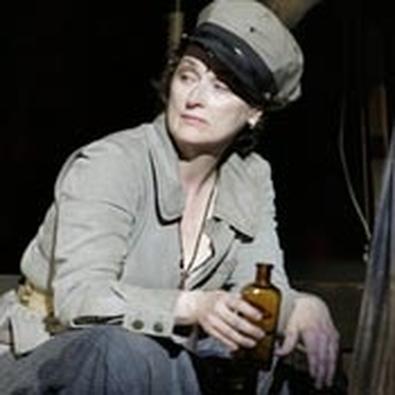
Interspersed with lively professorial commentary, recollections from Brecht's daughter, and footage of Brecht, the film takes as its jumping-off point the 2006 Public Theater production of Mother Courage and Her Children, featuring an adaptation by Tony Kushner and starring Meryl Streep, Kevin Kline, and Austin Pendleton. It was directed by George C. Wolfe with music by Jeanine Tesori.
"I wanted to do this film for quite a while, but I was waiting for the right production, and this was it," recalls Walter. "Here you had an adaptation by Tony Kushner, a great American contemporary playwright working in a Brechtian tradition. Kushner's plays are political, intense, imaginative, and they're an invitation to the audience to engage with the themes as active participants as opposed to passive recipients at an entertaining diversion. Also, it was an amazing cast with the chance to watch Meryl Streep build a character from the ground up. That was a privilege."
Even in retrospect, Walter is amazed at how open the Public, Kushner, and especially Streep were to filming their rehearsals. Once the players fully understood that Walter's intention was to show how rehearsals work so audiences would better understand the process, they were receptive, he says. They also liked the idea of being part of a documentary about Brecht, his times, his theatre.
Walter was with the cast and crew every leg of the journey, from the initial reading to opening night at Central Park's Delacorte Theater and beyond. Recalls the 42-year-old Detroit native, "It was an astonishing thing to watch Meryl on the monitor, at first struggling with the character and then at some point crossing a line. I was no longer watching Meryl; I was watching Mother Courage. She became a medium between the audience and history, between the audience and Brecht's incredible imagination.
"It's the kind of theatre that puts enormous demands on the actor because of its collagelike structure, it jump-cuts in time," Walter continues. "There are hairpin emotional turns. Mother Courage goes from weeping over the tragedy of the war to feeling great at how her business is doing. A lot of playwrights identify a character as a certain type -- the good father, the bad mother -- and then create a story arc within, which the character can change. Brecht's characters are more real, although they're also more stylized. He builds up character through the accumulation of contradiction. The actor has to be able to articulate every kind of contradiction. There are also the physical demands. It's a long play. Meryl is on stage virtually every minute, singing songs, doing monologues and lightning-fast back-and-forth comic repartee. The whole arsenal of theatrical devices is deployed to tell this story. You have to be a master of all of them."
Theater of War is Walter's second full-length documentary. His first endeavor, How to Draw a Bunny, a look at the life and death of pop collage artist Ray Johnson, won the Special Jury Prize at the Sundance Film Festival and was nominated for a 2003 Independent Spirit Award for best documentary. That was no guarantee of financing for a film about Brecht, though money wasn't a major struggle, Walter says.
"I knew a producer who was looking for a project, and we'd been talking," he recalls. "After Meryl gave her permission and the Public Theater agreed, I approached the producer and said we'd need the financing quickly. That worked to my advantage, having a short time to raise money. I didn't give anyone time to hem or haw. It was a blessing in disguise. 'We have two weeks. Yes or no?'"
Indistinguishable From Art
Walter always wanted to be a filmmaker; as a child his first love was Japanese monster movies, such as Godzilla, and the like. Though he was initially drawn in by the fantasy elements, he ultimately realized the process and form intrigued him more.
After spending one year at Michigan State University, Walter launched his career working on Sam Raimi's Evil Dead II as a boom operator. Walter also had a small role, playing the evil crawling hand, devoid of arm. No other part of him was in the shot. It was a low-budget movie, so everyone wore many hats, he recalls.
Walter then served as editor for a small production company in Maine that made documentaries for PBS, a form he was drawn to. "You're a little bit freer to tell a story in your own voice with documentaries," he says. "With narrative fiction, there are many conventions that are harder to break out of -- such as character development, which is tied to plot, and the three-act structure." Though he is now planning to branch into features, Walter emphasizes he never viewed documentaries as a steppingstone.
"Documentaries are not inferior to features," he says. "There is no hierarchy. They are just different ways of telling a story. The basic vocabulary is the same. You're using picture and sound to tell a story." He adds that making a fictional film may even be easier, because "you can tell the people in front of the camera what to do and then ask them to repeat it. You're paying them. Your responsibility as a director is a little different, but in both forms you're a collaborator. You never make a movie in isolation."
One of the pleasures he found in Theater of War was combining fictional and nonfictional elements. "I'm telling the story of a play and that's the fictional element," he says. "But there's also the running parallel commentary about that play, the world in which it was created, the reasons it was created, and by whom."
Another central joy was recording Mother Courage rehearsals and talking with the actors. And he relished incorporating footage of the original 1949 production, performed in war-ravaged Berlin. The two productions were very different on many fronts, not least their time and place, which informed the actors and the challenges they face. "In 1949 Berlin, the audience was living in the reality of destruction," says Walter. "The audience had been defeated, and they had to come to terms with their madness and blood lust and responsibility for the catastrophe of their defeat. In 2006 America, the experience is more abstract and requires more of an act of imagination for the audience to understand what it means to be starving or a refugee. For the actor the challenge is greater to help the actor understand it. Meryl said the challenge was to find the language that the audience could understand."
Walter is hopeful that, in addition to benefiting from the informative aspects of the film, audiences are entertained. "There is a false dichotomy between art and entertainment," he says. "I don't buy into that. I think art is entertaining, and really good entertainment is indistinguishable from art." Brecht couldn't have said it better.