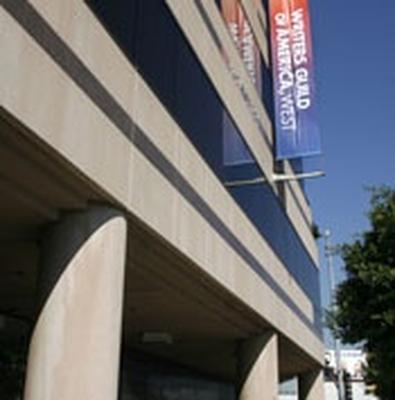
As wildfires raged throughout Southern California last week, entertainment-industry professionals fretted and strategized about what many perceive as another potential catastrophe: an increasingly likely Writers Guild of America strike that would shut down hundreds of productions indefinitely, and the possibility that actors and directors may also strike when their contracts expire next summer.
Negotiations that began in July between the WGA and the Alliance of Motion Picture and Television Producers heated up when the WGA issued strike rules on its website and sought strike authorization, which its members overwhelmingly voted in mid-October to grant. Despite public bickering — AMPTP president Nick Counter told TVWeek that the guild's demands are "over the top and unreasonable" and its unwillingness to concede anything "embarrassing," while WGA West president Patric Verrone and executive director David Young told Daily Variety that the AMPTP's latest offer is "disrespectful to the guild's proposals" — both sides have said they'd like to avoid a strike. Counter told Daily Variety Oct. 25 that "the goal is to reach an agreement by Oct. 31," the contract's expiration date; Verrone said after gaining the strike authorization, "Writers do not want to strike, but they are resolute and prepared to take strong, united action to defend our interests."
But what does the strike mean for members of the Screen Actors Guild, which will base its strategies for upcoming negotiations on the outcome of the WGA-AMPTP situation? Last week SAG schooled its members in etiquette regarding a WGA strike. In a brief message emailed to members and posted on its website, SAG stated that its support for the WGA will remain steadfast. However, per the no-strike clause in the guild's collective bargaining agreements, members must go to work and continue to audition in the event of another union's strike. "We encourage you, on your own time, to walk any picket line that has been set up by the Writers Guild to show your support of their effort," the missive stated. SAG's national board of directors also issued a statement Oct. 29 supporting the WGA.
SAG president Alan Rosenberg and Pamm Fair, SAG's deputy national executive director for policy and strategic planning, echoed those statements. "Screen Actors Guild's close collaboration with WGAW has brought many benefits to the members of both unions. We support the WGA in their current negotiations and pledge our continued solidarity," Rosenberg told Back Stage via email. Fair said, "We will support with any kind of rallies or pickets. Anything we can do to show solidarity, we will."
Verrone, an outspoken ally of Rosenberg on issues such as organizing new media and reality television, emailed, "So many of the issues and concerns writers face in our current negotiation are shared by our actor colleagues. Working together, we have been able to develop initiatives and strategies that are significantly more powerful than if we'd gone it alone."
Let There Be Work?
SAG members may have permission to work, but what would happen to thousands of television actors who find shoots shut down for lack of scripts and rewrites? FilmL.A., a nonprofit production-coordination company, recently reported that there were 6.5 percent fewer on-location production days in the July-September quarter compared with the same period a year ago. Television activity climbed 2 percent in that quarter compared with a year ago, an increase fueled by an almost 43 percent increase in third-quarter pilot production. Sitcoms were down 16.1 percent, dramas were down 12.1 percent, and reality programs dipped 0.8 percent. Movie production continued its slide, falling almost 22 percent.
The TV regulars with whom Back Stage spoke expressed concern about the strike but in general were not extremely worried about productions shutting down, saying it's out of their hands. "You read about this stockpiling of scripts, but in TV you don't have enough manpower or hours in the day to stockpile," said Marg Helgenberger, star of CSI: Crime Scene Investigation and Rosenberg's wife. "You'd have to have three staffs working 24/7 to make that happen; that's not how it works."
Helgenberger said she has kept tabs on the strike through CSI executive producer-writer Carol Mendelsohn, who is on the WGA negotiating committee. Helgenberger said Mendelsohn, like Counter, hopes a strike can be avoided. "[She is] hopeful that something's going to be hammered out.... I think they're going to be far apart from what we want, but she seems to think there will be some kind of compromise that will be amenable. Because she has a show to run, she doesn't want to strike," said Helgenberger, adding, "It seems there's enough worrying out there as it is — so many people wringing their hands. I'm not going to join the wringing of the hands."
Former SAG board member Jack Coleman, who plays Noah Bennet on Heroes, described himself as very concerned about a writers' strike because the NBC show is still shooting this season's episodes. "I think [a strike] is a very strong possibility. We are nowhere near wrapped. We won't wrap until probably the end of March. We're about to start Episode 12; my guess is we would get through 14 if the writers' strike happens in early November.... Then I don't know what we'll do," he said. "Shooting will certainly continue for a while, but I don't know how long."
Chandra Wilson, 2007 SAG Award winner for her role as Dr. Miranda Bailey on Grey's Anatomy, said the Grey's cast is "taking our cues from the writers." She added, "These are really important issues that are on the table, and of course nobody wants to stop working. We want a wonderful, fair resolution. We're a country that can arrive there without necessarily having to strike. So they have our full support."
Frances Fisher, a current, three-time SAG board member who recently guest-starred on Grey's Anatomy and TNT's Saving Grace, said she is reading everything about the strike and speaks with Verrone privately. "It's now or never," she said. "I completely support what they're doing, and if there's a strike, so be it. It's the AMPTP cutting off their own noses."
But strike or no strike, Helgenberger, Coleman, Wilson, and Fisher will still have steady jobs when the smoke clears. A strike would more directly affect actors who rely on auditions and occasional TV work to survive — the middle-class actors Rosenberg often cites in his public addresses. Chris Devlin, whose TV credits include MyNetworkTV's American Heiress and the upcoming TV movie Anna Nicole, noted that actors are still smarting from the 2000 SAG strike, as well as from the 1988 WGA strike, which lasted 22 weeks and cost the industry an estimated $500 million.
"The last strike[s] for SAG and WGA resulted in loss of jobs — commercials using nonunion talent, reality/game show programming — and some actors and writers are still suffering from that strike," Devlin wrote via email. "I wish that producers and advertisers would realize that our performances and the scripts are bringing in the record revenue.... We all want to work and generate more revenue for the studios and networks. Good business is good for us all, so I hope that through negotiations or even an outside mediator we can all come to agreement without striking."
Perhaps frequent TV guest star Kathryn Joosten (Desperate Housewives, My Name Is Earl) best summed up how a writers' strike would affect the majority of working actors in Los Angeles and New York: "I will not work if there is a writers' strike, because there will be no work to do," she wrote via email. "Each episode has rewrites every day. You cannot shoot an episodic without the writers being there."