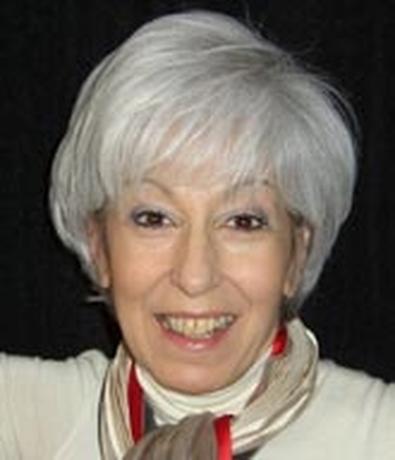
As I've never attended any of the performances of Helen Baldassare's students at Don't Tell Mama, I have no idea what the eager hopefuls learn during her classes. I can say, however, that were they simply to show up at one of her infrequent gigs — like the one she just ended in the Metropolitan Room after three Sundays — they'd be exposed to everything they need to know about constructing and executing a traditional cabaret act.
I mean everything. Calling her thoroughly successful presentation Ain't That a Kick in the Head, Baldassare had a unifying theme that was neither restrictive nor, at the other end of the spectrum, too vague. About to turn 60, she pegged her songs not only to her life but to the lives of the baby-boom generation. (She's not the first to do this, by the way.) The conceit gave her leeway to sing songs — starting with "Mack the Knife" (Bertolt Brecht-Kurt Weill, in Richard Burke's new translation) — that boomers grew up with. She also made room for a 1940s medley in honor of boomer parents.
Baldassare personalized her relaxed narrative — marked by a welcome-to-my-living-room delivery — that encompassed career and private life. On the subject of showbiz survival jobs, she sang Stephen Schwartz's waitress-centric "It's an Art." On the subject of relationships, she included the caustic Dillie Keane-Adéle Anderson "Much More Married," Susan Werner's baleful "Much at All," the bittersweet Carolyn Leigh-Cy Coleman "Rules of the Road," and Ronny Graham's all but forgotten "Love in a New Tempo."
The last song is typical of another Baldassare strength: her song selection. She strikes exactly the right balance by mixing tried-and-true repertoire — "Mack the Knife," the closer "May You Always" (Larry Markes-Dick Charles) — with numbers seldom or never heard. The hilarious Graham ditty is one of the latter; another is Phil Ochs' "While I'm Here." Speaking of carefully calculated mixes, she knows when to raise the roof — the Schwartz waltz and the Graham march — and then slot a change-of-pace number.
Baldassare's keenly aware of the need for singer-musical director rapport, expertise she makes manifest by her sincere camaraderie with wry pianist Bobby Peaco. Their spoof of Italian ballads and balladeers, "Samba Della Rosa" (Vinícius de Moraes-Toquinho-Sergio Bardotti), was one more peak. They've collaborated for years now and undoubtedly complete each other's sentences. Note to students: This kind of rapport is not for sale.
Yet another lesson Baldassare imparts without needing to articulate its importance is in how she uses her perfectly pleasant voice. She doesn't really have the pipes to knock the socks off a roomful of people — and the room was full on her closing night — but she knows something more significant: A great voice isn't a cabaret sine qua non; standout personality is. She's got the personality.
As a takeaway, Baldassare — well directed by Gerry Geddes — had a Glossary of Terms for Those Born After 1965 put on every table. The last word on the list is cabaret, and the definition given is "an art form popular in the 20th century." Funny, but not so funny. Nevertheless, whatever cabaret is as the 21st century unfolds — and it's looking less and less like a stairway to widespread fame and fortune — Helen Baldassare understands it and has mastered it.
By the way, at 60, Baldassare is not, as she claims, getting old. Older, yes, but not old.
Presented by and at the Metropolitan Room,
34 W. 22nd St., NYC.
March 2-16.