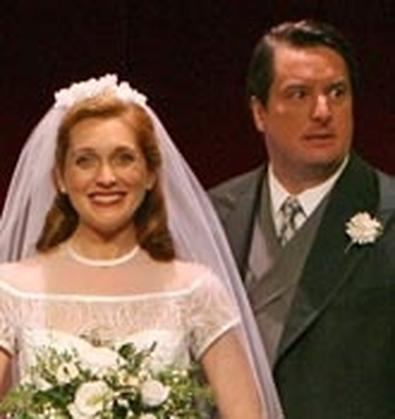
Dysfunctional families have long been fodder for American drama. Eugene O'Neill's Tyrones, Tennessee Williams' Wingfields, and most recently Tracy Letts' Westons have enacted searing conflicts of raised expectations and failures to communicate. But no playwright has approached the family dynamic with quite the same mixture of heartbreak and hilarity as Christopher Durang in his 1985 play The Marriage of Bette and Boo.
Bette (pronounced Bet) is determined to raise a large family. But when her rare blood type mixes with her husband Boo's, all but one of her offspring fail to survive. Raised a Catholic, she prays for a miracle; Boo quietly drinks himself into a stupor. Their families either ignore their misery or gloss over it with platitudes and prayer.
The play is narrated in a jumbled chronology by their grown son, Matt, who interjects thoughts about his favorite movies and the English novels he's studying at college. Not exactly a load of laughs, but Durang views Bette and Boo's unhappy union through a wildly distorted comic lens. Stillborn babies are thrown around like sacks of garbage, violent arguments break out over the proper way to clean up spilt gravy, and a priest amuses his congregation by imitating frying bacon. In this dark, delirious Roundabout Theatre Company revival, director Walter Bobbie and a company of expert farceur-tragedians elicit belly laughs and tears in equal measure.
Both Bobbie and his cast remember that Durang's characters are not just zany cartoons, even though they sometimes act as if they were drawn in pen and ink and stars would emerge from their heads if someone conked them on the noggin. Fortunately, Durang supplies that vital third dimension, with every ridiculous action backed by a valid emotional subtext. Bette prattles on about Winnie the Pooh and calls her grade-school classmate in the middle of the night because she idealizes her childhood. Boo wonders why there are no bars in hospitals, because he can't cope with the endless visits there that inevitably end in tragedy.
The cast deftly provides that undercurrent of emotional truth, keeping the play from becoming a two-hour comedy sketch. Kate Jennings Grant poignantly conveys Bette's desperate longing for a fairy-tale family, while Christopher Evan Welch nails Boo's dogged numbness, exploding only once with fearful anger. As Matt, Charles Socarides skillfully combines a child's need for order with adult intelligence. John Glover is a glowering monster as Karl, Boo's boorish father, and Julie Hagerty is expertly oblivious as his dithering wife, Soot. Bette's parents are just as daft — and deftly played by Victoria Clark and Adam Lefevre. Heather Burns is particularly moving as Emily, Bette's perpetually apologizing sister, and Zoe Lister-Jones balances her perfectly as Bette and Emily's sarcastic sister, Joan. Terry Beaver delivers several gemlike comic moments as the bacon-imitating padre.
At once disturbing and hysterical, this Marriage reminds us that Durang is one of the best playwrights we have, and that this is one of his best works.
Presented by Roundabout Theatre Company at the Laura Pels Theatre, 111 W. 46th St., NYC. July 13-Sept. 7. Tue.-Sat., 7:30 p.m.; Wed., Sat., and Sun., 2 p.m. (212) 719-1300 or www.roundabouttheatre.org. Casting by Carrie Gardner.