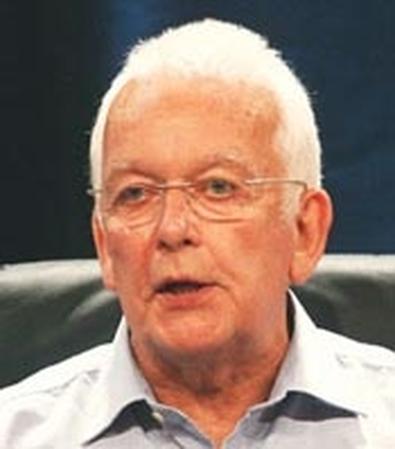
Shame on those of you who wonder why we need yet another Jane Austen adaptation. "The perfect one hasn't been done yet," explains Andrew Davies, Britain's preeminent screen adapter, whose Austen adaptations headline a PBS Sunday-night series that runs through March. "Jane Austen has got everything," he says. "She writes great love stories, she's intelligent, she's witty, she has great characters. And I always feel that I want to tell that story again. So that's it." Point made.
Davies says he writes for intelligent viewers but not necessarily those who have read the books. His goal, therefore, is to present "a lively, engaging drama that isn't just a kind of nostalgic look at a different sort of society but something that engages us with problems and passions that are just as real now." Yes, passions. He not only notes that the plots definitely include sexuality; in his adaptations he includes extensive stage directions that speak quite frankly of such things — even if the result is not shown graphically.
When he writes, he hears the characters' voices — but not necessarily the voices of actors who might be cast. "So it's sometimes a bit of a shock at the read-through," he says, "when they all turn up, and I think, 'Hmm, not so sure about this.' But if they're any good, they manage to very swiftly overcome this feeling."
Prime examples, he says, include Felicity Jones, who plays heroine Catherine Morland in Northanger Abbey. "Absolutely perfect," he pronounces. "I couldn't have imagined anything better. I could have sworn she was about 16. In fact, I didn't meet her until I'd already seen her audition tape and seen some rushes. And I'd sort of fallen in love with her as the character. And I was almost disappointed to find out that in real life she was much more sophisticated and intelligent and grown-up and educated, because it was just such a delightful performance."
He also lists Hattie Morahan, playing heroine Elinor Dashwood in Sense and Sensibility, ultimately so right for the part, notwithstanding his first impression of her. What of these actors with good looks who need to play "plain" or even homely? "There's a lot in the acting but [also] in the makeup," Davies admits. "You see them sitting around the table [at the first read], and they look very good. David Bamber [Mr. Collins in Pride and Prejudice] is not a bad-looking man. [As Mr. Collins] his clothes didn't fit him very well, his hairstyle was kind of creepy. And I always think of him as being slightly overweight. But David Bamber isn't overweight. He somehow has the ability to act overweight, which is clever."
Then there are actors who brought qualities to their characters that particularly pleased the screenwriter. He mentions David Morrissey, playing Colonel Brandon in Sense and Sensibility. "His character is the strong, silent type," Davies says. "So it's the intensity of his gaze and stillness of his demeanor and his ability to just let a pause happen, which is almost a kind of old-fashioned leading-actor film-star thing. Dan Stevens, who is playing Edward in Sense and Sensibility — it's a very difficult part to play, because the character can't speak of his feelings; he's trapped in a secret engagement, but he's in love with Elinor. So [Stevens'] acting, especially in the early part, is just a kind of master class in reticence and hesitation. There's one little scene where he's saying goodbye to her, and she is hoping for a proposal. So he's got a scene in which he says, 'These weeks for me have been very happy.' She thinks, 'Now he's going to say‌.' And he's got this little present. He [hands it to her], almost like, 'This is not what I wanted to give you, but here it is,' and then he just says goodbye and goes out. And she's there, with her big eyes, and she thinks, 'What was that all about?' He's one of those actors, like Colin Firth, who — a lot of actors find this very hard — just leave a sentence trailing."
Pushing Envelopes
Davies began writing as a schoolboy. "I think I probably would have continued writing, even if nobody ever bought anything I wrote," he says. "It is a compulsion." The first thing he sold was a radio play. Assuming this was his niche, he wrote more of them, then started writing television plays, in the 1960s. "I sold one," he says. "And then a whole five years went by before I sold another, so it was good I had a day job, teaching. Slowly the writing began to become more important, and I made more money from it than from the teaching. But I didn't give up the teaching till I was 50."
But even that slow build didn't come easy. "I mailed out the envelopes [enclosing spec scripts], and most of them came crashing back," he says. "Obviously some of them got to the right address. And I did get an agent after about my second or third radio play got done. Somebody wrote to me and said, 'I would like to be your agent and exploit you in all media.' But I never found that my agent ever got me much work. In a way, I had to get that for myself. But I've become increasingly dependent on my agent over the years, just to write good contracts, that I get my share of the DVD royalties and things."
The Keira of His Class
Of doing an Austen adaptation, he notes, the leading characters are likely to be so young that casting will involve newcomers. "They'll be looking to create stars, which is delightful," Davies says. "So you get these fresh faces. And it's nice for the audiences too, because they don't think, 'Oh, here comes so-and-so, and we've seen her in this and we've seen her in that, and now here she is in this.' They just believe this is the character." To build the audience, though, the newcomer is surrounded with well-established names. "I often think it's a really tough job, being an actor," says Davies.
"It's hard not to experience not getting a part as rejection. But it's trying to choose who we think is the right person for that part. It has to be soul-destroying, going up and getting recalled and getting recalled. And then somebody else gets it. The number of young English actresses who go up again and again and again for parts that Keira Knightley gets. And it's a bit the same for writers, because I get all the plum adapting jobs, it seems."
What can you do to endear yourself to him? Don't "act." Don't paraphrase his script. Don't audition dressed as the character. But don't be afraid to stop midaudition and ask to start again. "It kind of shows an ability to get outside your work a little bit," he says. "And it's very encouraging when the directors give them some note and they try again and do much better." Also on his list of suggestions during a take: "Look her in the eye, say the line, and that's it. Don't do anything else. And just keep still until the director says, 'Cut.'"
Upcoming and not yet cast: His script for Little Dorrit, with about 40 to 50 roles, he estimates. Requirements? A good English accent. The best of British to you, as they say!
Bio Briefs
Adapted the Colin Firth Pride and Prejudice (1995), both Bridget Jones films, and Bleak House (2005)
Has won five BAFTAs, an Emmy, and four Writers' Guild of Great Britain Awards
Knows really cool stuff about actors. For example, when he first met Firth, "his coloring was fair-to-ginger [light-red hair]. We had him dye [his hair] dark. He obviously liked the effect so much he's kept it ever since."
Andrew Davies adaptations on PBS include the currently airing Northanger Abbey, Pride and Prejudice (Feb. 10-24), Emma (March 23), and Sense and Sensibility (March 30-April 6).Davies' titles available through Acorn Media are Doctor Zhivago, Othello, To Serve Them All My Days, Tipping the Velvet, and The Chatterley Affair.