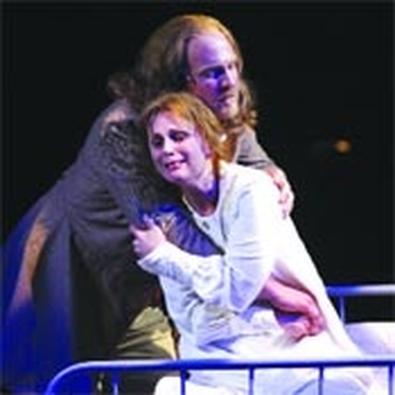
Like many managing directors, Dean Gladden of Houston's Alley Theatre has had to adjust to the sharp downturn in the economy. After the stock market began to slide, institutions cut their donations to the Alley by at least 50 percent or stopped giving altogether. Adding to his burden are the effects of Hurricane Ike and the recent drop-off in oil prices, which is likely to curtail contributions from local companies in the next fiscal year.
Still, almost every regional theatre in the country would love to have Gladden's problems. "We've increased the artistic budget by $3 million within the last year," he said. "Now maybe we'll increase the budget only $2 million."
Gladden isn't bragging or being glib, and he knows a thing or two about the challenges of a stagnant economy. Before he came to Houston two years ago, he was the managing director of the Cleveland Play House from 1988 to 2006. "We certainly lived through a number of downturns there," he said of the Rust Belt city. "I think this one, though, is different. I don't think we've ever seen the financial markets collapse, the auto industry collapse, and oil prices go south all at the same time." Events of 2008 devastated several regional theatres, at least three of which have shuttered since October: Milwaukee Shakespeare, the American Musical Theatre of San Jose, and Stamford Theatre Works in Connecticut. Although each closed for a unique set of reasons, the deteriorating economy was the common denominator.
Additionally, North Shore Music Theatre in Beverly, Mass., announced recently that it will close this year unless it raises $4 million by spring. The Oregon Shakespeare Festival, a 73-year-old institution with the largest resident company of actors in the country, announced it had an operating budget deficit of $750,000 in 2008 and anticipated a $1 million shortfall this year. And because contributions to nonprofit theatres are often lagging economic indicators, these occurrences could be mere portents of worse things to come.
"It's going to be much harder in 2009 and 2010," Gladden said, but he added that there are several things theatres can do to survive the rough times ahead.
Fulfilling the Mission
First, companies need to look inward. "Theatres in difficult times have to go to their missions and make sure they're serving them," Gladden said. "You don't want to lose sight of why you exist. You have to go to your values, and you have to program according to those."
Part of that is avoiding the urge to play it safe. Cleveland's economy struggled off and on during Gladden's tenure. He had to cut costs accordingly. Some choices were difficult, including programming more two-character plays. Even then, though, he didn't shy from riskier fare, choosing Charles Ludlam's gothic horror cross-dressing satire The Mystery of Irma Vep, for example.
Also, if corporations and foundations slow or cease their giving, theatre officials should concentrate on individual donors. In the late 1980s, Cleveland ranked fourth among U.S. cities in its number of Fortune 500 companies; when Gladden left in 2006, the city had fallen from the top 20. "We had to build up our individual base over our corporate base, which we were able to do," he said. "We just had to work harder to bring people into the theatre. There's no magic formula other than a lot of hard work."
Last, he says, if you're in a position of authority, act like it: "It's very important that the leadership of the organization continue to be optimistic. You're looked upon by the board and your employees as leaders of the organization, so you should be looking for creativity and innovative things to do at difficult times."
David Hawkanson, executive director of Steppenwolf Theatre Company in Chicago, said many companies won't survive simply by hitting the reset button, noting that theatres faced difficult challenges even before the stock market began to slide in mid-September: an aging audience, stiff competition from electronic media, and tamer programming. "A situation like this always makes you smarter, makes you articulate, makes you clear about why you're doing it and why you should be supported," he said. "I wish that was enough to get us through it. I'm not sure it is."
Guarded Optimism
Not everyone is convinced the situation will worsen before it improves. Bill O'Brien, director of the theatre and musical theatre departments at the National Endowment for the Arts, said that, given the grant applications he reads on a regular basis, he is enthusiastic about what lies ahead. "Without trying to seem like I'm ignoring bad signs, I do have a lot of faith in what the capabilities are," he said. "The last couple of challenges -- a recession and 9/11 -- seem to have shown us that, in the past, what didn't kill us seems to have made us stronger."
O'Brien also bases his guarded optimism on a new NEA report that indicates the nonprofit theatre community grew substantially in the past two decades. From 1990 to 2005, the number of companies with annual budgets of at least $75,000 doubled, from 991 to 1,982; real assets grew nearly 60 percent, while liabilities were flat. Within that time frame, the United States took part in three major wars, endured two recessions, and saw at least two steep declines on Wall Street. A collapse of the nonprofit theatre community, however, could have a substantial impact on the broader arts-and-culture sector in the United States, which generates $166.2 billion in economic activity every year, according to a 2007 study by Americans for the Arts, a Washington, D.C.–based advocacy group. Nonprofit arts organizations also support the equivalent of 5.7 million full-time jobs in the U.S., the study said. By comparison, the number of jobs directly or indirectly connected to the U.S. car industry is about 2.95 million, according to the Center for Automotive Research.
A Helping Hand?
Despite the fact that it supports nearly twice as many jobs as General Motors, Ford, and Chrysler, nonprofit arts organizations should not expect a bailout from the federal government. "We don't have discretionary funds that are just sitting there ready to respond to a short-term need," O'Brien said of the NEA. "What we've traditionally been doing is probably as important now as it ever was: seeking out and recognizing those theatrical events that are most deserving of our attention and enthusiasm and raising their visibility."
The recent theatre study seems to support O'Brien's claim. For every dollar granted by the NEA, companies receive $8–$12 from individuals, $1.88 from businesses, and $3.55 from foundations. It would appear, then, that the endowment will continue to use its grants as seed money rather than flood insurance. Nevertheless, there are others who say the government should fund the arts more substantially than it has in the past and that it makes economic sense to do so.
From 2000 to 2005, the nonprofit arts community generated roughly $30 billion in tax revenue at the federal, state, and local levels, while receiving about $4 billion in total government support, according to the Americans for the Arts study. "Investment in the arts doesn't come at the expense of economic development," said Randy Cohen, the organization's vice president for policy and research. "Rather, it's an industry that supports jobs and generates government revenue." Fearing drastic cuts that could come, Cohen said it is essential for theatre officials and others in the arts to be "getting that message out there and keeping that message out there."
Hawkanson went a step further, insisting that everyone in the theatre community -- including artistic directors, producers, and Actors' Equity Association -- has to demand more government support than they are currently receiving, particularly at the federal level. "If Obama rolls out his public-works projects, we've got to make sure the language and the opportunities deal also with the needs of the artists in this country," he said. "He's made statements to that effect...but if he's going to knock out a trillion-dollar package, we've got to be there making sure that our artists and actors get a part of that."