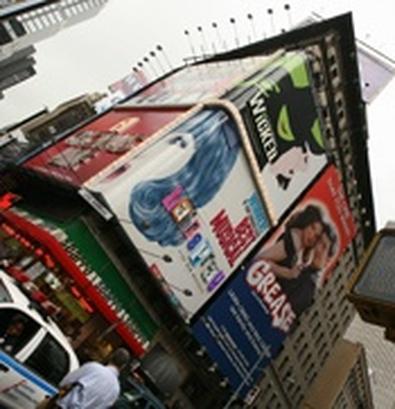
After three months of intense and at times acrimonious contract negotiations with theatre owners and producers, the stagehands union launched a strike Sat., Nov. 10, pitching most of Broadway into darkness for the first time in four years.
Talks between Local One of the International Alliance of Theatrical Stage Employees and the League of American Theatres and Producers broke off Nov. 8. With no new talks scheduled and IATSE president Thomas C. Short giving strike authorization to Local One, it was only a matter of time before Broadway stagehands walked off the job. That they did so before the workweek officially ended Sunday evening, however, caught the theatre community by surprise, especially the league.
"They have chosen to strike -- without notifying us, rather than to continue negotiating," Charlotte St. Martin, the league's executive director, said in a statement. "It is a sad day for Broadway, but we must remain committed to achieving a fair contract."
Bruce Cohen, spokesman for Local One, did not comment, but Short said in a news release, "I am dismayed that just hours after my departure [Thursday] the employers made a 180-degree turn and began bargaining in a regressive manner. This action demonstrates a clear lack of will on the employers' part to reach an agreement and leaves me no choice but to authorize a strike."
The league wants to change longstanding work rules that require them to hire a fixed number of stagehands for a set amount of time, regardless of the amount of work that needs to be done. Owners and producers contend that many get paid for doing little or no work. Union officials have said they will make changes if they get benefits of equal value.
Members of Local One showed up at the St. James Theatre at 10 a.m. Saturday to begin picketing Dr. Seuss' How the Grinch Stole Christmas! The Musical, the first show to be affected by the work stoppage because of its 11 a.m. starting time. Soon the block of West 44th Street between Broadway and Eighth, which has four theatres, was choked by pickets, police, and members of the media. Among the shows shut down were Phantom of the Opera and Les MisĂŠrables, Broadway stalwarts that have run for more than 15,000 performances combined.
In front of the St. James, 32 picketers marched counter-clockwise in a tight oval, no more than 30 feet long and eight feet wide, inside police barricades of galvanized steel. Some of the stagehands carried signs that read "No Takeaways," some held leaflets in a various shades of neon colors, some stared blankly ahead, and one talked on a cell phone. Instructed by officials in their parent union to say nothing to reporters, the stagehands didn't even chant. Though they appeared dutiful in their picketing, there was a noticeable lack of emotion, energy, and theatricality that often animates a union on the opening day of a work stoppage that it has initiated.
"I don't know if we can survive," said Grinch producer James Sanna. "We do 12 shows a week instead of the usual eight .... It's a holiday family show with a limited run."
When asked what he thought of the league's position about changing the work rules, Sanna said he would not comment. However, he added, "Philosophically, I agree with them. People who aren't working shouldn't get paid."
Rusty Ross, the actor who plays Young Max in the Grinch, said, "I can't comment on how hard [the stagehands] work all the time, but in the time that I've been in the theatre, I see everyone working hard."
The strike is the first on Broadway since 2003, when Local 802 of the American Federation of Musicians walked off the job for four days. Mayor Michael R. Bloomberg helped broker a deal then and last month offered his services again, but he was rebuffed by James J. Claffey Jr., president of Local One. On Nov. 9 during his weekly radio show on WABC, Bloomberg seemed less eager to get into the fray, at least for now.
"These are private companies and private employees with their own union and they should negotiate," the mayor said.
It is hard to imagine, however, that Bloomberg or other city officials will stay out of the issue if the strike goes longer than a few days. According to a league news release, New York would lose $17 million a day. Broadway is poised to earn $1 billion in box office revenue alone this year, and the Main Stem helps to pump about $5 billion annually into the city economy.
"I feel bad that sensible heads haven't prevailed," said Max Klimavicius, owner of the restaurant Sardi's, which serves as the unofficial home office of the Great White Way. "Everybody else is affected. New York without Broadway is not New York."
In 2003, Local One, Actors' Equity Association, and the other Broadway unions supported the musicians by refusing to cross the picket line, and the same is happening now. Local 802 instructed orchestra members to join the picket line. The Equity Council, likewise, instructed actors to honor the strike.
Local One has a $4.1 million strike fund, and last month Claffey said $1 million would be offered to the other unions affected by the work stoppage. Maria Somma, spokeswoman for Equity, said actors had to report to work and sign in with union representatives so they can receive their strike pay.
The league also has a strike fund that it has built up for a few years with ticket surcharges. According to various news reports, the fund totals approximately $20 million.
Eight Broadway houses that operate outside of the league purview remain open: Four that are run by nonprofit companies -- American Airlines Theatre and Studio 54 (Roundabout), the Biltmore (Manhattan Theatre Club), and the Vivian Beaumont (Lincoln Center Theater); the independent Circle in the Square, Helen Hayes, and Hilton; and the Disney-run New Amsterdam.
Although the nine Nederlander theatres have a contract that is also independent of the league, it notified Local One that its members would be locked out if they struck. In all, 28 out of 39 Broadway houses that had shows running are closed until further notice.
The job action by the stagehands has also tossed actors into a perfect storm of uncertainty. Combined with a strike by the Writers Guild of America that has shut down much of Hollywood, thespians are faced with an unprecedented work stoppage -- one that has ground production to a halt across broad swaths of theatre, film, and television and one that has made a notoriously insecure profession even more so.
"You have to have such resilience to survive in this business, and that resilience gets tested every day," said the actor Matthew Rauch. "It's a hard job and a lot of people want to do it. And when the rug gets pulled out from under you, well... The fight is going to be tough. This is a nightmare."
Rauch is starring in the play 1,001, which is running Off-Broadway and is thus unaffected by the strike; however, the show closes Nov. 17. "Maybe I'll go back to voiceovers," he said. "Who knows?"