Photo Source: Derrick Belcham
Ball certainly created an iconic American story in his tale of a big-city black police officer, Virgil Tibbs, who finds himself trapped into helping a murder investigation in a tiny Southern town during the turbulent 1960s. Ball wrote numerous books featuring Tibbs, and the Oscar-winning film version of “Heat” spawned two sequels and a hit TV series. So with characters and a story this well-known, it’s incumbent upon any new version to supply something fresh. But the stark, scenery-free staging in the small black-box Theater C at 59E59 Theaters, involving 10 actors, four of whom play multiple roles, just isn’t enough. Though it may be a new way of telling this story, we’ve seen plenty of such stagings before. Even the ever-present white noose, which hangs balefully from the ceiling dead center, seems cribbed (think of that tree in Harold Prince’s staging of “Parade”). Predictably, characters have a way of finding themselves under that noose when in jeopardy. Worse, the evolving relationship between racist police chief Gillespie and Tibbs, which forms the spine of the film, is not well charted here. Without that to hold things together, we’re left with a pretty standard-issue mystery plot decorated with repeated displays of virulent racism. Indeed, Pelfrey and Tantalo’s excessively shrill dramatizations of this most American disease paradoxically end up diminishing it.
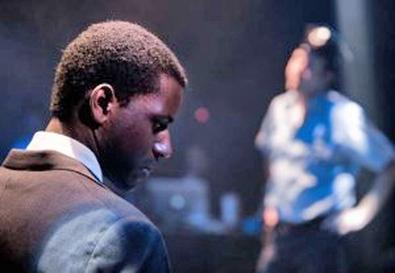
Sean Phillips brings intelligence and dignity to Tibbs but is forced to spend too much time hiding behind a cliché deadpan detective mask. Gregory Konow’s forceful Gillespie is nevertheless too one-note of a Southern good-ol’-boy bigot. As Sam Wood, an officer increasingly sympathetic to Tibbs, Nick Paglino offers an attractive vulnerability but is less successful suggesting disturbing depths that briefly make him a suspect. Ryan O’Callaghan doesn’t differentiate enough between Harvey Oberst, a bravado-filled thief, and Purdy, the put-upon brother of the town sexpot. More successful is Bryce Hodgson, who makes Ralph, the diner waiter who gets the sexpot in trouble, and Eric Kaufman, a business partner of the murder victim, distinct both physically and temperamentally. Not doubling the two female roles seems a mistake. While Scarlett Thiele and Julianne Nelson are effective as that sexpot and the respectable daughter of the murdered businessman, respectively, they can’t do much with their thin parts. One actor playing both would at least have had an opportunity to show range.
I was 13 when the film came out and saw it multiple times. It also inspired me to read the novel, which as a teenager I found interesting both for its differences and for what felt like a harder-hitting look at racism. After seeing this stage adaptation, I revisited the film for the first time and had the opposite reaction. Norman Jewison’s movie is suffused with complicated humanity, making its racism all the more upsetting. On stage, as embodied by stereotypical characters, it comes across as so much mustache twirling.
Presented by Godlight Theatre Company at 59E59 Theaters, 59 E. 59th St., NYC. March 28–April 25. Tue. and Wed., 7:30 p.m.; Thu. and Fri., 8:30 p.m.; Sat., 2:30 and 8:30 p.m.; Sun., 3:30 p.m. (212) 279-4200 or www.ticketcentral.com.