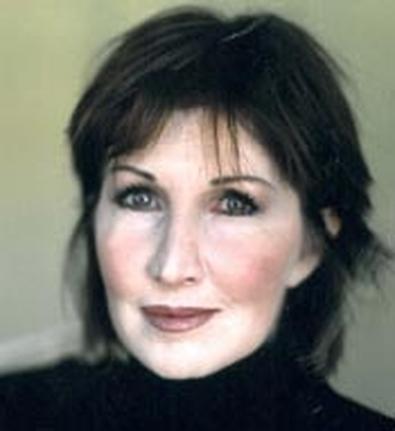
Some theatregoers link Joanna Gleason with musicals — 1977's I Love My Wife, 1987's Into the Woods (earning her a Tony for best actress in a musical), 2005's Dirty Rotten Scoundrels — but she's equally adept at dramatic work and has been proving it for more than 30 years.
Still, something about Alison, the 1960s radical she's playing in Willy Holtzman's Something You Did, opening April 1 at Off-Broadway's Primary Stages, feels like a departure. Imprisoned for more than 30 years, Alison is up for parole as the play begins, not long after Sept. 11, 2001. Despite Alison's role in a fictional anti-war bombing at New York's Grand Central Terminal, despite her being convicted for various crimes, the play asks whether radicals can really be remorseful, and whether society can really forgive.
Gleason, 57, is about the same age as her character; the play, she says, lets her reconnect to her generation's great controversies. "It's my time because I was in high school or college when Alison was," she explains. "But I had the theatre department, which was its own sort of commune with its own radicals. Social activism wasn't high on my to-do list, but Willy's play gives me an opportunity to ask if I was just caught up in theatre, which I think I was. I didn't have any acting out to do that wasn't going to be in theatre, but the causes were real and important."
Indeed, hindsight has proven essential to finding Alison, Gleason says. "Remember, Willy's writing about actions from 30 years ago, so go back to her post-adolescence: Alison's under the influence of her father, very much trying to please daddy, getting caught up with the men in the movement too, and finding outlets for her idealism — she wanted to register voters in Mississippi. Then Vietnam happened and outrage. If I look at her 30 years later through the eyes of a woman in her 50s, it's like you're raising your own child. I can say, 'This was a mistake' and 'I'm proud of you for this' and 'This was an outrage.' "
Alison "stewed in her juice for 30 years," Gleason says. "Repentance is there, and it's more than 'I'm responsible for being irresponsible.' On the other hand, there's still fire and zeal. One plot point is that her father, a prominent lawyer, didn't let her speak on her own behalf at her first parole hearing because he thought she'd inflame with her rhetoric and what would seem like remorselessness. Now her father's died; it's five years later." Finding Alison, she says, "meant finding other things I regret deeply, that I wish I'd have done differently. You use your imagination and hook it up to your experience."
Coastal Disturbances
Gleason, whose father is beloved Let's Make a Deal host Monty Hall, grew up in California and worked on stage there early on — in the musical Promises, Promises and opposite Stacy Keach in Hamlet. For personal and professional reasons, she's often lived on either coast — much of the 1980s was in New York and on Broadway; much of the '90s was in L.A., often on large and small screens. Her TV credits include Hello, Larry; Love & War; Temporarily Yours; Oh Baby; the short-lived Bette; and King of the Hill, on which she's the voice of Maddy Platter. Film credits include Crimes and Misdemeanors, Heartburn, Mr. Holland's Opus, Boogie Nights, and The Wedding Planner.
"The great thing about California was having unbroken time with my son, my mother and father," she says. "I'd spent a decade in New York not seeing them much. But California wasn't a fulfilling life creatively. The work pool dries up; the town is not my kind of town. So there I was until I realized I was pining for New York, to feel like an actor again." When an offer to play Dr. Emma Brookner in the 2004 Off-Broadway revival of Larry Kramer's The Normal Heart materialized, Gleason was nearly simultaneously approached by her friend Jeffrey Lane, who wrote the book for Dirty Rotten Scoundrels, about joining the Broadway-bound tuner. Miraculously, she was able to schedule both productions. Gleason and her husband, actor Chris Sarandon — they met in 1991 during the ill-fated Broadway musical Nick & Nora — "packed up our cars and drove cross-country. We put our house up for sale and never saw it again."
Kramer "generously put in a scene in Heart from the London production but not in the original New York production for me and RaĂşl Esparza at the top of Act 2," Gleason says. Kramer convinced her that what's important "is not if the role's a lead. More and more, I see ensemble pieces as the way to go. Into the Woods was also an ensemble piece. There's no reason to wait to star in something. At some point, you get fatigued hanging on to notions for your career. You say, 'I want to work.' If something comes along that's good and you get to be in it, you do."
Sometimes, she adds, actors have to find something small to do. For example, "I've done five independent features in the last two years," Gleason says. "They're small parts, and I had to read for them. At some point you say the game has changed, all bets are off. I had to sit in a room of people I've never seen before who are all 20 and reading for the first time. It made me unhappy to think, Jesus, my friend is associated at a very high place with this film and I have to read because some bean-counter in distribution doesn't know my work — for 10 lines. But you have to get over yourself, because you can carry it around and be harrumphy or just do it."
Not that Gleason will take a role that's wrong for her — even when fiscal necessity dictates otherwise. Shortly after they married in 1994, she and Sarandon moved to California, nearly penniless. "I got Love & War, so it was some money," she says. "But Chris was offered a movie — a half-million dollars for a very pro-life, anti-abortion movie. We said, 'Oh, crap.' It was propagandist crap. The good news is that Chris said, 'I'm not pretending this is a movie.' You make your choices.
"Perhaps I am better known for musicals because they're big and visible and they receive acclaim and have bells and whistles," Gleason continues. "You can also wait around for a long time for a chewy role. My rule of thumb: I don't want to take a role where I'm in the wings watching others have fun."
Actors have to understand how the business works, she says: "You're a commodity. Interest is piqued when the little recognizability meter goes up — you're in a hit movie, you're in a movie getting attention, you're starring on Broadway and everyone has to get tickets and come to New York — and it's a 10-minute window to parlay that into something. It's, 'What did I see you in lately? Was it a hit? And will putting you in my project bring me ticket buyers?' It's painful when my friends, suits in the film industry, say, 'I made sure he didn't get the role, because he's not worth anything,' because I think, Man, he's one of our best actors. There's a point when the world breaks down into us and them. You can either waste time on sour grapes or get a project that has steam and get to the next project on that steam."
Gleason ends with an anecdote about her first feature: Hannah and Her Sisters. "I walk in — there's Woody Allen and Mia Farrow and Tony Roberts. I thought, I hope I don't fuck it up. Then I thought, I'm going to do what they do and pretend the camera's not there. I mean, when Woody hires you, it's for that thing you do. It's a 15-second meeting to cast you. Everyone has a persona; everyone's 'Hi, how are you?' has a quality. He hired me for mine. That's what I gave him."
Outtakes
Attended Beverly Hills High School, appearing in productions of The Music Man, The Mikado, and The Grass Harp
Nominated for five Drama Desk Awards, winning three
Additional Broadway credits include The Real Thing and A Day in the Death of Joe Egg
Is an accomplished stage and screen director, including The Cartells on the New York stage and episodes of Love & War