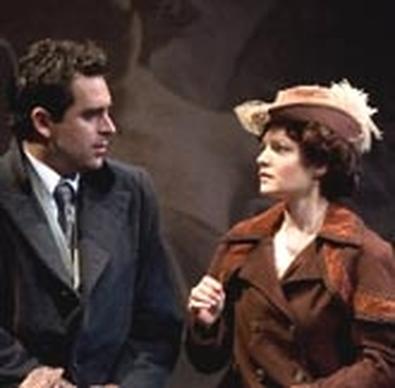
Director Jenn Thompson believes there are common misconceptions about Tennessee Williams' The Eccentricities of a Nightingale — most significantly "that it's a rewrite of Summer and Smoke, when in fact it's a completely different play. Yes, the name of the town is the same; so are the characters' names. John is a doctor and the son of a doctor and Alma is a minister's daughter. But while Summer and Smoke is a bodice-ripping black-and-white soap opera, Eccentricities is a gray play. I actually think it's better than Summer and Smoke."
So does Scott Alan Evans, co-artistic director of the Actors Company Theatre (TACT), which is currently mounting the lesser-known Williams play. Indeed, it hasn't had a major New York revival since it debuted on Broadway in 1976 and closed after 24 performances. A television version for PBS's Theater in America, starring Frank Langella and Blythe Danner, was broadcast shortly before the Broadway production opened. Evans and Thompson both believe the play was simply ahead of its time and has rarely been produced for more than 30 years in part because "people have the erroneous impression that it was a later Williams play, when he and his work had fallen out of favor," says Evans. "In fact, the bulk of it was written at the height of his career in 1952."
Summer and Smoke was produced on Broadway in 1948, but according to Thompson, throughout his career Williams kept coming back to these characters because he believed he hadn't quite nailed them. "Williams identified with Alma more than any other character that he wrote, and that's why he kept returning to her," Thompson says. "Before Summer and Smoke, Alma appeared in several of his works, including two short stories, 'Yellow Bird' and 'Oriflamme.' "
TACT is now in its fifteenth season; its mission is to produce rarely seen but meritorious plays. Evans and Thompson believe Eccentricities falls precisely in that category and will have resonance for contemporary audiences, who are now ready for the play's "subtlety, sophistication, and ambiguity," says Thompson.
Set in Glorious Hill, Miss., shortly before World War I, Eccentricities (like Summer and Smoke) recounts the relationship between spinster Alma Winemiller and her neighbor, Dr. John Buchanan. But in Eccentricities, "Tennessee evened the playing field," says Thompson. "In Summer and Smoke, John is the bad boy and Alma is the repressed spinster. It's cut-and-dried. Here he's a good boy and as stuck as she is. While he wants to go to Cuba, be a researcher, and perhaps not get married at all, everything has been set for him. John is intrigued by Alma's bravery. She has what he desperately wants, which is the guts to be authentic. But he is not evolved enough to fall in love with her."
One of the most ambiguous elements in the play is John's feelings for Alma, but even more open to interpretation is Alma herself. Is she as authentic as Thompson suggests or is she just a troubled and confused young woman? And then there's Alma's proposal that she and John spend the night together. She understands they have no future, but that's okay because the memory will sustain her for a lifetime, she says. Would Alma really have those views, and if so, do they show her to be sophisticated or merely pathetic? Most problematic is the final scene, set six years later, with Alma matter-of-factly picking up a stranger for a sexual tryst. Is she a sexually liberated woman or emotionally dead? A question that may be asked about the entire play: Is it ambiguous or simply unclear?
"I choose to believe it's ambiguous," says Evans. "It can be interpreted in so many ways. We see that in our talkbacks. Some people view Alma as very strong; others see her as lost. But that's part of what makes this play so modern. Today people realize that there are no simple answers. Decisions, and how they're made, are complicated: There are compromises and there is more than one point of view."
Adds Thompson, "You can see this play three different times and each time experience it differently depending on what you're coming into the room with and who the actors are and what they're doing. The play doesn't tell you what to think, and that's what makes it sophisticated; that's what makes it great theatre."
Evans and Thompson both see Alma as a strong woman who knows who she is and what she wants. "That's not to say it was a life without compromises," notes Thompson. "But she is a sexual person with needs who wants to experience the physical. She needs the encounter with John to set her free. She's not ashamed. She's unapologetically living her life. That's modern."
Mary Bacon, who plays Alma, agrees: "She's fulfilling herself sexually, and when people accept their lives and make the best of it, they're liberated." Still, it's not an easy role to tackle, she admits. There are so many potential stumbling blocks — from reconciling Alma's neuroses with her clear-eyed vision of her place in the world to making Williams' intensely poetic language sound real. "Every sentence has an exclamation point," Bacon notes. "It's as if Alma is constantly hyperventilating, and she is. But that's because she's intensely interested in everything going on around her. So there is a kind of innocence there as well, and that's a key. The challenge is to be as gentle as possible, trust it, not to overstate it. Alma has the line [describing love] 'It's like walking in the snow without leaving footprints.' If I can do that, I'll be honest. Williams makes you honest."
Brutal and Romantic Set
Bacon's availability to play the role is a central reason TACT is staging Eccentricities. "As a repertory company with a core group of actors, plays are chosen in part on the basis of who would be right for what role," Thompson explains. "The big challenge is to have the right Alma. Mary has been with the company since 2001 and is perfect for the role. Everyone else in the cast is also a company member. The one exception is Todd Gearhart, who plays John, but he's worked with us several times."
Gearhart says his challenge is to "walk that fine line between being too cold and impersonal and too warm and accessible," he says. "If John is too cold, there's no reason for Alma to love him. But if he's too warm and accessible, there's no reason for them not to be together in the end. John is a golden boy who is fighting against the expectations of his family and society. He feels trapped and wants to step out the same way Alma does. With her, he finds the place where he can be truthful and speak from his heart. John is as much in love with Alma as he can be."
One of the most evocative elements of this production is Bill Clarke's expressionistic set, which combines the heavenly and the seedy. A photograph of an angel projected onto a scrim forms the backdrop. Standing in front there's a crumbling wall. Loosely inspired by a book of landscape photographs called The Deep South, the set was designed "to have a romantic tone that's also creepy and dark," says Thompson. "For all the beauty, there is pain associated with the time and place, beyond the characters."
But it's the characters and their creator whom Thompson wants audiences thinking about as they leave the theatre. "I love the fact that audiences can walk out debating the play," she says. "But I'm most hopeful that they discover and appreciate this play on its own terms: its economy and the beauty of its language." Evans concurs. "This play has been unfairly delegated to a minor status, in the shadows of Summer and Smoke," he says. "It stands on its own. It's an extraordinary play."
The Eccentricities of a Nightingale is running at the Harold Clurman Theatre (410 W. 42nd St., NYC) through May 24. Tickets: (212) 279-4200 or www.ticketcentral.com. For more info: www.tactnyc.org.