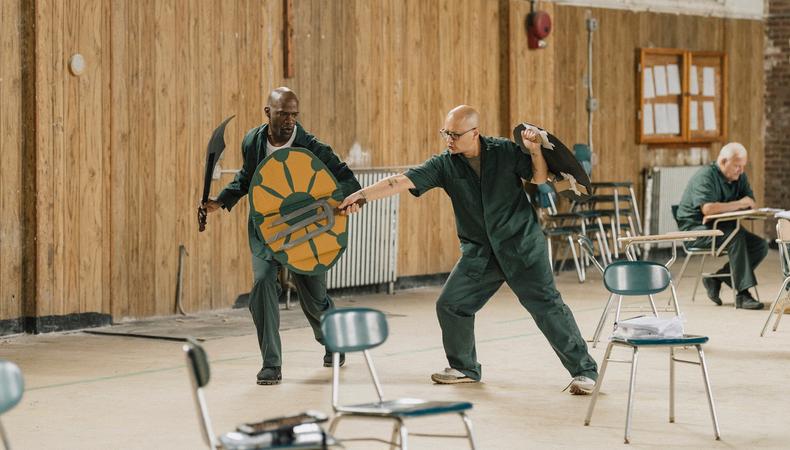
Theater has the power to transport actors and audiences whether it’s performed on Broadway, in a park, or in a prison. In “Sing Sing,” Colman Domingo stars as the wrongly convicted John “Divine G” Whitfield, a participant in the real-life Rehabilitation Through the Arts program. The Oscar nominee shares the screen with a host of actual RTA alums, including Clarence “Divine Eye” Maclin, who costars as a version of himself.
For costume designer Desira Pesta, working on the film meant conceiving both everyday prison uniforms and creative looks for the stage. “This was a dream project, because we had the research-based reality as well as the fun, tangible, crafty aspect,” she says. Here, Pesta discusses the unique experience of working on Greg Kwedar’s acclaimed drama.
How did you become attached to “Sing Sing”?
I was approached by Monique Walton, one of the producers, who had seen my work. She was on the jury for SXSW a few years prior, and a film I designed called “Summer Animals” was a jury award winner. So she saw my name there, and it was total happenstance. When I talked to Greg Kwedar, we connected about the fact that I’m a huge proponent of criminal justice reform; I’ve been a longtime supporter of the Innocence Project. Additionally, my sister is a psychotherapist for those who used to be incarcerated. It’s a wonderful story, and there are a lot of beautiful theatrical moments, but I think on a human-interest level, that’s where we connected.
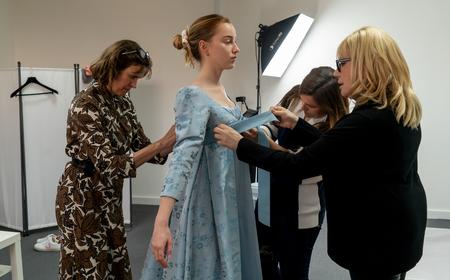 How to Become a Costume Designer
The film was shot over only 18 days. What was it like to develop Colman’s character with him in such a short amount of time?
He was super game. We had some quick fittings, but because I got his measurements, we talked through a lot of stuff prior [to filming]. Colman is a very gracious and open person, and he wants to hear what others think. I know he spent a lot of time with [the real] Divine G, talking through his life. He was a sponge about what made sense for the collective.
What was the process like when you were fitting the formerly incarcerated actors? Did you take steps to ensure that they weren’t re-traumatized by the experience of putting on prison uniforms?
Absolutely. I want the world to know what a giant step this was for anyone who was playing either a version of themselves or a different character within the prison system. I don’t think many costume designers have experienced [working with] actors who are being re-traumatized, and that’s something the producers and the filmmakers were super sensitive to. As somebody who is a voracious learner, I want to be as informed as possible. And I thankfully had my sister to glean from; she is a huge proponent of being trauma-informed.
Costume designers often [act as] psychologists and therapists; we have a lot of very intimate moments with people, and we need to have a sensitivity to the human experience and to bodies that other people on set don’t necessarily have. Going into fittings, [we had] conversations with Clarence Maclin and some other folks who had been in prison. It was a great learning experience for me and my assistant costume designer, Katharina Windemuth.
One of the most striking pieces in the film is Divine G’s purple hoodie, which he often wears during rehearsals. Is there a story behind that garment?
That is based on research; I have this beautiful photo of John Whitfield sitting at an RTA rehearsal in this vibrant purple hoodie that was very important to him. All the props to the actors, because we were shooting in 100-degree weather in an un-air-conditioned prison. I realized that at a lot of events that our director and producers have gone to, they wear purple. It’s been really cool to see how that color’s been brought through into our lives after filming, and I’m really happy that Divine G got his wish.
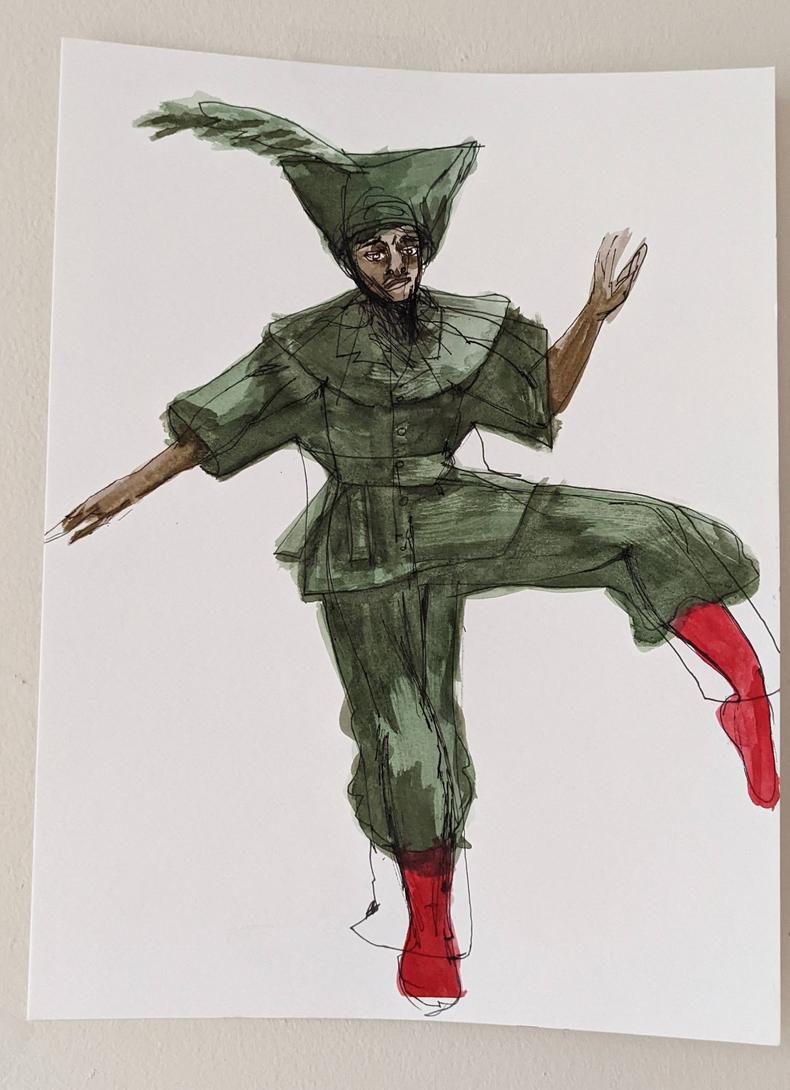
What was it like to create the costumes for the “Midsummer Night’s Dream” production that opens the film?
I love Shakespeare. I did a lot of Shakespeare shows in grad school, and my thesis was on “Henry V.” Ultimately, Greg wanted it to feel as though we were on the West End and that at the opening of the film, we have no idea where we are; but we know it’s a high-scale production with fabulous actors commanding the audience. Then we see them having to strip and remove their costumes, and we [find out] where we are.
The play the characters stage, “Breakin’ the Mummy’s Code,” was originally written and performed by real-life RTA members. How did you put together the costumes for the production?
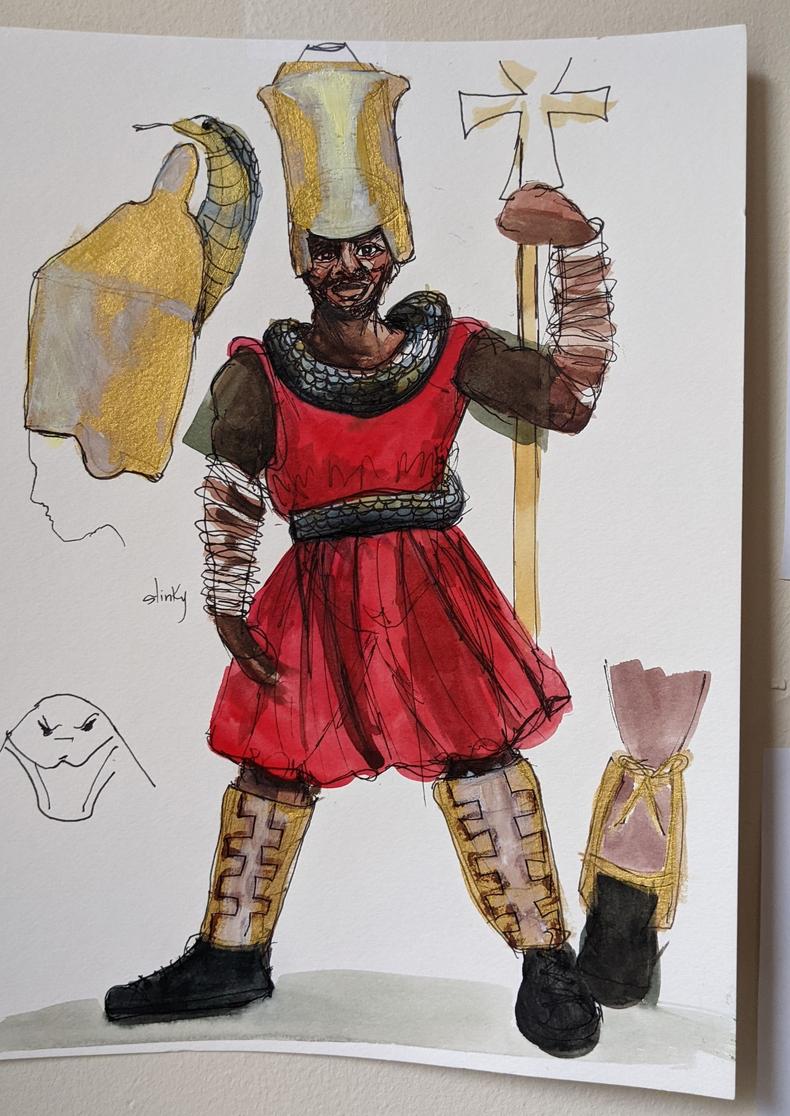
I was able to watch the entirety of the original “Breakin’ the Mummy’s Code” because they had it filmed, and we also have photos. Ruta Kiskyte, the production designer, and I wanted to lean into the creativity, originality, and finding the magic in theater.
We were looking more at black-box community theater: How do you take a piece of cardboard and imbue it with this power? It’s all about make-believe. We leaned hard into looking at the real stuff [the original production] did—anything ingenious we wanted to honor. And anything we thought might need a little bit of a cinematic lift we were able to do with movie magic.
Everything was practical. I wanted to use materials that were able to be grabbed within the prison system. The RTA, in its early stages, didn’t have the funding it does now. What was donated? What was brought from granny’s attic? What was found in a thrift store? We wanted to make sure things felt real. I also love making things by hand. I made a lot of costumes, and so did Katharina. [We did] method costuming, which means making something out of household materials, cheap stuff, [and other things that are] easy to access.
There’s a beauty and patina to theater costumes. I went to NYU for grad school, and we had a whole costume shop that has stuff from the ’80s, so you can tell something’s been worn 44 times—knowing there’s a giant zipper and there are rips and repairs and big seam allowances. What does that look like? I wanted to make sure that we did that. We had the great benefit of having access to the SUNY Purchase costume shop in upstate New York, which had supplied some of the costumes for the original production. We went there with [former RTA volunteer director] Brent Buell, who Paul Raci plays in the film. They were really sweet and gave us the ability to take 15 things, so we were really discerning.
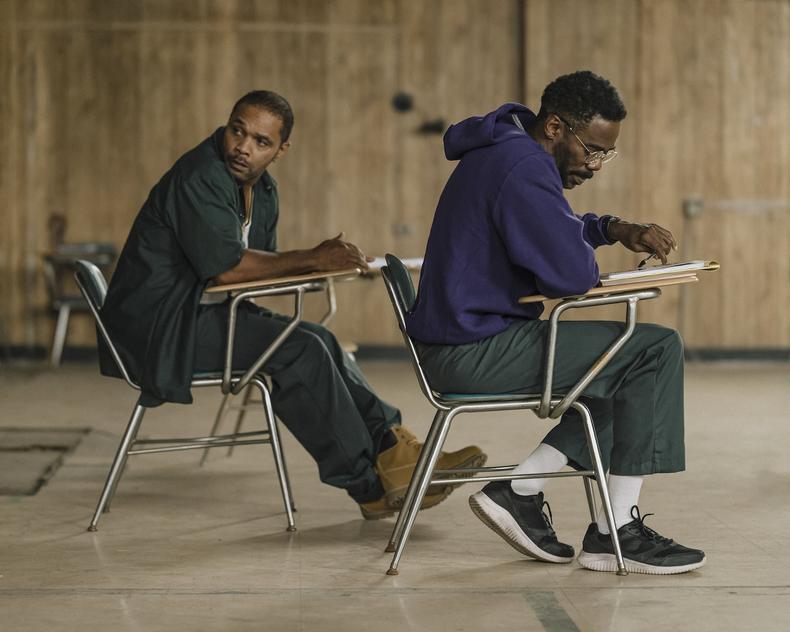
Clarence Maclin and Colman Domingo in “Sing Sing” Credit: Dominic Leon
In a recent Variety interview, Colman said that “Sing Sing” had a “very gentle set.” Would you agree with that description?
When you said “gentle set,” it made me really emotional. Not to be super cheesy, but we knew it was more than a film. Bringing these men, who I now call dear friends, together and [watching them] re-experience things and also find the ecstasy of being onstage was incredible. Brent was there every single day. I spent so much time with him. We would all stay at the same hotel afterward and would go out to the fire pit and talk. It was this intense bonding in a way that’s hard to put into words.
Because the subject matter is deeply hard to witness, we had a lot of real stories being shared on set, and there were a lot of unabashed tears. I think that’s what was gentle about it—that we were all loving and open and knew how hard this was [for the actors]. Speaking to those who’ve been on [other sets], you know how harsh conditions can be: loud voices, rushed circumstances, stress, bad behavior. This was a departure from that in a way that I hope other sets can [emulate].
Colman has also spoken about the fact that everyone who worked on the film received equal pay. Can you talk about that experience?
It’s so awesome to go into something knowing that a production assistant who is working their butt off—starting before us all, picking up the vans, cleaning up the garbage at the end of the night—is making the same amount as the producer and lead actor. I think that egalitarianism is essential. I’m not trying to get into socialism, but I think there’s a horrible hierarchy on [many] sets—so many people sitting in chairs and calling shots and getting $18 coffees. And then the people doing the hard lifting are not even making a living wage. I think [“Sing Sing”] is hopefully opening eyes as to how a film can be successful and how everyone can feel like they own a piece of it.
An additional benefit is that because of the success of this film, we’re all collectively getting checks that are tied to how many months or weeks we worked on this. I’m thrilled for the storytellers. I’m so happy, because they have been working so hard, and Brent volunteered at RTA for 10 years. We’re not rich, but the gesture is incredible.
Did you learn anything from working on this film that you hope to bring to your future projects?
I’ve always tried to be sensitive to actors, but I think “Sing Sing” was an immeasurable experience in sensitivity. Finding out what people wear in prison was so hard. I did so much digging. I love going down rabbit holes. If something seems impossible, there are books; you can go on Facebook; you can go on Flickr. I found a lot of information in internal Department of Corrections newsletters.
This experience taught me how to cull information from everywhere. I was able to ask the actors who had been incarcerated for firsthand information. I met a corrections officer, randomly, because her son was in a commercial I was doing, and I interviewed her. There’s so much to learn with every job, whether it’s interpersonal or whether it’s doing papier-mâché for the first time. I did a lot of the headpieces [for the stage scenes], and that was a blast. [It’s all about] learning new skills and figuring out things you might not know how to do.
What advice would you give to an actor coming into the fitting room for the first time?
One thing I find a lot is that people don’t know their sizes, or they’re afraid to share the real numbers. If you’re not quite sure, go to a tailor and get yourself measured. It’s really important, because oftentimes we’ll have no prep, and then we’ll get an actor, and maybe you’ll have to have them on set that day, and we didn’t get the right sizes. It happened to me recently, and it sucks for everybody involved.
If something’s bothering you, something’s itchy, something hurts, don’t be a tough person and be like, “Oh, no, I’m good. I’m good.” Make sure you tell us. Additionally, I think with a lot of modern clothing, it’s very loose and comfortable. With period clothing, it’s funny how many actors are like, “This doesn’t feel good.” I don’t even mean a corset. I just mean a good pair of trousers. Recognize that fashion has come a long way: We walked differently, we had different undergarments. It’s all hopefully going to inform the character, so harness and embrace that if you can.
This interview has been edited for clarity and length.
This story originally appeared in the Jan. 30 issue of Backstage Magazine.