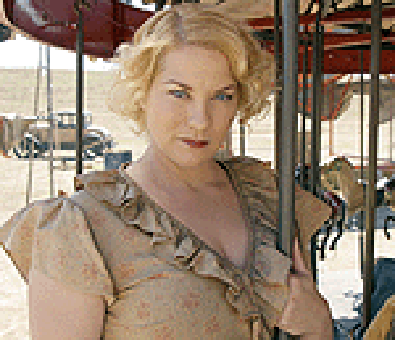
Watching the cast of Frasier tackle one of its classic show's nimble scripts is like a lesson in great ensemble casting; the five principles blend beautifully, a perfect comedic symphony of complimentary notes, beats, and crescendos. The cast chemistry is so spot-on, you almost don't notice it. But if things had worked out just a little differently, that celebrated chemistry might not have turned out just so.
At this point most showbiz vets know the story: The role of Frasier Crane's acerbic producer Roz, a part that Peri Gilpin wore like a well-tailored suit for 11 seasons, was originally given to Lisa Kudrow. During the rehearsal week it became apparent that Kudrow didn't quite fit in with the other pieces of the puzzle, and she was replaced with Gilpin. Of course Kudrow eventually found a home with the equally well-balanced Friends ensemble, but beyond that happy ending, this story illuminates what can be a devastating situation for actors. What do you do when you're cast in a pilot, when you can taste the fame and fortune a successful television series might bring ... and then you're replaced?
First of all it's important to understand the reasons for recasting. They are many and varied and include cast chemistry, script rewrites, and the complex issue of certain players just not testing well. In many instances it has little to do with acting talent. "I don't think I've really quite experienced [a recasting situation] where they've decided, 'Wow, this person isn't talented enough,'" says Joey Paul Jensen, a casting director who's worked on the Disney Channel shows That's So Raven and Even Stevens. Jensen cites a recent series she worked on, Phil of the Future, as an example. "The original story had a caveman in it. Their first instincts were that they wanted to go with a very large man," she says. "We hired Tony Longo, who's about 6-foot-7, to play the caveman. Then after they did the pilot, they felt that they wanted to go a different direction. They weren't even sure if the caveman fit the series."
The caveman eventually went back in, but the part was recast. "Instead of a big, tall guy, they went with a smaller, slighter actor: J.P. Manoux," says Jensen. "They found that, story-wise, that was a better fit. It had nothing to do with Tony or Tony's performance."
Jeff Greenberg, the casting director for Frasier, says that many times it's not a matter of good acting--it's a matter of good casting. He tells every fired actor the Kudrow story as a way of illustrating this point. "I say, 'Lisa Kudrow was fired off of Frasier, and it didn't mean she wasn't good--it just meant she wasn't right,'" he says. "Sometimes people aren't good, but sometimes they aren't right. That's the thing that's important to know and really hard to understand. Having been an actor myself, when you don't get the part or you're fired, you only think it has to do with you not being good enough. But sometimes that's simply not the case."
After all, a pilot is a difficult beast to begin with. It's tough to get a complete picture of a show until all the elements are assembled, which they often aren't when actors audition. Such was the case with Kudrow as Roz. "In the eight-day rehearsal week, we had a test audience about three days before we shot the show, and at that point all the elements were put together," says Greenberg. "It seemed very apparent to those involved that the way Lisa was playing the character--which was exactly how we wanted her to play it and why she was hired--[was] not balancing the scenes with Frasier at home, all the conflict with his dad. Kelsey [Grammer] as Frasier is the funniest when he's really in conflict with someone.... It seemed we needed more conflict there to balance the scenes at home."
Because characters are often still being conceived and fleshed out during the shooting of a pilot, sometimes it's difficult for producers to articulate exactly what they want--they just know it when they see it. Ellie Kanner, a casting director who worked on the pilots of Friends and The Drew Carey Show, recalls how difficult it was to find the right actor for the role of Mimi, Drew's vindictive workplace nemesis. "There was an actress playing the part of Mimi, and she got replaced because they didn't know what they wanted, but it just wasn't working," she says. "They just said, 'Bring in some more people.' So the week they were shooting, I brought in some more people. Kathy Kinney was one of them, and she brought in her own persona, her own character, and brought it in a different direction. That's what they wanted, but they couldn't articulate it. They couldn't articulate it enough to ask the actress to do what Kathy Kinney did."
In addition, there are often a number of people--from the network to the producers to the studio--who have veto power. "There are layers and layers of people whose decision-making abilities are a part of the team that makes the final decision," says Jensen. "And the personal opinions of all those people can differ greatly."
Cynthia Ettinger, a longtime member of The Actors' Gang and part of the diverse ensemble cast on HBO's Carnivale, got a taste of this firsthand when she won the part of Clark Kent's doting mother Martha on the WB's teen Superman series Smallville. "When I got there, I could just tell that everyone had different ideas about what the character was, and I felt like they all had different ideas about what the perfect mother was," she says. "The writers, producers, director--one of them would say, 'She's supposed to be funny!' Then they'd [say], 'Now you're too sarcastic--she's supposed to be sweet! But she's supposed to be strong!'"
After the pilot was shot, Ettinger was replaced with Annette O'Toole; the powers-that-be said they didn't feel that her look and persona were right for the character. Though Ettinger agrees that the role wasn't the best fit, she has one regret: "What I should have done was just get them all in a room and say, 'Hey, I feel like you have all these different ideas [about the character], but you did cast me," she says. "Let me just do my thing.'" Though she realizes that losing the role probably had nothing to do with her as an actor, Ettinger says she would have felt better if she had spoken up. "What I would have felt better about is taking care of myself," she says. "The depressing part was not necessarily getting fired but that I didn't take care of myself in the situation."
Brian Haley, an actor and popular standup comedian, was cast in last season's short-lived The Brotherhood of Poland, NH, only to be replaced by Chris Penn. He echoes Ettinger's sentiment: When you're an actor on a pilot, it's crucial that you look out for yourself. "When you're doing a project, you must not please anyone but yourself," he says. "You cannot. There are too many people who are trying to get you to please them on a pilot, and they all want their way, and they don't know what is best. You are the only one who knows what's best, and if your best is not good enough, then you're not right for that part. But if you are going to succeed at that part, you have got to do it your way. No one got into Tom Hanks' head and told him how to do Forrest Gump. You can't teach someone how to do Forrest Gump; that's got to come from within you."
This lesson, adds Haley, isn't always easy to learn. "When [I] do a pilot, I don't know what happens, but I find myself constantly caving in to try to make things work," he says. "'Let's just make them happy, get this thing rolling, and then I'll have my way after the series gets rolling. I don't want to rock the boat.' That's constantly in the back of your head, and you've got to exorcise that demon and go forward and do what you think is right, what you think is best. That's what they hired you for."
In some cases it might even be possible to fight for your role. After the pilot for The Brotherhood of Poland, NH, was shot, it was decided that it needed retooling. Haley's part was rewritten, but producers granted his request to re-audition for the role. He didn't get it. But sometimes actors successfully win back their parts. Greenberg points to another series he worked on, last season's It's All Relative, as an example. "I didn't cast the pilot, but I ended up casting the series," he remembers. "They wanted to replace Paige Moss, who played the sister. The network didn't care for her, but we loved her. They thought she looked too harsh. We had her come in and test again at the network, and we really softened her look--hair and makeup and wardrobe. And she won her own role back."
Jensen experienced a similar situation with Shia LaBeouf, the young actor who played the lead on Even Stevens and recently generated some buzz for his performance in the Project Greenlight movie The Battle of Shaker Heights. After the pilot for Even Stevens was shot, some thought that LaBeouf might not be the right actor for the role. Jensen, however, felt strongly that he was. "I said [to his agent], 'Please, just let him know: I'm the person who's seen everybody come through the door, and I still believe that he's the one. So please tell him to get the emotion and his ego out of the way and go back in there and vie for his job and prove it.' And that's what he did."
LaBeouf's commitment to the role impressed producers, which brings up another point: Even if it turns out that you're not right for the role, it's key that you give your all every step of the way. After all, you can be replaced at any time. Kanner remembers one situation in which a well-known actor was hired to do a pilot. She went through a series of auditions and nailed all of them. But when it came time for the table read, something was off. "She just sort of walked through it," says Kanner. "Even though it was just a table reading, there were network and studio executives there, and she didn't sell it. And because of that they ended up replacing her. She was more than capable of doing it, but they got nervous."
In the event that you've done all you can, worked your hardest and fought for your role and you're still being replaced ... well, it's time to move on, something that may be easier said than done. Still, it is possible to come away from this experience with a positive outlook.
First off, Jensen recommends inquiring about the reason for the change. "I think it's important to know, if it's possible to find out, the change of direction and why," she says. "If it is a reflection on the actor's work, then I think it's important to know that, so that one can try to adjust that in their work or expand their craft to compensate for that in the future. If that is not the reason--I think most of the time, that is not the reason--then I think there should be some confidence in knowing that the people who put them into that part will remember them in the future and will keep them in mind for other upcoming projects."
For Ettinger, moving on involved some soul-searching and a return to her roots. "I threw myself back into the theatre. I did shows for a year," she says. "I really just thrashed myself silly in the theatre. And then I felt resilient and ready to go back out into the world." Ettinger encourages actors who experience something like this to do the same and to remember that in most cases it's not about your ability as an actor. "Go back to where you are safe and comfortable, which is what I did with the theatre," she says. "But also think about the times you've had to reject something or someone, and realize that you still have compassion and love for that thing, even though you don't want it in your life. By doing that I was able to say, 'Well, it doesn't really have anything to do with me,' just like if I say, 'I don't want you to be an agent.' It doesn't mean I hate you, it just means I'm in a new place and I feel like Smallville was in a new place. They got what they wanted [for the role], and I think it's perfect. I don't ever look at that show and think I should be on it--never. Not for one moment."
Haley recommends doing whatever you need to do to stay positive. "You've just got to keep a positive attitude," he says. "Realize, even if it's personal, it's not personal. Keep your head up and keep going. You just try and [think], 'What did I do wrong here?' Learn from your mistakes and move on."
It's also important to remember that this is a necessary, if unpleasant, element of show business. "In many professions people get fired and sometimes for reasons that are not fair," says Greenberg. "I just think you have to find a way to deal with it. It's devastating and it's not easy, but if you want to stay in the business, you have to suck it up; you have to deal with it. You have to somehow get over it and move on. You have to find a way to not let it destroy you. If it does destroy you, it's the wrong business for you."
After all, others feel your pain. "I had heard for years that you're really not in the club until you get fired from something," says Ettinger. "It's kind of like auditioning for something a bunch of times and then not getting the part. It's a drag, but it's not the end of the world, and it doesn't mean you're a bad actor; you're just not right for that part. It's the same exact thing; it's just on a bigger scale."
Though it may be hard to believe at the time, being fired from a pilot isn't always a bad thing. Actors shouldn't feel pressure to take a role that doesn't feel right, says Haley. "You don't have to take work in a pilot. It can be very limiting, very constraining. That's something to weigh when you're taking a pilot. I passed on taking a fantastic part on Broadway to get the part in Brotherhood of Poland. In hindsight, I really wish I had done the Broadway thing." Still, Haley has moved on from the experience. He recently finished filming an episode of Law & Order: Criminal Intent, and he is currently hard at work retooling his standup act as a one-man show.
Greenberg says you also need to realize that sometimes being fired from a pilot can be serendipitous. "You just have to know that, in retrospect, this is all for the right reason," he says. "Maybe this makes you available for a role that will be all that much better, a la Lisa Kudrow."
That's certainly true for Ettinger, who adores her role as sultry Rita Sue on Carnivale. And, unlike Martha Kent, she feels this part is tailor-made for her. "People say to me, 'Do these people know you? My God! How did they know you could do this?'" she says. "I had one audition, and it was a miracle, and that's it. So I feel like there really is divine intervention. I couldn't be happier with the job I have now." BSW