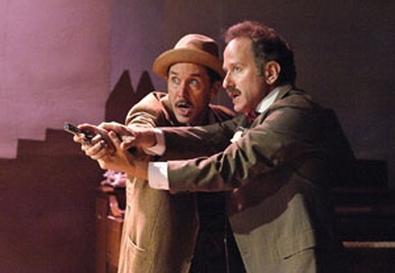
Photo Source: Jacob Goldberg
Our hero and heroine are teenagers Ned Nimble, a humble newsboy, and his older sister, Flossie, a counter girl at the lunch stand owned by the redoubtable Mother Murphy, the unofficial guardian of these two abandoned children. Ned is determined to find their lost mother, who gave them away as babes to take up with the suave but evil Prince Charlie, who, unbeknownst to her, framed her husband, Albert, for a crime that Charlie committed. The sexually voracious Charlie soon dumped her and moved on to a succession of greener pastures. Seeing the error of her ways, she assumed the pseudonym Gertrude Clark and went to work as a private nurse to Old Montgomery, a rich tycoon whose sole heir is his nephew, who just happens to be Charlie. Also in the mix are Flora Bradley, a former actor who is posing as Charlie's English wife to give him a veneer of respectability in his uncle's eyes, and the vicious Chinese Sam, a "dog doctor" whose offices are near Mother Murphy's stand.
The plot begins as Albert leaves prison and Charlie accidentally meets and develops a yen for Flossie, though unaware of who she really is. The incident-packed tale has all the standard melodramatic flourishes: lightning reversals of fortune, kidnappings, gun battles, impossible coincidences, endangered virginity, noble appeals to religion, freighted asides, and of course a happy ending. It's a show in which the villain actually says things like "I have you in my power" and "Bah!" and identity can be concealed behind a pair of dark glasses. Roe's smart and sly helming both honors and sends up the material, and while some comic rhythms had yet to fall into place at the show's third preview, I have no doubt the bumps will quickly be ironed out. Roe has also added a surprisingly effective conceit of having the characters sing the opening and closing lines of some scenes (and has written his own music to boot). These moments locate the honest emotion that audiences of the day would have found in the material, giving the show sweetness and heart.
It's easy to see how the perpetually cheerful and relentlessly naive Flossie could have been a star-making role, and snappy Erin Leigh Schmoyer goes straight for the goods in a thoroughly winning turn. Paul Bomba is an excellent Ned, wisely underplaying the character's strident morality while giving off a whiff of street tough in a performance eerily reminiscent of the young Martin Scorsese. Tod Mason is persuasively smooth and menacingly effete as the dastardly Charlie, while the commanding Claire Warden is brisk, bad, and very funny as Flora, his faux spouse. Everybody contributes good work, but other standouts include Carol Lambert's spunky Mother Murphy, Peter Judd's crusty Old Montgomery, Ingrid Saxon's wide-eyed Gertrude, and Erwin Falcon's raucous, political-correctness-be-damned Chinese Sam.
"From Rags to Riches" is not as interesting or resonant as some of the other plays Roe has unearthed, and its blatant anti-Chinese bigotry strikes some sour notes. But if you are in the market for a loving and intelligent evocation of a once-classic American art form, then hie thee to Metropolitan Playhouse.
Presented by and at Metropolitan Playhouse, 220 E. Fourth St., 2nd floor, NYC. Sept. 23–Oct. 16. Wed.–Sat., 8 p.m.; Sun., 3 p.m. (Additional performance Sat., Oct. 15, 3 p.m.) (212) 995-5302 or www.metropolitanplayhouse.org.