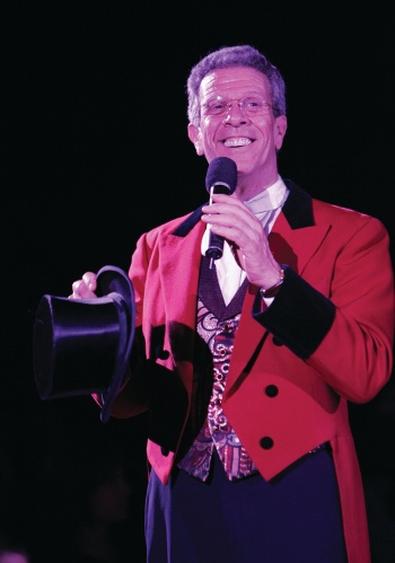
The Big Apple Circus’ founding artistic director Paul Binder served as ringmaster for more than 30 years, and is the author of the new book “Never Quote the Weather to a Sea Lion: And Other Uncommon Tales from the Founder of the Big Apple Circus.”
What does performing as ringmaster entail?
I was in the Dartmouth Players in college, so I studied acting. But the ringmaster is a very specific role. For one, you’re holding a microphone all the time, and working in the ring is the extreme of theater in the round. It’s almost 360 degrees. It is the classic form of theater, [going] back past the Greco-Roman theater to tribal rituals out of which all the theater grew; it was virtually always done in a circle. So [in the circus] we trace our roots back to the original theater. Once I was in it I took the time to do the homework and understand that wow, this is powerful stuff.
How did you initially get involved in show biz?
I was a theater rat—I couldn’t leave. I just had to be near that stage all the time.... My first job out of Dartmouth was as floor manager for “The French Chef” with Julia Child—an incredible job. We did two shows a day: The morning show we taped would be the main course, so we would eat it for lunch. And then in the afternoon she would do the dessert. I would go home with bags of food! Eventually I went to Columbia Business School looking forward to the possibility of working in show business. When I graduated, I got a job right away with Merv Griffin Productions, which led me to become associate producer of “Jeopardy.”
What prompted your interest in the circus?
I had three days in San Francisco with nothing to do and I happened to come across the San Francisco Mime Troupe doing a performance in Golden Gate Park. They did and still do outdoor theater [with] stages set up in parks in the Bay Area, commedia-style stages. I was blown away by the performance. They were doing very active political theater in commedia style, very clever. And I said, “All I want to do is be in that company.” So before I left town I did an audition for them and they gave me the job. I gave notice, packed my bags, left New York, and ended up in San Francisco. And that’s only the beginning of the story!
How did mime inform your career?
It was good training because we were working outdoors in the park. We had to be on top of the game to keep the audience. They weren’t paying admission; they were just gathered together sitting or standing. It demanded really intent focus and a clarity of presentation, which came in handy later on. I took an act with a partner named Michael Christensen. We took a juggling act, flew to England, and traveled on the streets with that act all the way from London to Istanbul. And we made our living that way! Everywhere we went, we set up our circle on the street and juggled. We arrived with virtually no money. We eventually worked our way back to Paris and were discovered on the street by the booker for the Casino de Paris, which is a wonderful music hall.
How does one go about steering their career like that?
I carved my own path but it was always something that suddenly emerged. I’d be working at something—bringing my passion to it, very important—and somehow because of that, what would emerge is something else that says, “Follow this, this looks like it might be great.” Another way to put it would be, people with passion recognize passion, period.
What can we expect from your book?
It’s got a foreword by Glenn Close. Glenn was in the original cast of “Barnum.” The Big Apple Circus had been hired to train the company in circus skills.... She wrote about how terrified she was to juggle all by herself. I had the opportunity to teach her to do it. I don’t have to tell you how good an actor she is. She’s just a gem.
What advice do you have for performers, in the circus or otherwise?
If you’re a writer they’ll say write what you know. That’s true for any artist, performing artists included. Be yourself; start with whoever you are. My character in the ring, Mr. Paul, was me but writ large. I was always myself and allowed myself to be seen by the audience, but there were costumes, makeup, and very good lighting, so I was able to create myself in a theatrical way. It’s really about being comfortable in your own skin. And no matter what the character is, make sure you’re bringing yourself to it.
Is that what you look for in performers?
We’re looking for people who seem honest and who are able to make contact with their own honesty. If you’re doing a triple somersault, it’s a little harder to make eye-to-eye contact. But still, there should be a sense that the audience knows who you are, that you’re not behind an impenetrable mask. You have to be who you are and then push it through the screen of the character or situation. First get to know yourself. It worked for me.
Like this post? Check out more of our Inside Jobs!