Over the past year or so, Andy Greenwald has had to master the art of existing in multiple timelines at once. It’s a skill they don’t teach you in First-Time Showrunner School, but there was a point last summer, Greenwald explains, when he was simultaneously rush-editing Episode 2 of his upcoming USA crime drama “Briarpatch” for a screening at the Toronto International Film Festival, block shooting Episodes 5 and 6, preparing to film Episode 7, rewriting Episodes 8 and 9, and writing Episode 10.
Keeping all of the plot points straight and remembering what the characters in the off-piste murder mystery know (and didn’t know) at all those various points in the story was, Greenwald says, one of the biggest unexpected challenges of helming the TV show.
READ: What It’s Actually Like in a TV Writers’ Room
The other stuff—having to manage a legion of creative and technical people; making sure everyone’s voice was heard and that they harmonized in the end product; being responsible for every single detail of production—he was prepared for all of that. As an entertainment journalist for glossy magazines like GQ and Spin in the early aughts, Greenwald had the opportunity to pick the brains of some of the most influential creators in TV. He became friendly with “The OC” creator Josh Schwartz and wrote two scripts for Schwartz’s short-lived 2009 web-series, “Rockville, CA.”
He put his TV writing dreams on hold, however, to write about television for ESPN’s sports and pop culture site, Grantland. “I felt pretty church-and-state about it,” Greenwald explains. “If I was going to be writing about these people and interviewing them, I did not feel it was appropriate to also pursue a career with them.”
Still, Greenwald insists this period was the best education an aspiring showrunner could have. He learned to appreciate the interconnected nature of the business through the lens of the shows that actually get made. He also watched as the rise of streaming services led to an explosion of content, all of it competing for viewers’ precious free time. “It made me realize that if you are arrogant enough to try to get people’s attention, you’d better consider what it is you’re presenting to them,” he advises. “You’d better sharpen your ideas, and you owe it to them to be entertaining.”
When ESPN shut down Grantland in 2015, Greenwald landed a gig in the writers’ room of Noah Hawley’s mind-bending X-Men spin-off “Legion,” while podcasting for Grantland editor-in-chief Bill Simmons’s new venture, The Ringer.
READ: What it Takes to Be Successful in TV Writing
Of course, the idea for “Briarpatch” predates most of this. Greenwald discovered (and devoured) the Ross Thomas crime novels on which the series is based around 2004. “I have long thought that it is a crime that he is underappreciated,” he says of Thomas. “If you go back to the Grantland archives, there are multiple examples of me begging people to make shows of these books. No one took me up on that, so I had to do it myself.”
Greenwald admits that while “Briarpatch” may not actually be his favorite of Thomas’ books, it struck him almost immediately as one of the most adaptable. “Because it was relatively straightforward, it felt like the most malleable of his books,” he says. “I thought it would be a fantastic spine to put different kinds of muscle and sinew on top of.”
The important thing when it comes to adaptations, according to Greenwald, is to remember that whatever happens, the original work still exists. “Adaptations get into trouble when people feel so respectful and worshipful of the original material, they forget to do something that’s worth doing on its own,” he explains. “I love Ross Thomas’ ‘Briarpatch.’ I wanted his spirit and tone to be in every frame of the show. But I also didn’t want to limit myself to that story.”
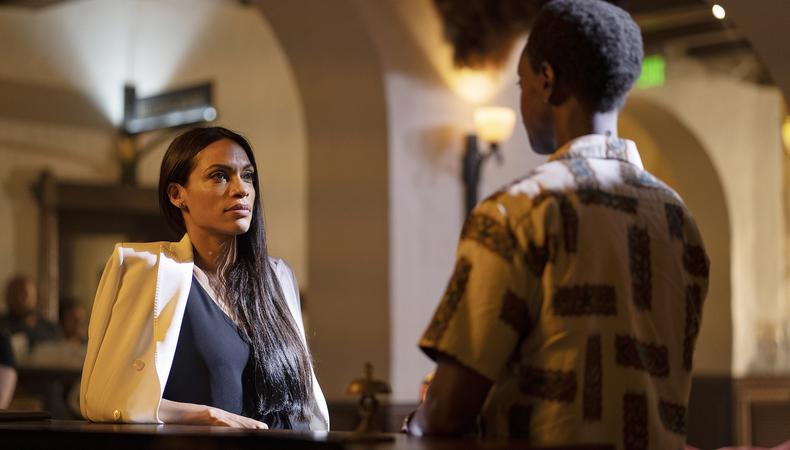
Greenwald’s biggest change was the show’s lead character. Thomas’ novel follows Benjamin Dill, a hard-nosed Washington insider who returns to his quirky Southwestern hometown to investigate the death of his sister. Greenwald knew from the start that he wanted his version to focus on a woman. Casting Rosario Dawson, a woman of color, as Allegra Dill opened up even more possibilities for storytelling.
“Doing colorblind casting was important to me. I just think it’s important in general,” says Greenwald, who also staffed the show’s writers’ room with women and people of color. “Every decision is political, so I don’t want to call it political. But it’s as much [me] hoping to make a show that better reflects our world—which is important and is a priority for me—but also, selfishly, look what it does for story! It just makes the story more exciting, and we’re able to spin it in so many more directions.”
Ready to get to work? Check out Backstage’s TV audition listings!