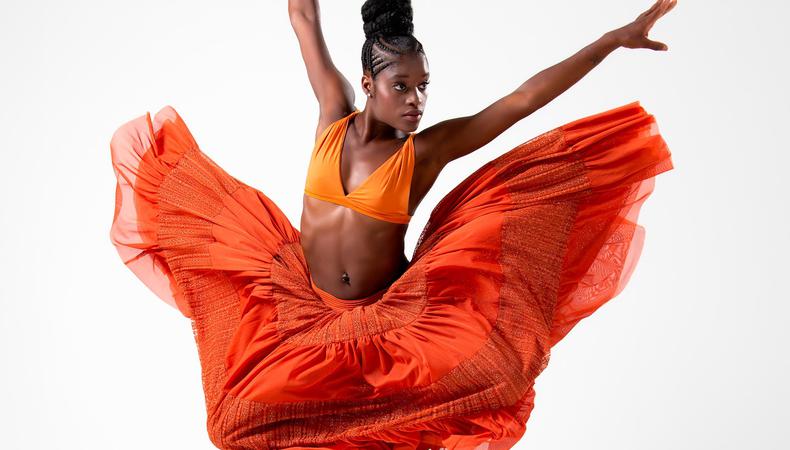
If you’re anything like us, you may have started following ballet accounts on Instagram during the pandemic, assuaging your longing for live performance by watching dancers jeté and pirouette across your phone screen. But one account in particular, Blacks in Ballet, has been doing much more than celebrating the beauty of bodies in motion. It’s the social media arm of an organization, founded in 2020, that’s dedicated to highlighting and celebrating the work of Black dancers across the world, as well as providing educational resources and opportunities to underserved community organizations and kids with a passion for dance.
Blacks in Ballet co-founder Ingrid Silva is a Brazilian ballet dancer and activist who’s a longtime member of Dance Theatre of Harlem. She also established EmpowHer New York, a platform that connects womxm with one another and supports their work across a variety of disciplines. In 2019, she and dancer Misty Copeland spearheaded a movement to make brown-tinted pointe shoes more readily available. And if that all wasn’t enough, Silva also has a memoir coming out this August that she wrote during the pandemic. Backstage spoke to Silva via Zoom about Blacks in Ballet, why representation is vital in dance, and how the ballet world has (and hasn’t) changed in the years since she started her career.
 How To Become a Dancer
 “Ballet is predominantly white, and that’s how it was created. I feel like it has evolved a lot—but in different places, in different companies, not as much. And we need to see the change in general.”
How did Blacks in Ballet start, and what’s the organization’s mission in a nutshell?
So Ruan Galdino and Fábio Mariano are the cofounders, [and they’re] also both dancers. Ruan has been my close friend for a while, and so has Fábio; we performed together at Dance Theatre of Harlem. We saw so much happening and changing in the dance world. And the three of us are Brazilian, and there is a huge lack of representation in dance in general in Brazil. And I wanted to create a project that would reflect what the future should look like, and also what the now should look like. Because we have many organizations and many places talking about diversity, but they’re not doing the actual diversity [work] in those places. We see one person here and there, and that’s not enough. So we had this conversation. I dance at Dance Theater of Harlem, Fabio dances at Collage [Dance Collective, in Memphis], and Ruan dances in South Africa, at the Johannesburg Ballet. And in our companies, we see a lot of diversity. But we were thinking, for all these kids coming up, if they don’t see what they can be, it’s going to be extremely hard for them. Like, if you didn’t know me, and we would be sitting together, and I’d be like, “Hey, I’m a ballet dancer,” people often get, like: “Oh, you’re a ballerina?” It’s not normal for them to see a Black ballet dancer, in general. So the concept of creating [Blacks in Ballet]—it’s a digital platform, but it’s also a source of finding dancers from all over the world. We just don’t feature Brazilian dancers; we feature global dancers, and we make so many actions.
What kind of actions has Blacks in Ballet organized recently?
We created a workshop with Ruan teaching ballet and Dionne Figgins teaching Broadway dance to a group of 50 kids who couldn’t afford dance classes because of the pandemic. We got together with the United States Consulate of Brazil and provided those classes to these kids. But also, we have been helping communities of dance in schools and dance projects who cannot afford or can’t survive what’s going on now to raise funds. We’ve been doing a lot of that. And we’ve been providing classes too, on the side…. We’ve been growing more and more, and the idea is to keep doing it—keep supporting, creating scholarships, giving opportunities. That’s the main point.
That all sounds like really vital work. I’m sure the world of ballet can feel really closed off, especially to communities of color.
I mean, ballet is predominantly white, and that’s how it was created. I feel like it has evolved a lot—but in different places, in different companies, not as much. And we need to see the change in general. I’m pretty sure now, companies have more talks about diversity than anything else. But it’s something that should be done without people talking about it, because it’s common sense. But I feel like you always have to shed light on things that you look at and you’re like, “Mmm, this doesn’t work. This does not reflect the rest of the world.”
Do you see meaningful change starting to happen in the ballet world at large?
Right now, with the pandemic, I don’t think I can give you a concrete answer, because no performances are happening. But I would say about brands—when you talk about brown pointe shoes, when you talk about brown tights, brands, in a way, make it difficult to have that diversity and inclusion. If we go to the store today, you probably can get your pink pointe shoes, but I can’t get my brown pointe shoes right away. I have to order, and then it’s more expensive than the pink. And what kind of diversity and inclusion is that? I mean, it’s just a different color material…. So I think that not every brand that says that they are welcoming, or that they’re making changes, is [actually] versatile.
What’s the culture of ballet like in Brazil versus in the U.S.?
I am originally from Brazil, and as diverse as the country is, there is not much diversity in the dance community. I had to leave Brazil and come to the United States to pursue my dreams, to pursue my career, to get recognition. And when I go to Brazil now, everybody’s like, “Oh, wow, that’s Ingrid Silva.” But I’m like, “I’m from here!” I could have done all of this here if they were ready for me. And as crazy as it sounds, even though I’ve been living in the States for 13 years, nothing there has changed. They’re so old-minded. Dance has changed.
Take America as an example: We have the best companies here. A lot of companies are changing to brown pointe shoes and skin-colored tights. Why do we always just have to be in pink? What kind of tradition is that? That’s the same as with the body type, you know? I believe it’s really beautiful to be skinny, long, [and] have all these lines, but you shouldn’t get sick for all of this. So I think it’s about breaking the cycle in the culture that we have in ballet. The history of ballets, when you look at them, you’re like, “Oh, wow.” You have people painted, and they were playing slaves in this historical thing? It’s crazy.
You’ve been a member of Dance Theatre of Harlem for many years. How has being in that company affected you as both a dancer and an activist?
Being in the company has been revolutionary for me. Honestly, it was the first time I saw dancers that looked like me. I think [Arthur] Mitchell did a wonderful job breaking barriers when he founded Dance Theatre of Harlem, because, back then, it was about proving that Black dancers could dance. And now it’s more about bringing dance to everyone, because that’s how it should be. Dance Theatre of Harlem is one of the most diverse companies in the dance world. We have dancers from Brazil, we have dancers from Cuba, Haiti, Korea, Mexico, all in one company. That’s really beautiful, because it reflects so many people in the audience. This is what dance is about; you want to go to something and you want to feel something, [and] you want to see yourself, maybe. And I think feeling motivated [by] seeing yourself onstage—it’s beautiful.
Ready to get to work? Check out Backstage’s dance audition listings!