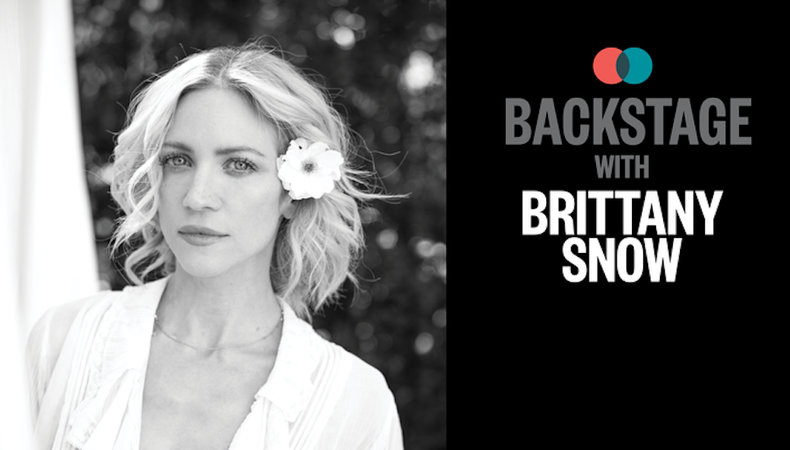
2025 is Brittany Snow’s year. Best known for her roles in the “Pitch Perfect” franchise and the 2000s revenge rom-com “John Tucker Must Die,” the actor is showcasing a new depth to her craft. Stepping away from her girlypop ensemble past, Snow is dominating the television landscape with a series of hard-hitting, dramatic performances. From playing a socialite caught in a web of obsession, seduction, and murder on the Netflix sensation “The Hunting Wives,” to a determined journalist on Hulu’s true crime miniseries “Murdaugh: Death in the Family,” to the wife of a suspected killer on the Netflix thriller “The Beast in Me” (out Nov. 13), Snow is proving she can command the screen in darker roles. It’s a bold new chapter that’s nothing short of a stunning career resurgence.
In conversation, Snow is refreshingly grounded, a quality you might not expect given the high-stakes world of Hollywood she navigates. Here, she discusses her secrets to maintaining balance, her preparation for embodying complex characters, the crucial work of intimacy coordinators, and how “Pitch Perfect” reignited her passion for acting.
You’re in three of the biggest TV series of the year. How do you stay grounded during periods when it feels like you’re constantly on the move?
I think it’s because I feel like this is all happening really quickly, and I understand the ephemeral nature of the whole thing. And the feeling that what really matters is my family back home. On one hand, I’m with my dog and my friends and picking out wallpaper for my house. I guess that’s what keeps me grounded, is that there’s a lot of balance. I’m older now, and I sort of feel like I can maintain that balance.
“The Hunting Wives” took everyone by surprise. The series is quite spicy. How did you prepare for the role of Sophie O’Neil?
I did a lot more mentally than I did anything physically, because I knew that it was going to be a challenge for me to show up as not only my best self, but someone who was going to be bold enough to make those big choices in terms of the intimacy scenes or leading a show with Malin [Akerman, who stars opposite as Margo Banks].
I felt really up to the task, because I think I had been emotionally and mentally training for something like [Sophie’s role] for so long. Not like in the gym, but as part of my therapy. I prepared with just a lot of confidence that I knew I could pull this off. And it was so much fun. I took it really day by day and just leaned into being present and having so much fun with the character.
You’ve credited Lizzy Talbot, the show’s intimacy coordinator, for helping with those steamier scenes.
I’m so glad we get to talk about Lizzy, because I don’t know if we could have done any of those scenes without her. She was such an advocate for us, in a way where she was very specific, and really had to be our eyes and ears and our lens into what the shots were going to be and how it was going to be portrayed.
When you’re acting in those types of scenes, you can’t be worried about whether your body looks strange at this angle, or if you’re going to not be happy with the way the shot makes your leg look. Just having someone that you trust looking out for you… and also the specificity in which it takes to feel safe. Knowing what you’re showing, knowing what the scene is, knowing how you need to move in certain ways—that was all so at the forefront of all of our conversations.
A lot of actors are nervous about filming those types of scenes. What have you learned that would help someone be more confident playing a role that requires intimacy?
I think an intimacy coordinator is really important because it takes the pressure off of you, [so you don’t] overcomplicate the process. You have so many other things to think about, and your job is to be that character and be in the scene and be really present and listening. And I know for me, I was very worried about my brain being in two places and having to be like: What do I look like? Is this going to be OK? Oh my gosh, what am I doing? And then also having to be in the scene.
So it takes that dynamic out of it and lets you just have fun. And that’s what Malin and I did. We’re with each other, and that’s what intimate scenes are supposed to be; [they’re about] connection. And so I would say to advocate for yourself. If you don’t have an intimacy coordinator, you can definitely ask for one, as you should. Especially as a woman, you need to feel so safe.
What goes into working with an intimacy coordinator?
Lizzy was our eyes when it came to the intimacy scenes, telling us, “OK, you’re not going to be happy with this. Maybe move your body in this way.” And making sure [actors] feel safe—and feel empowered. Because it’s a scary thing to put yourself out there like that.
I’ve spent a lot of my life—and I’m very vocal about this—not being very confident in my body. I got to my mid-30s, and I was like: This is the time when I have done so much work inside to be confident, and I want that to show through. An intimacy coordinator really makes sure that happens, that you’re making the right choices for yourself.
On “The Hunting Wives,” your character presents a polished, poised facade at first, but we quickly learn there’s a whole other person underneath. Was there a difference between playing Sophie as she presents herself on the surface versus playing her as she truly is?
Definitely. I talked a lot with [series creator] Rebecca Perry Cutter about how [Sophie] is sort of like a caged animal who has put herself in there to her own detriment. And I think that feeling of feeling caged and enclosed was really important to me in those first couple episodes. The nail-biting, the fidgeting, the feeling wide-eyed and nervous is because she’s afraid of herself, not necessarily the situation. But she’s that type of woman who has kept herself inside this box because she’s actually afraid of if the door gets opened; she doesn’t know what she’s going to do to herself or to others.
And that was really fun to play with, because then we sort of opened the door after each episode a little bit more. Then by the end of the show, you really see the door is swung wide open. [Laughs] And now she gets to be this new type of woman that you’ll really see in Season 2. So I hope that came through, because I did want to show an overarching behavioral change.
What are your hopes for Sophie’s storyline on Season 2?
We’re really excited to dive into this new type of woman who now is coming back home to who she’s always been. [On the first season] you see in a flashback scene that she is sort of a wild card, and has been keeping herself caged in a way. In the beginning of Season 1, she’s not being true to herself. And now you get to see who she really is. That’s what I’m excited to play, a woman that I think all of us have inside of us. What happens when societal norms are put away? Needing to be a perfect mom, a perfect wife, and putting yourself in this box—if that’s stripped away, because now you’ve killed someone, what happens to you?
You’re on another Netflix crime thriller, “The Beast in Me,” where you play Nina Jarvis, the wife of a suspected murderer (Matthew Rhys). What was something you kept in mind when portraying this character that may have secrets of her own?
This character is so fantastic, and I loved playing her because I really do relate to being the type of woman that people are constantly underestimating. Maybe not because of them, but something I put on myself is I feel like, in my life, I’ve always been seen as one way, maybe because I’m blond—or people, I guess, underestimate women in general. They seem like they could [only] be one way, but are really perhaps another.
That’s what I wanted to incorporate with Nina. She is also wearing quite a mask. I talked about this with Antonio Campos, our director, and Howard Gordon, our [showrunner]. She’s playing house in a lot of ways, because she feels like this is the life that she needs to portray. Specifically to Aggie [Claire Danes’ character], but also to Nile [Rhys]. She doesn’t come from this world, so she’s playing a character.
But as the show goes on, you sort of pull back and see that this is not the type of girl that is comfortable in these settings. That morally gray area does exist with her as well, because you soon realize that she has ulterior motives. Every single person in this story is doing something animalistic, in a way, and primal, by trying to survive. And I think Nina is no different. So I was really excited to play someone that sort of takes a different shape as the show goes on.
We can’t end this interview without revisiting “Pitch Perfect.” That was kind of another unexpected hit that turned into a major franchise. What did you learn about yourself as an actor from the experience?
“Pitch Perfect” was such a great coming home and coming back to the business for me. I had taken some time off, and it really made me fall back in love with acting again—the camaraderie of the girls, getting to sing and dance, being comfortable playing such a community-driven character. Like, someone who’s just at the forefront of wanting everyone to have fun and have a good time.
I think that those movies just made me fall back in love with filming again. My favorite part of the process is being part of a community, like a summer camp, in a way. I learned a lot about myself, and I appreciated getting to work. I mean, I’ll never take that for granted, and those movies proved that to me.
Where to find casting calls for “The Hunting Wives” + other Netflix projects
For those hoping to join a project like “The Hunting Wives” or another Netflix series, be sure to bookmark our Netflix casting page or check out these resources:
- How to Get Cast on Netflix’s “The Hunting Wives”
- How to Audition for Netflix
- How to Get Cast on a Show Like “The Beast In Me”
This interview has been edited for clarity and length.