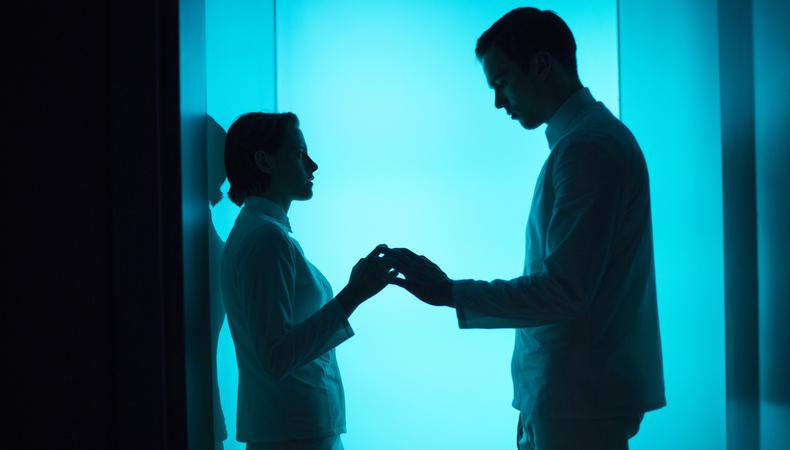
Drake Doremus is a romantic at heart. “I’m not an intellectual filmmaker; I don’t have political or intellectual agendas,” he says. “But I do feel a lot of things. And I want to let those feelings out.” It’s a sensibility that has informed his previous films, including the swoon-worthy “Like Crazy,” but one that might appear at odds with a dystopian film featuring a genetically engineered society devoid of emotion.
The futuristic world of “Equals,” with its minimalist aesthetic and structured societal roles, is the last place one might expect a story of star-crossed lovers. Citizens serve dutifully in peace, without disease or desire; when Silas (Nicholas Hoult) begins experiencing feelings, he is diagnosed with Switched-On Syndrome and ostracized. His growing attraction to Nia (Kristen Stewart) is not only dangerously unlawful—it’s foreign. Together the two struggle to understand their infatuation as they confine it to knowing glances and late-night trysts.
Doremus, who directs and provides the film’s story (with a screenplay by Nathan Parker), saw sci-fi as a huge challenge. “It was sort of scary to take on a genre that, to me, can be very cold at times, and try to take it and do something extremely warm,” he says. “But I love being scared. If I feel comfortable or like everything’s going to be fine going into a movie, that’s not a good feeling. I love the idea of being uneasy about it and out of my element, because that’s the only way I feel I can grow. I learned so much on this movie, probably more than any I’ve ever made.”
Infusing a cold world with moments of affection—first subliminal, then blossoming into “Romeo and Juliet”–like passion—takes a specific approach to production design. While some key sets were built, including the bathroom in which Silas and Nia explore their attraction, many scenes took place in museums and universities in Japan. “Our production designers did a really good job finding locations that had a very zen-like quality, a cold, structured design but also elements of nature,” says Doremus. In fact, the locations ended up adding “a spiritual element to the process” of developing Parker’s script, he says.
As in his other work, Doremus used music to define and enhance the world of “Equals.” The transition from “the hollowness of the sound design at the beginning of the film and then how rich and intimate it becomes as the love story starts to take hold,” as he describes it, stemmed from a close collaboration between musician Dustin O’Halloran and the sound design team. “Music is kind of like sound design, because it’s not necessarily telling the audience anything. A lot of it can come across as a texture or tone.... I feel like words can’t express what music can.”
For that reason, Doremus also DJed while filming. “I would hide speakers on set and play music before a take,” he explains. “Rather than saying, ‘Action,’ the music dropping out would be the indication to start the scene. It’s all about mood and tone for me, all about creating this world that the actors can breathe in, as opposed to trying to create or falsify.” The cast could more easily convey the “intellectual curiosity” of their dystopian civilization after listening to Apparat, for example.
Although casting Hoult and Stewart proved a “no-brainer” for Doremus, finding actors who could master a lack of emotion without coming off robotic proved difficult. It wasn’t until he saw Bel Powley’s audition tape that the director understood the appropriate delivery. “I said, ‘That’s exactly what I want.’ I used her as a benchmark for everybody else.”
What’s the secret to a great self-taped audition? “There’s something special about [Powley], she’s very present—she’s not worried about doing another take or the next audition,” says Doremus. “Nothing existed before or after that moment.”
Ultimately, the director says he’s drawn to actors who “don’t give a shit. I can always tell in a take when someone cares a lot or really wants the part.... You can just smell it. It’s really important to prepare, but at the same time let go and not care so much, because otherwise you end up stifling what could organically occur in the performance.”
Like this interview? Check out more from creators and Meet the Maker!