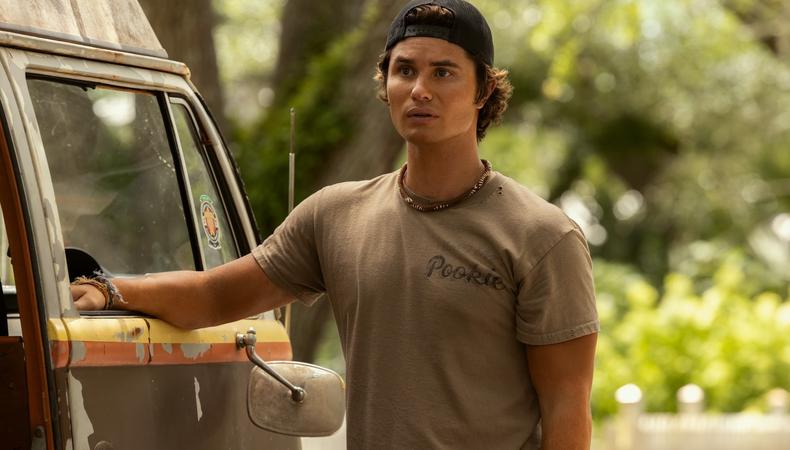
When “Outer Banks” debuted on Netflix in April 2020, Chase Stokes had only a few bit roles to his name, including a blink-and-you’ll-miss-it part on one of the streamer’s biggest hits, “Stranger Things.” But the teen adventure drama immediately rocketed to the top of viewership charts, taking its core young cast—namely Stokes, as well as Madelyn Cline, Rudy Pankow, Madison Bailey, and Jonathan Daviss—along for the ride into stardom. Six years later, the fifth and final installment is set to bring the story of the treasure-hunting, globe-trotting misfits known as the Pogues to a close.
“Whenever you do something this long, everybody’s looking for a sneaky bit of information, so you are confined to your little community,” Stokes tells us in one of the actor’s first conversations about the series since wrapping filming as John B, the show’s central character and narrator. “So it is nice to finally start talking about it.”
Here, Stokes digs into the earliest days of the show, shooting self-tapes with his costars, and how he concluded his journey as John B.
Spoilers below for the fifth and final season of “Outer Banks”
Your very first job was a small role in “Stranger Things” Season 1. What did you gain from that role?
I still, for the most part, stay in touch with Finn [Wolfhard]. Weirdly enough, the executive that was on “Stranger Things” was also the executive on “Outer Banks,” so even though I bombed that [“Stranger Things”] audition and it ended up turning into a one-line situation, it ended up being my saving grace because he was somebody who pushed for me to get the job of John B. So any time early in your career where you’re auditioning and you’re seeing friends book jobs, you’re seeing people start to craft a career, you never really know what points you’re actually touching or the people you’re connecting with. In my case, it was the thing that I thought was the end of the world, which was bombing an audition where I couldn’t say a single word, which turned into a job that changed my life in more ways than I could ever account for.
I want to preface this by saying 27 is not old. But it’s the age you were when “Outer Banks” began, so you didn’t have instant success. Looking back, are you glad fame found you after a period of auditioning and grinding?
I already struggled with handling the success of the show as it was. Giving that to me any earlier would have been super self-destructive. I would not have done well with it.
When I first came to L.A., I was in a class with a ton of working actors. I was working at a bar at Universal City Walk. I would go to class on weeknights and see people go and shoot an entire TV show and come back. Then they would talk about their experience. Then go and shoot a movie and come back. And I was still working at the bar. So I think in watching how people handled it, and watching egos come out and egos not come out, it was all just information.
I played ice hockey until I was 18, and that’s when I transitioned into really taking the craft seriously. I didn’t grow up in the theater. I didn’t grow up taking classes. It was the second chapter of my life. So in a way, I am thankful that it wasn’t an immediate gratification. I’m very thankful that I got to be around people who were working that took me under their wing, to let me just be a fly on the wall. Those were invaluable years. As time passes, you look back on those early years of really trying to figure out who you are as an adult and as a professional. You look back and you’re like, God, what a fever dream that was.
You mentioned the time you spent in classes. Is there something you took from there that’s still in your acting toolbox?
God knows how many concussions I’ve had—I think I’m on double digits now—so I already have a little bit of an issue with memory retention. A friend of mine who studied in Edinburgh for years and is an incredible theater actor taught me about the memory house. It’s where you walk around and give a piece of dialogue to a specific item—a plant or a refrigerator—and it helps your brain retain whatever that information is.
On set, you’re using that same technique but with characters, the way that you’re moving your body, moving from a mark to a second mark. That, for me, has really alleviated the stress early on in my career, especially coming into such a dialogue-heavy character right off the jump, and worrying so much about, Am I getting the words right? Am I getting the material right? Versus just living and existing in the character so that it feels free, that it feels authentic, that it feels truthful.
Over the six years of “Outer Banks,” were you auditioning a lot?
It’s interesting, because Netflix has first right of refusal. There’s the underlying, unspoken thing that if it’s a competing streaming service, you can’t really do it. There are a lot of limitations on you. Then there’s also being the lead of a show; that’s another level of limitation. I was auditioning, but obviously you’re trying to fit in the perfect project and the right window and the right amount of time that doesn’t overlap or overstep. If the showrunners don’t want you to do it, or if it’s a potential conflict, it’s immediately a no. I have had the good fortune to work in between seasons, which has been awesome. But this is the first time, truthfully, in seven years where it’s been an open landscape. I don’t want to say I’m hitting a reset button, but it’s like, OK, instead of having tunnel vision and knowing I’m going back to this safety net, it’s more like, Let’s craft this next chapter of the career.
Drew [Starkey] and myself and Rudy, for the majority of the time, we were reading for a lot of the same roles. So we’re asking a castmate to tape us knowing we’re going to tape them for the same role like three days later. There was never competition, which was also a really beautiful thing. Because we’re also very different artists. It was cool, like [Jonathan Daviss] would help me with tapes, I’d help [Madison Bailey] with tapes, we all coexisted in this beautiful universe where we knew there were more projects coming, but we didn’t really know if we could do it. So it makes it fun.
Was there anything you got close to that was particularly disappointing?
“Twisters” was one of those movies where I met with Universal multiple times. For Colleen Hoover’s “Reminders of Him,” I was in their offices quite a bit early on talking to Colleen and her producing partner Lauren [Levine] before it was even really in the audition process. I just kind of DM’d her and was like, “I love this book and would love to be a part of it.”
I’m sure there’s a number of others, but those are some standouts where I watched those movies turn into rocketships for Glen [Powell] and Tyriq [Withers]. You’re so happy for those individuals, because you want everybody to win. The generation before us, there are so many incredible artists. I think my age range is just now starting to see the lay of the land. I always get so much joy seeing people have a run in this industry, because it’s so hard to break through.
What was the last thing you shot for “Outer Banks”?
It was a reshoot of a fight sequence we shot in Croatia. We shot on a dirt road an hour and a half outside of Charleston against a blue screen. It was a weird day of almost all pickups. So we’re doing the plane sequence where Cleo blows up the Twinkie and we’re driving off. We’re reshooting pieces of that. Then we were reshooting when Kiara decides to go after the Blue Crown and that whole fight sequence. Those were my last two pieces, which was really bizarre. It was almost anticlimactic in a way.
The schedule shifted in true “Outer Banks” fashion. We think we have everything dialed in, and then there’s a thunderstorm and we have to switch up everything at the last minute. Or a location falls through. We had the schedule almost done chronologically to the end. Then, of course, the location pulled out, and then we had all these reshoots come in from Croatia. So it was bittersweet in a sense, but also so on brand for what the show is and how we shot it for seven years.
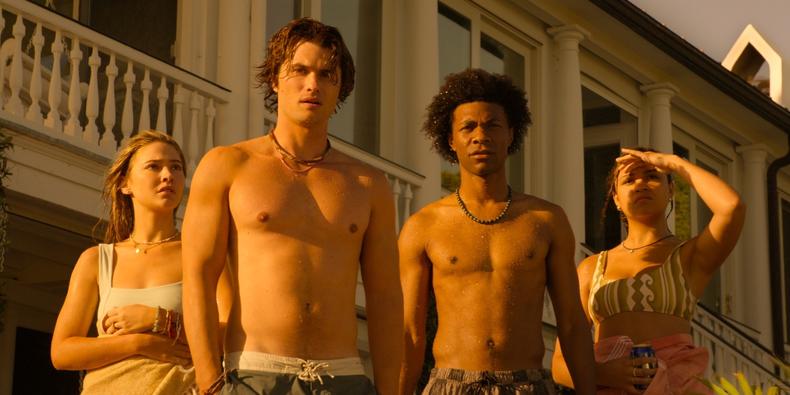
The show ends with a wedding, which is interesting because you don’t always get to end a show with a scene that also feels like a wrap party. What can you say about filming the last moments fans will see?
It was such a full-circle moment. When [co-creator Jonas Pate] started this show, he told us he wanted to end with John B and Sarah having a baby and getting married. To have the guy who started this in his little shack next to his house writing it by himself, to turn it into reality seven years later and end exactly how we said it was going to, was incredible.
We also hadn’t been at the Chateau, John B’s house, in years. That location, they essentially were like, “We’ve made enough money off of you guys. We don’t need you to come to this property anymore.” People were breaking in and trespassing. So by the grace of the film gods, we lucked out to get that property for one day. That was what I was referring to; that was actually supposed to be our final day of shooting, which would have been pretty magical. But it just turned out so beautifully, and to see every character from the beginning of the show come back, to have Roger [Mitchell], who plays Pope’s dad, officiate, it was just so kismet. It was the exact way I think we all hoped the show would end.
These kids never wanted to be perceived as the bad guys. They never wanted to be perceived as the low end of the totem pole. They just wanted to be accepted. So for that wedding to be the moment of acceptance and for the community to be present was really beautiful. There was not a dry eye that day.
What do you remember most about the day after you wrapped, the first day you woke up knowing there would never be any more “Outer Banks”?
The big thing for me is, I moved my whole life to Charleston. I bought a house there, and my sister moved to Charleston. So it was this weird sense of not only the show being done, but also the longest chapter of “Chase consistently living in one place.” It was this very bizarre, very real feeling of, Wow, the training wheels are gone. I’m not gonna go see the same people at work every day. I’m not gonna see the same hair and makeup people I’ve seen for seven years. It was really solemn.
I guess the best way to describe it is like, you graduate high school and you’re equal parts so thankful that you don’t have to go to seventh period ever again, and you’re thankful that you finally made it through by the skin of your teeth. But you don’t have that community and that consistency from elementary school to high school, where you’re waking up in the morning and you’re going home at 2:30. That schedule, that consistency is gone. So you are having those lingering thoughts of, OK, now I don’t know what’s next.
I was also packing my life up, because I was in the process of selling the house in real time. I’d bought my dream house and done it the way I wanted. Because that chapter was done and obviously I wasn’t going to work in Charleston again, it was also time to say goodbye to that. It was kind of a double slap in the face.
How would you compare any uncertainty you feel now to what you felt at the beginning of “Outer Banks,” and what does any difference tell you about what happened in between?
At the beginning of “Outer Banks,” Rudy and I always said we had nothing to lose. That very quickly dissipated, because we realized this show was [big], that there was now a lot to lose. There was a lot riding on it. Netflix made us aware of that, that this was a tentpole for them. As the show ends, it’s more of, How do I shed the skin of this teenager? I’m 33 now. I’ve grown up with the character through my 20s and into my 30s. I’m looking at it through the lens of an artist saying, “What is something different that feels exciting and thrilling for the next chapter?”
I didn’t immediately take a job, which I think is naturally what a lot of people like to do after a long-running show, because you like the consistency. But I took a couple of months to do a deep dive on myself. I had the existential crisis of like, How often do I cut my hair? What are my style choices? Who am I outside this show? Fortunately, I found a new home, and I’m about to start on a new journey [on AMC NASCAR drama “Thunder Road”]. I allowed the uncertainty to exist, to be a little more strategic about the next chapter of my career. It’s important, you know; the next job is the most important job.
This interview has been edited for clarity and length.