When asked about the impact he hopes to make with his work, David Simon often tells a variation of the same story: Fresh out of college in the early 1980s, working as a stringer for the Baltimore Sun, he managed to uncover a major scandal involving University of Maryland basketball coach Lefty Driesell pressuring a young woman who had accused one of Driesell’s players of sexual assault. Simon’s reporting prompted the university to undertake a lengthy investigation of the coach’s conduct, which ultimately resulted in what he describes as a slap on the wrist—followed by an extremely lucrative contract renewal.
“I remember being shocked that it had amounted to nothing,” says Simon. “I came out of that moment and I never again thought about impact—not in TV, not in journalism. From that moment on, I had the sense that my job was to get it right and get as much of the story as I could. After that, what happens happens. Maybe people see what you wrote, maybe they fix the problem, maybe people reform something—or maybe they just make it worse. But it’s not my job.”
“I had the sense that my job was to get it right and get as much of the story as I could. After that, what happens happens.”
Simon’s job these days is to bring those stories to the small screen; his latest miniseries, an adaptation of Philip Roth’s 2004 novel “The Plot Against America,” premieres on HBO March 16. It took him a while, however, to admit to himself that he was no longer a journalist. He first dipped his toe into television writing for NBC’s “Homicide: Life on the Street,” adapted from his own book detailing the year he spent reporting on the Baltimore Police Department. He would go on to adapt his second book “The Corner: A Year in the Life of an Inner-City Neighborhood” into the HBO miniseries “The Corner.” His subsequent series “The Wire” ran for five seasons on the network, receiving widespread acclaim (if disappointing ratings); to this day, it is considered a cornerstone of the small screen “Golden Age.”
“I was probably two or three years into making ‘The Wire’ before I started to admit to myself, maybe I wasn’t going back to a newspaper,” Simon says. “There was a lot of denial on my part that I was actually a TV hack. But I’d become a TV hack, for better or for worse.”
If Simon’s work has a common thread, it’s a focus on how systems of power perpetuate inequality, whether in the Baltimore drug trade (“The Wire”) or the 1970s sex industry (“The Deuce”). It’s a preoccupation, he believes, that comes from his years as a journalist. “Everything that had value was a critique or a statement or an argument about current affairs or the political—about who we are, how we govern ourselves, what’s gone right, what’s gone wrong,” he says. “The same arguments I enjoyed having in the newsroom with people I worked with were the ones I saw value in.”
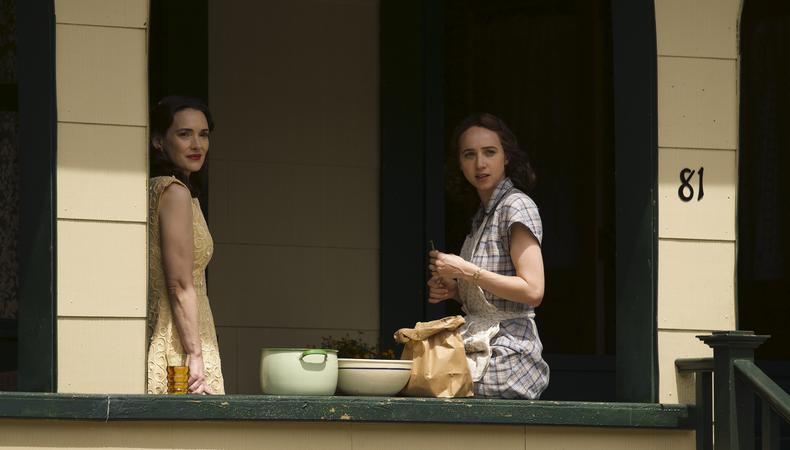
“The Plot Against America” is the first series Simon has adapted from a work of fiction. Roth’s novel describes an alternate history of 1940s America in which famed aviator and Nazi sympathizer Charles Lindbergh harnesses white fear and antisemitism to rise to power, defeating Franklin Roosevelt in the presidential election of 1940. The story is told from the perspective of 10-year-old Philip Roth (Simon changed the name to Levin for the series) as his Jewish family experiences the upheaval and bigotry that characterize Lindbergh’s presidency.
 Maggie Gyllenhaal on the Character Choice She Fought for on ‘The Deuce’
 Simon recalls a lunch with HBO executives shortly after Donald Trump’s inauguration where he informally pitched the idea of a series based on the book. “Roth has maybe the best dystopian narrative for this particular political moment,” he told them. “It’s an outsider that actualizes white middle American fears of the other and uses it to accrue political power and begins to undermine the democratic norms of the country. It’s really what we [were] already seeing even in [those] first months [of Trump’s presidency].”
Premiering ahead of what is assured to be a bitter and chaotic general election, the six-episode limited series is bound to touch a nerve, similar to other speculative shows like Amazon’s “The Man in the High Castle” and Hulu’s “The Handmaid’s Tale.” Simon admits that, though it’s become much more commonplace, it hasn’t always been easy getting his brand of low-key, often gritty, socially conscious work made. “The one thing I don’t have is an audience,” he says. “It’s…a little bit fraught. I don’t walk into HBO and [hear them] say, ‘What are we making next?’ ”
Simon’s advantage, he says, is that the types of stories he’s interested in can usually be made for exponentially less money than, say, a “Game of Thrones” or a “Westworld.” “If we ever go over [budget], it’s truly an act of God,” he insists. “We’re very responsible. That matters, because if we’re not delivering a big audience, we’d better not be spending big money.”
Ready to get to work? Check out Backstage’s TV audition listings!