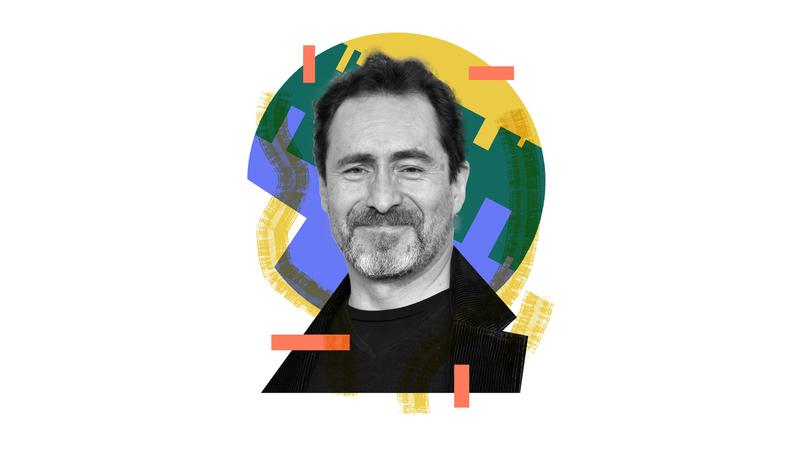
A member of Mexico’s famed Bichir family—both of his parents and his two brothers are actors—Demián Bichir grew up in the theater. He has conquered both screen and stage in Mexico, winning an Ariel Award for best actor in 1995 for his performance in “Hasta Morir.” Bichir found acclaim stateside with 2011’s “A Better Life,” which earned him an Oscar nomination, and on FX’s “The Bridge.” He now stars alongside Robin Wright in her feature directorial debut, “Land,” playing a rugged outdoorsman. And up next: catch him in the much-anticipated “Godzilla vs. Kong.”
What advice would you give your younger self?
I [used to] take [acting] extremely seriously, to the point that I was suffering every time I was creating a new role, every time I would step into a new character, a new play. You have to enjoy the ride [and] enjoy the process. I learned that throughout the time I was doing a play by [August] Strindberg, “The Ghost Sonata.” It took us four months to rehearse. The process was very difficult, and at some point I was really not enjoying the process. I realized that I was too worried about it, and then I naturally relaxed because of the help of others. That’s precisely what I love about the film we made, “Land,” because you can’t really achieve anything on your own. You need other people’s love and generosity in different ways. For example, there’s a line in the film [in which] Robin’s character asks me, “Why are you helping me?” and I say, “You were in my path.”
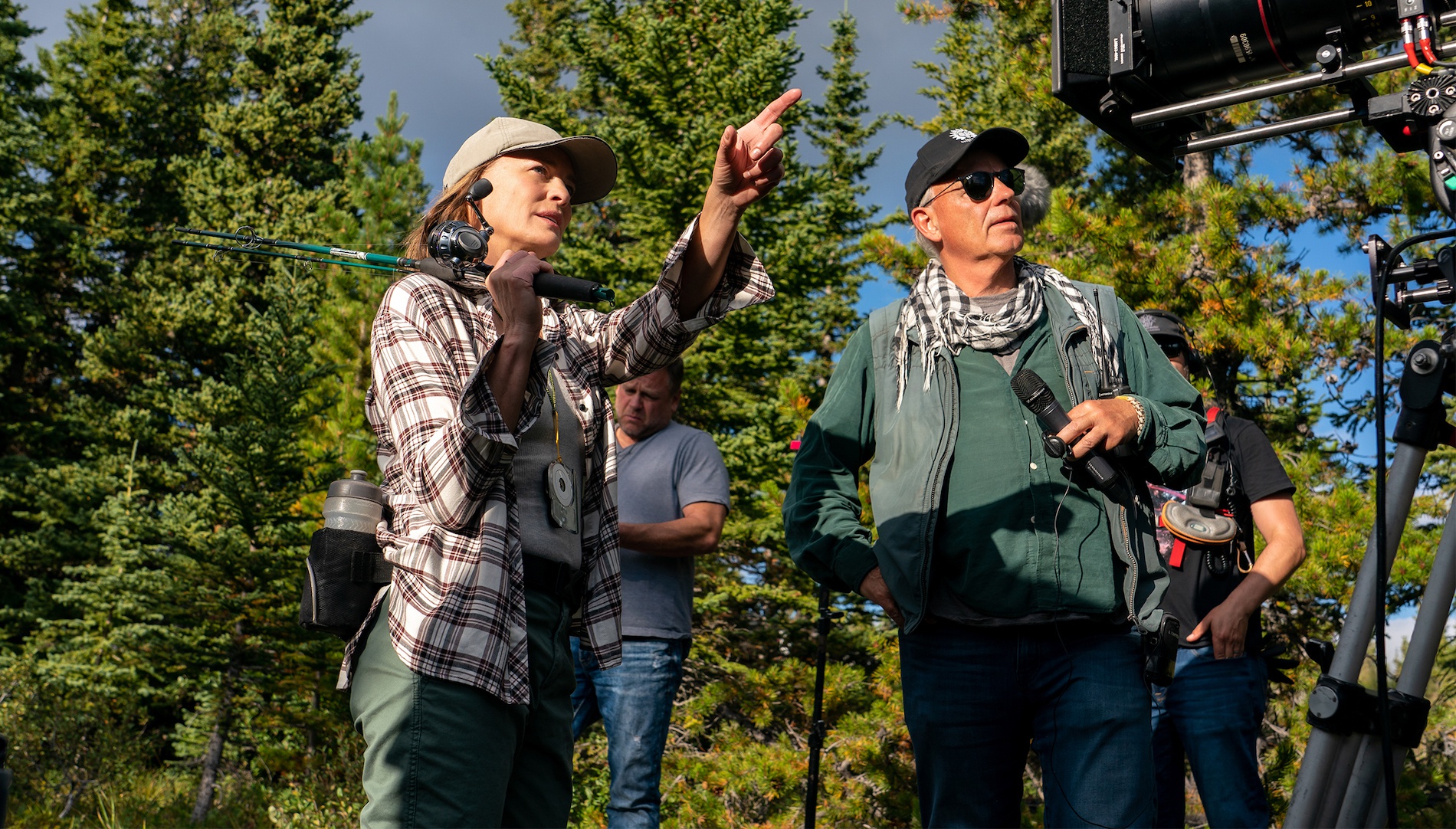 Robin Wright Never Intended to Direct Herself in Her Feature Film Debut, ‘Land’
 Sometimes we don’t see what’s happening around us. You do need the generosity of others, the kindness of others. But in order to receive, you need to be very generous. You have to be open; you have to surrender to that possibility. It was my co-star in that play—he told me, “No, we shouldn’t suffer in the process; we should enjoy the process. We should have a blast and be happy through it.” And everything changed from that point on. I’m still very, very strict. I’m very committed, and I always start diving into every project in a deep way, but now I enjoy the process very, very much.
What is your worst audition horror story?
Growing up in the theater in Mexico, all of the projects would come to me. So I moved to New York, and I got an agent. I took three different courses of English and speech training. I remember the first time I sat in front of this new entity that I had never seen before in my life, a casting director, and I was a wreck. I began reading, and after the first line, she stopped me right away and said, “No, please don’t do that accent.” I froze, because I thought, What accent? This is the way I talk. So I go again, and she stops me again and looks at me with wide eyes and goes, “Let me stop you right there. That’s all I need from you.” That was my first audition.
They say that thousands of actors move [from outside the U.S.] to Los Angeles—and probably New York or Chicago—every year to pursue a career as an actor. And 90% of those aspiring actors go back to their countries before their first year ends, disappointed and feeling terrible, with [their] morale all the way at the floor. It’s very difficult territory. To be an actor is a difficult thing itself; it doesn’t matter where you do it or in what language you want to be an actor. If you decide to be an actor in the most competitive industry on the planet, you’re up for a ride. But you have to keep on going. You will get a lot of nos before you get a yes. But that’s part of it. Back in those days, I always said, “I will make it. It doesn’t matter how much it takes; I will make it because I’m stubborn. If I can’t make it because I have some talents, I will make it because I’m stubborn.”
What’s the wildest thing you’ve ever done to get a role?
I put myself on tape for “Savages” because I wanted to play a different role than Oliver Stone wanted me to play, than the role that I ended up playing, Alex. He said, “No. You’re too handsome to be bad.” And I’m like, “I don’t agree with you. I think I can be very bad.” I said, “Can I send you a scene?” He said, “I don’t have a script yet, but yeah.” I knew the novel, Don Winslow’s “Savages,” and I created my own stuff, and I did it at home. I sent it over, and he said, “That’s a fucking character!” But that [role] was for Benicio Del Toro.
How did you get your SAG membership?
Thirty years ago, I did a commercial for Pac Bell. That’s all that I remember.
You come from a family of actors, but growing up, you wanted to play soccer. When was the moment that you decided you wanted to be an actor?
I grew up doing professional theater, ever since I was a kid. At the same time, I was trying to become a professional footballer. I invited [my coach] to an opening night of a play that I was doing. The next time we were training, he called me up and said, “It was beautiful to witness that. And I wanted to ask if you know who [famed Brazilian footballer] Pelé is?” Of course! Everybody knows Pelé. “I just wanted to tell you Pelé didn’t have any other choice in his life. And you’re a great actor.” It was a very kind and subtle way to tell me I was not talented enough to play football. [From] that point on, I embraced what I was doing in the theater way more.
This story originally appeared in the March 11 issue of Backstage Magazine. Subscribe here.
Looking for remote work? Backstage has got you covered! Click here for auditions you can do from home!