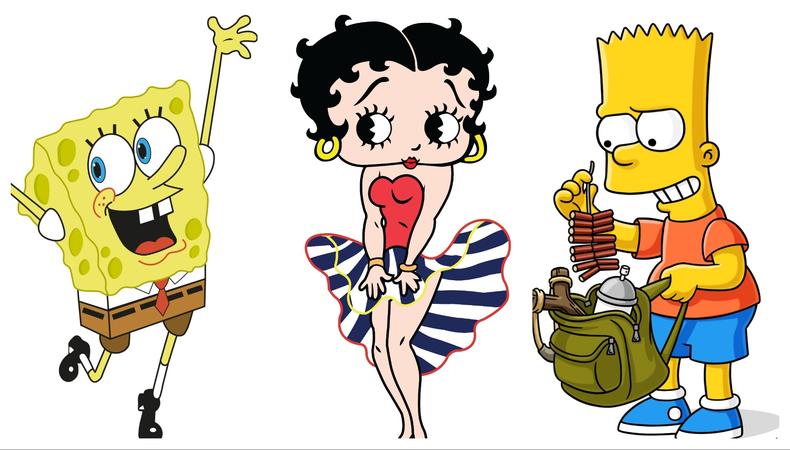
Two dogs, a cat, a bear, a rabbit, a mouse, an anthropomorphic sponge, the Grinch, a flapper, and a 10-year-old boy walk into a bar. What is this, the worst setup for a joke ever? Nope! Just a list of 10 famous cartoon characters and the voice actors who helped bring them to life.
1. Bugs Bunny
Looney Tunes characters hold a coveted spot in pop-culture history, and none more so than the wise-cracking, quick-thinking Bugs Bunny. Voice actor Mel Blanc brought Bugs to life by giving him a streetwise, slightly sarcastic quality—which, while iconic, is just the tip of the iceberg when it comes to his vocal contributions. Blanc has often been called “the man of 1,000 voices,” and with good reason: In addition to Bugs, he voiced a host of Looney Tunes characters, including Pepé Le Pew, Porky Pig, Tweety Bird, Wile E. Coyote, and dozens of others.
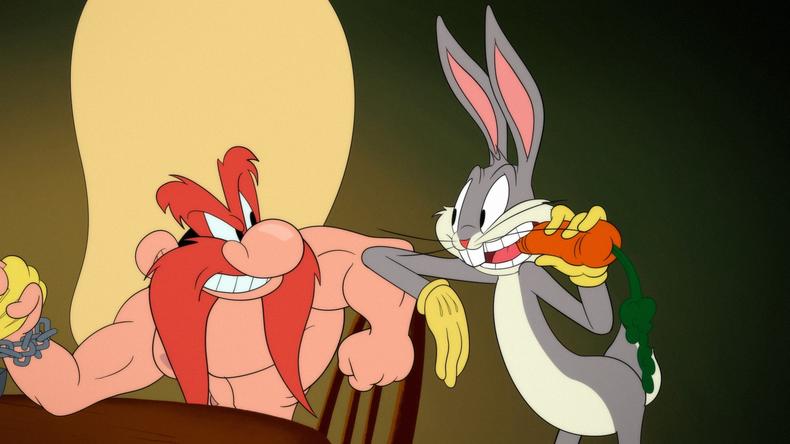 Courtesy Warner Bros. Animation
2. Betty Boop
Betty Boop’s first (unnamed) appearance was in the 1930 cartoon “Dizzy Dishes” where she was voiced by Margie Hines. Though the character would go through a few changes before getting her own animated shorts—including transitioning from a dog to a human girl—the voice Hines created for her stayed consistent. It was likely the charm of her high-pitched, now-iconic “boo-oop-a-doop” that endeared Betty to audiences (it obviously wasn’t the dog stuff). Though she was voiced by several different actresses during her heyday in the 1930s, most notably by Mae Questel, every actress delivered a performance that matched the standard Hines had set with Betty’s original appearance. Despite her age, Betty Boop remains as relevant as ever, having received her own Broadway musical—“Boop! The Betty Boop Musical”—in 2025.
3. Snoopy
First introduced in the Peanuts comic strips in 1950, Snoopy quickly became America’s favorite beagle. Fifteen years later, when the Peanuts gang made its way to the small screen in the animated special “A Charlie Brown Christmas” (1965), animator Bill Melendez realized that Snoopy—who in the strips mostly “talked” via thought bubble—needed a voice. To convince strip writer Charles Schulz, Melendez recorded himself making sounds for Snoopy and sped the recording up. After some resistance, Melendez got the gig. While Melendez doesn’t actually say much (Snoopy mostly talks in a sort of dog gibberish, saying things like, “Bleah!”), the voice he gave Snoopy has become so synonymous with the role that several other voice actors in recent years have had to work hard to emulate it.
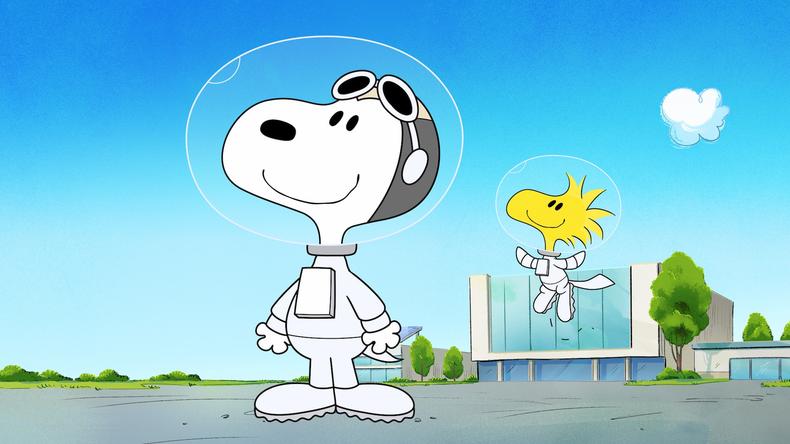
Courtesy Apple TV
4. Mickey Mouse
Mickey Mouse is likely the most iconic cartoon character on this list; in 2008, the LA Times reported he was more recognizable than Santa Claus. While several actors have played Mickey over the years, his voice was invented by Walt Disney himself, who played the role between 1928 and 1947. Disney certainly set the tone for Mickey’s high-pitched, aw-shucks demeanor, but more contemporary fans are likely most familiar with the work of Wayne Allwine, who voiced Mickey from 1977 until his death in 2009 in projects like “A Goofy Movie” (1995), “Fantasia 2000” (1999), “Who Framed Roger Rabbit?” (1988), and early seasons of “Mickey Mouse Clubhouse” (2006). Walt’s Mickey was a little more mischievous and rascal-like, but the Mickey of more recent years has become distinctly squeaky clean, transforming from just one of Disney’s many characters to the face of the company itself—almost synonymous with Walt’s legacy. Allwine’s take on Mickey reflects that status change: His Mickey is a little higher-pitched and jovial.
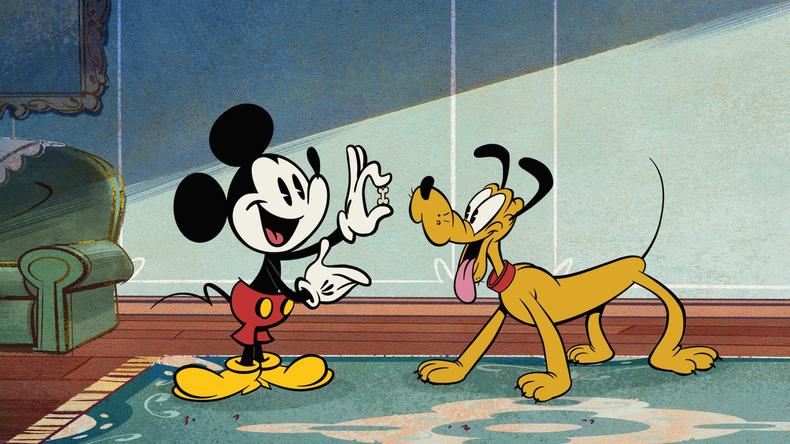
Courtesy Disney+
5. The Grinch
In 1966, Dr. Seuss’ “How the Grinch Stole Christmas” was brought to the small screen, with actor Boris Karloff both narrating and playing the titular role. Though Karloff, who was best known for his work in horror films like “Frankenstein” (1931) and “The Mummy” (1932), might have seemed like an odd choice for a children’s special—much less a Christmas children’s special—it’s now impossible to imagine the Grinch without him. His raspy baritone brought the character to life, and going all-in on a menacing tone helped the Grinch’s change of heart at the end of the special pay off so spectacularly. Karloff’s influence on the character is so deep-rooted that Jim Carrey, who played the character in an equally beloved live-action adaptation in 2000, acknowledged shades of the original Grinch in his own performance. “He made such an impression on me,” Carrey told Vulture in 2025.
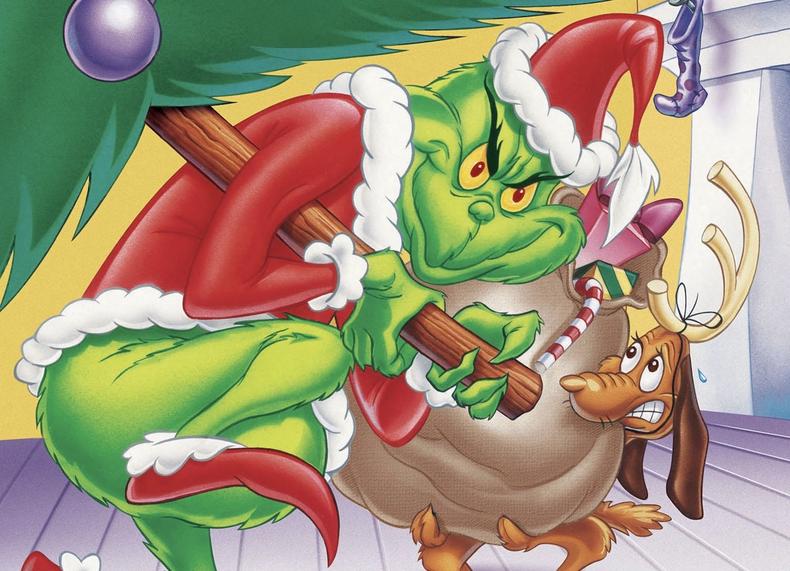
Credit: Entertainment Pictures/Alamy
6. SpongeBob SquarePants
Who lives in a pineapple under the sea? SpongeBob SquarePants, of course, voiced by actor Tom Kenny since the show’s debut in 1999. Kenny came up with the voice for the eternally optimistic sponge himself, recalling to NPR: “When it came time to come up with a voice, it was just a matter of finding a voice that was childlike and maybe childish but not a child, non-age-specific, enthusiastic and just kind of weird. And we finally settled on this elfish helium voice that SpongeBob wound up being.” (Kenny confirmed to NPR that no actual helium is involved.) His distinct tone—somewhere between nasal and throaty, and perfectly high-pitched—has been an essential part of the character since his first appearance, as has his signature laugh, which Kenny performs by tapping his throat. In a sea of other immediately recognizable vocal performances—including Bill Fagerbakke as Patrick, Clancy Brown as Mr. Krabs, and Rodger Bumpass as Squidward—the titular character remains the clear standout.
7. Bart Simpson
You’d be hard-pressed to find anyone who doesn’t at least have a passing knowledge of “The Simpsons” (1989). Though the whole Simpson clan has achieved icon status, there’s no doubt that Bart remains a fan favorite—likely due in part to the spunky performance by his voice actor, Nancy Cartwright. Despite being an adult woman, Cartwright seems right at home playing the mischievous 10-year-old. In fact, she is so much a part of Bart that she evidently ad-libbed his famous catchphrase “Eat my shorts” during a table read.
8. Scooby-Doo
Why is it always “Scooby Dooby Doo, where are you?” and not “who are you?” Well, wonder no longer: As with many entries on this list, the lovable mystery-solving Great Dane has been voiced by several actors over the years, but his signature R-forward sound was first created by Don Messick—though not necessarily for Scooby. Messick had previously voiced Astro, the family dog on “The Jetsons” (1962), and if you listen to Astro’s voice, you might notice something a little familiar. Regardless of which animated dog the voice was originally created for, the sound is now synonymous with Scoobert Doo (yes, that’s his real name), and his scene-stealing, goofy antics soon made him the clear fan favorite among the Mystery Inc. gang. Messick played Scooby from his first appearance in 1969 all the way until 1996.
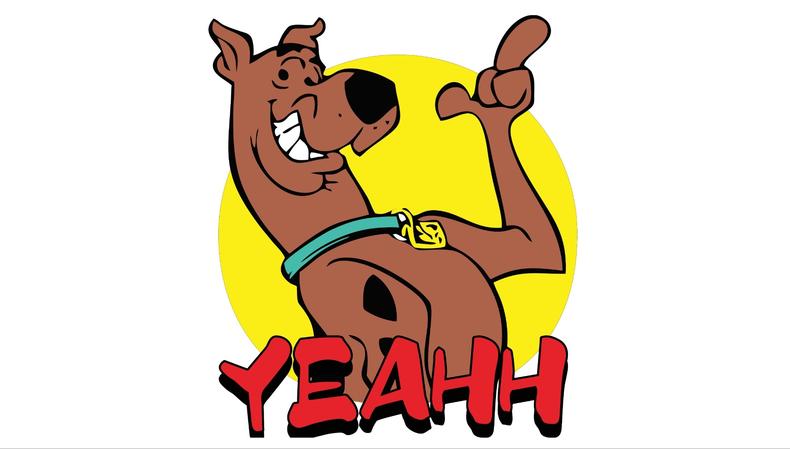
Credit: Rio Agung Setyawan/Shutterstock
9. Winnie the Pooh
Think of Winnie the Pooh and you probably think of two things: his insatiable taste for honey and his signature befuddled “Oh, bother.” Pooh was first voiced by Sterling Holloway, a veteran Disney actor who lent his distinct sound to many projects over the years—and it certainly was distinct. You have to wonder how many young fans wondered why Winnie the Pooh’s voice was coming out of a villainous snake in “The Jungle Book” (1967). Since 1988, Jim Cummings has supplied Pooh’s voice, doing an impressive job of maintaining the sweet, slightly raspy sound fans have come to associate with the character. Cummings, who also voices Tigger, recalled in an interview that he was initially nervous to take on the roles. “I was a little bit afraid because I was thinking, What if I can’t keep it consistent? What if I don’t sound like how these characters should sound?” It’s safe to say Cummings’ fears were unfounded.
Credit: Yana_Nahorna/Shutterstock
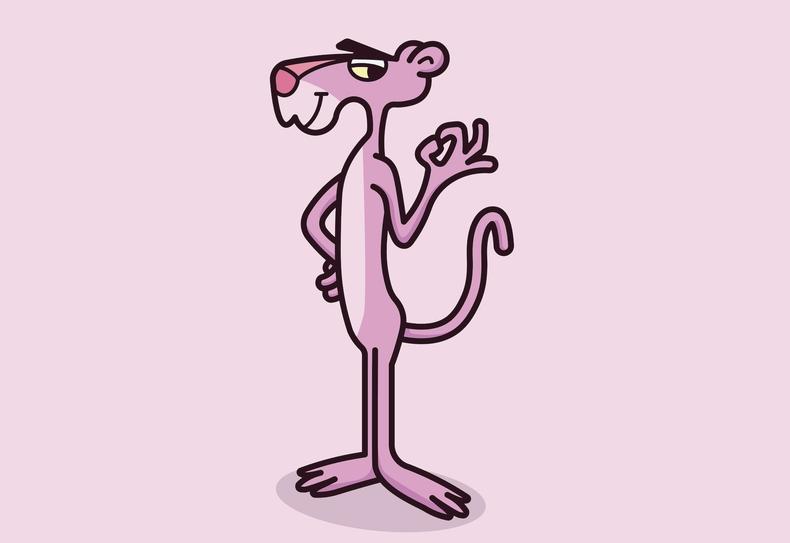
10. The Pink Panther
Much like Snoopy, the Pink Panther’s notoriety predates his even having a dedicated voice. He first appeared in the opening credits of the 1963 Peter Sellers film “The Pink Panther” and—despite having nothing to do with the actual movie—became a cultural icon (alongside Henry Mancini’s equally excellent theme song). The Pink Panther went on to star in several animated shorts and eventually his own TV series, “The Pink Panther Show,” beginning in 1969. The titular character was mostly mute throughout (the few times he spoke, he was voiced by legendary voice actor Rich Little). In 1993, however, “The Pink Panther” was rebooted as an animated series, this time giving the character a voice—courtesy of actor Matt Frewer. Frewer had the unique challenge of voicing a character with a 30-year legacy at that point, and he opted for a cool, John Travolta–esque take on the role (though in an interview, he claimed he basically just used his regular voice). Frewer’s performance may not have been what made the Pink Panther famous, but the fact that so few people remember the panther ever spoke suggests it didn’t damage the cat’s legacy, either.
Credit: Yana_Nahorna/Shutterstock
Ready to voice your own iconic cartoon character? Check out our audition call board.