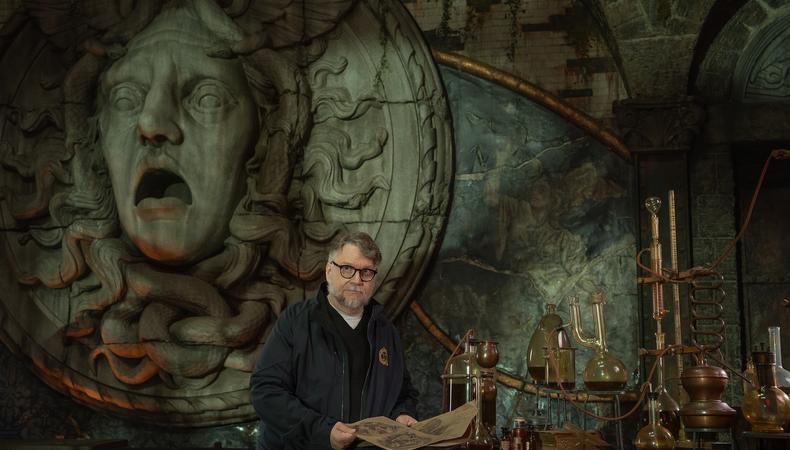
Like the mad scientist that gave Mary Shelley’s 1818 seminal work of Gothic horror its title, Guillermo del Toro has been consumed by the idea of bringing “Frankenstein” to life for years. “When I was a kid, I saw the creature, Boris Karloff, and thought, ‘That’s a saint. That’s my Messiah,’ ” the Oscar-winning director told us. Now, del Toro’s monster has been unleashed on the world (or, at least, on Netflix); his adaptation is an epic allegory of fathers and sons starring Oscar Isaac as Victor Frankenstein and Jacob Elordi as his reincarnated creation.
We sat down with del Toro to dive into his thoughts on life, death, religion, and how they all combined into his decades-in-the-making masterpiece.
How are you feeling now that your “Frankenstein” is finally out?
It’s funny, because it’s a movie that evolved with me as a human being. So I have a little bit of postpartum depression. For decades, [when doing a movie like] “Crimson Peak,” I would say, “OK, I’m going to rehearse things for ‘Frankenstein.’ ” I’d work with [production designer] Tamara Deverell, or [cinematographer] Dan Laustsen, or [costume designer] Kate Hawley, and I’d say, “OK, they’re going to be with me on ‘Frankenstein.’ ” A good camera move, I’d go, “I’m going to use this for that one scene in ‘Frankenstein.’ ”
It’s also compounded by the fact that this is deeply biographical for me. It started as a story of me and my father, and the need to make amends and maybe accept each other. Then, while I was busy being a son, I became a father. But I kept behaving like a son, which is what happens to Victor. So then I said, “I’m also going to talk about me having to tell my kids, ‘I’m sorry.’ ” One of the decisions was, if Mary Shelley made it painfully autobiographical, which it is, I’m going to make this painfully autobiographical, which it is. It’s the greatest experience shooting a movie I’ve ever had. But it’s tough, because now, like Victor says, having reached the end of the Earth, there was no more horizon left, and the achievement felt unnatural.
I’ve seen you say you were raised Catholic and then lapsed later in life. I’m very much the same. What is it about the story of “Frankenstein” that is so attractive to people with that kind of background?
I was very intrigued as a kid: Why did God send his son to be crucified? Because pain was a learning tool for God. God needed to experience death because he had created life. That blends with the Frankenstein myth. In a different way, Mary Shelley fused birth with death through her mother dying 11 days after she was born, and through her many miscarriages and stillborn kids. The first one, she buried without even naming it, because it was so frail and so young that they didn’t have time to baptize him. So, you know, the pageantry of Catholicism and the violence of Catholicism—we have a really bloody iconography.
I remember my grandmother saying, “I don’t like you reading horror stories.” And I said, “Well, then take the Bible away.” There are enslaved people, disemboweled people, people crucified upside down. The Maccabean brothers are toasted on an oven, and they amputate their legs and their hands. There’s also the component of all that being pleasurably ecstatic, because you’re offering it to God, or doing it for God. The fusion of blood and redemption, pain and redemption, all this is what fuses horror with the Catholic dogma, at least in my mind, so profoundly.
It’s interesting, because there’s so much of Marco d’Agrate’s “Saint Bartholomew Flayed” in the design for your creature.
Completely. That is one of the images I sent to [creature designer Mike Hill]. I said, “This is our creature.” And also phrenology diagrams from the 1800s of the head. Those two [inspirations] were important because I said, “We’re not going to do a repaired body. We’re going to do a brand-new, minted human soul.” So [the creature] needs to live almost like a fetus, like a baby, like an alabaster sculpture. This is somebody Victor made. He has pieces of memories, but the soul is completely new. So it’s more than a baby. It’s like an uncanny new soul. And the only way you’re going to express it is by making it ethereal—pale violets, oyster grays, very much like an alabaster sculpture.
I spoke with Oscar for our cover story, and something he was really hitting on was, in your original conversations, how much you discussed defiance—wanting to defy your fathers, to defy death, obviously, to defy religion.
I have learned that life is like fishing: You gotta pull, and you gotta release, right? But I’m 60. I know Victor as a character—or me as a young director—it’s all pull; it’s all defiance. Victor is the type of person that has certainty, which is the most dangerous type of person you will encounter in your life, be it a politician or a scientist. The absolutes are where the oxygen leaves the room. When somebody has no doubt, you should truly just brace yourself, because something terrible will happen.
As I age, I’ve gone through fairy tale stories into stories that have the complexity of accepting that you are both the main character and the villain in your film. “Nightmare Alley,” we follow a man that is entirely wrong until he realizes, in the last 10 seconds, that he can finally purge himself. The same is true in “Frankenstein.” You follow a guy that is completely certain, all the way to the dynamite being lit, that he is on the righteous path. Then he realizes the abysmal mistake he has made.
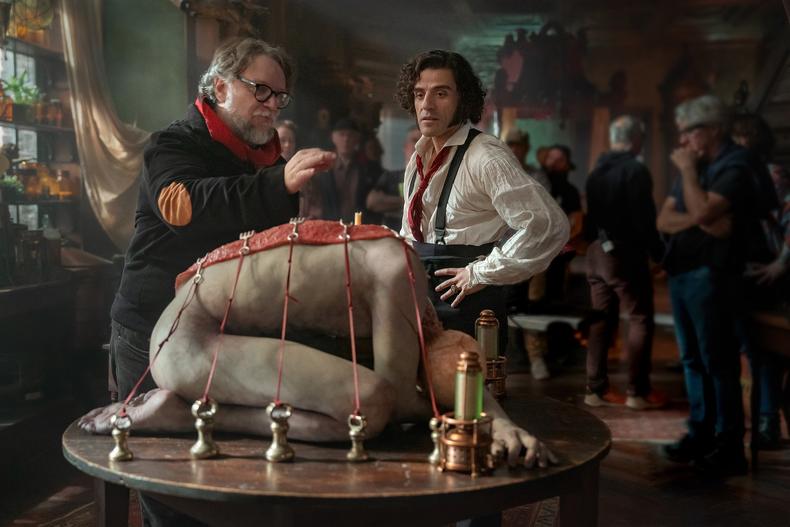
I want to get your perspective on a story Oscar told us. He said you filmed the last scene, and then he came to you and said, “I’m not sure it’s quite right.” And then you reset the next day, and you did it again. What made you have the confidence to say, “Let’s try it again”?
He gave me a reason. I said, “We got it; I saw you accepting the creature.” And he said, “Yeah, but I want to do it as my father. I did it as me. Can I try it as my father?” And I said, “Go ahead,” because that’s a good reason. You’re going to channel something completely new. He said, “I want to be the creature, and I want to be my dad, saying I see you and I accept you and I ask your forgiveness.” I thought that was very powerful, very profound. So, when somebody promises a horizon, you pack your bags and get in the wagon.
That actually makes the story he told us even more meaningful.
That’s what made me do it. To me, there is no stone you should leave unturned if somebody says, “What about this?” It’s worth it, meaning you have to listen to the movie. The difference between being a young director and an old director is you listen to the movie. The real credit on a film should be a film by the film. When something goes wrong, or something needs repetition, that is the movie trying to form itself. Every time there’s an accident with an actor forgetting a line, or [in “Frankenstein”] a gust of wind blowing the veil of the mother [Mia Goth] in red, that is the movie directing itself. You enshrine it. You don’t cut. You make the camera keep rolling. You find a way.
The one other thing that Oscar mentioned that I want to get your take on is he said you were often directing him using jokes.
What is great about jokes is they are very situational. Or I would tell him a little story. When you talk to actors, you want to talk to them about being, not about doing. You don’t want to tell them, “Think about this.” No, you want to tell them, “Look, there’s a joke where a guy is absent-minded,” and then they do the scene absent-mindedly.
There’s a very powerful height difference between Oscar and Jacob. What can you tell me about using that as a storytelling tool?
[I use that] every time there are power dynamics. I tried to play with that in [“Nightmare Alley”], the dialogue between Lilith [Cate Blanchett] and Stan [Bradley Cooper].
With the creature, there are pointedly several moments in the film where you see it towering over Victor and yet being gentle. Then, finally, at the end, when it throws Victor against the cabinet and tosses him around… He’s not the baby anymore. You’re tracking that moment when the father and the son have a moment, and the teenager is taller than the dad, and the father, at least in the back of his mind, goes, “Uh-oh.” It was about taunting with the camera, particularly when the monster rises and Victor is crouching on the floor. You realize, Oh, this could and will go wrong at some point.
I want to ask about the ending shot of the film, the creature watching the sunset. How was that captured?
We were on the top north of Canada, and I knew I wanted the sun. We went for sunset rather than sunrise, because the position of the landscape allowed us to shoot basically an infinite icescape for real.
The movie is a circular structure. That’s why circles and mirrors are always in the film. It starts with the captain and the sun rising behind him, and his back is to the sun. Then Victor tells the monster, “The sun is life.” The creature cannot die, so very humbly accepts the sun on his face at the end, meaning he will be alive. He will be alone, he will be eternally broken, but he can accept it. Which is where we all get between 50 and 60; you get to that moment of acceptance. There’s a gentility to doing it with the real sun. You don’t have to fake a flare. It’s so completely, disarmingly natural.
So we waited, and that day we [also] shot the point of view of Victor seeing the monster on the horizon, tiny. We knew we had one time that day to catch that, because the sun was really setting, and you don’t come back. It’s too expensive to move 130 people. So we planned the camera, and then the ice started melting. Everybody started running. We ended up doing it one time, and even the shot of him on the horizon, the DP [Laustsen] said, “It’s not exposing.” And I said, “Well, you’re going to do it under protest.” And it’s the shot that’s in the film. There’s no substitute for reality.
It is an incredibly symbolic moment. It’s very different from the book. The book ends with the creature disappearing in the distance, carried away by the current. I wanted to say one thing in this movie—the creature has reacted to everything for the entirety of the film. If you’re kind to him, he loves you. If you’re violent to him, he hates you. He’s all reactive. And for the first time in his life, he decides to liberate the ship of the people that shot at him and tried to kill him, so it’s his first human act after forgiveness. I needed that symbol, like he can now face the sun. So it’s a very powerful, very beautiful, very clear image. I think clarity is important. It’s symphonic. You want the horns to be clear; you want the winds and the strings to be clear. And that’s a string moment. It’s a solo violin, and there’s a purity to the sound and the image that is very, very profound for me.
Have you thought about what the film would have been like if you made it at the beginning of your career, and what does that tell you about who you are now?
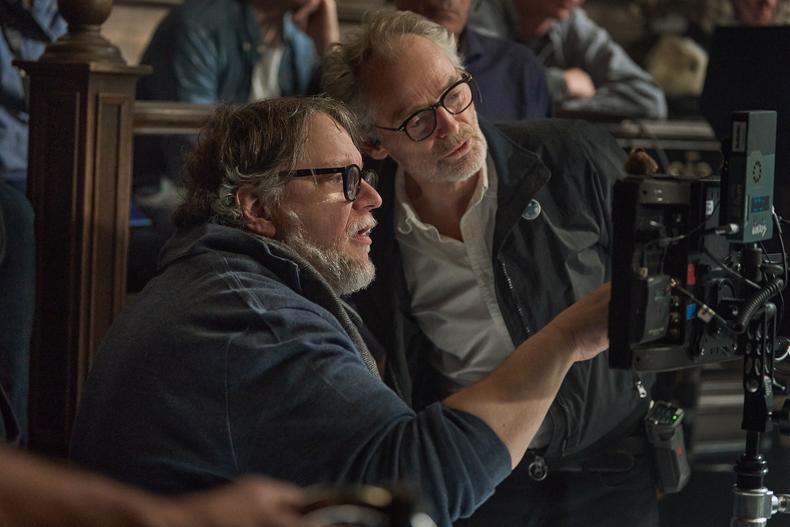
You get to a point in your life where you accept that you’re not going to always be right, and that life is going to take you by the hand and show you what is right. I think you have to access the Tao of it all in order to make a movie this size, to try to retell a story that has been told 100 times with your own voice. It’s like Johnny Cash singing [Nine Inch Nails’] “Hurt.” He was at exactly the moment where his voice could sing that and mean what he meant as an old man, very different from the regret of “Ring of Fire.” This is a man who says, “I’m here, and I realize I’m on my last lap, and this is all the pain I feel.” If you are Mary Shelley and you are 18, or you are 60 and you’ve done things that hurt you or others, and you’re not a perfect being, I think you either rebel against the world, which is what Mary Shelley did, or you rebel against yourself, which is what I did.
You’ve talked a lot about the importance of authenticity, and I know you often handcraft or paint small details on your sets. What’s something you did that for with “Frankenstein”?
I painted the wooden archangel that Victor prays to in his childhood bedroom, the one that becomes a Red Angel. I repainted the wings, the face, the arms, some of the dressing, and the legs and the feet. Because I didn’t feel like it felt of the time. The paint job was very rough, so I took it home and I repainted it with my acrylic paint and completely changed the paint job. I [also] commissioned many of the props out of my own pocket because they were too extravagant. All the wax sculptures—the anatomical waxes in Victor’s apartment—they are mine. I’m not going to saddle the production with $100,000 worth of anatomical waxes. For the anatomical miniature, I commissioned the ivory. I just think that if you don’t make an oil painting that looks of the period, or you don’t make a sculpture that looks of the period, the movie goes to hell.
Years ago, I saw you compare the idea of doing “Frankenstein” to being at the Olympics, saying that whether you land a 10 or a 6 you will have been judged. So where do you think you’ve landed, and how does it compare to where you thought you’d land?
This is the only time in my life where I don’t have a relationship between the movie and the outside world. I just don’t connect. The movie came out beyond what I wanted, and I know that sometimes you’re reading every review, checking everything, gauging every movement. This is the first time I haven’t. It’s a very intimate relationship between the movie and myself. I adore it, and it was very purging. Those are the reasons to make it. Through the decades, you’ll find that people connect with movies at a molecular level when they’re pure and sincere and felt and thoughtful. And this is one of those.
This interview has been edited for clarity and length.