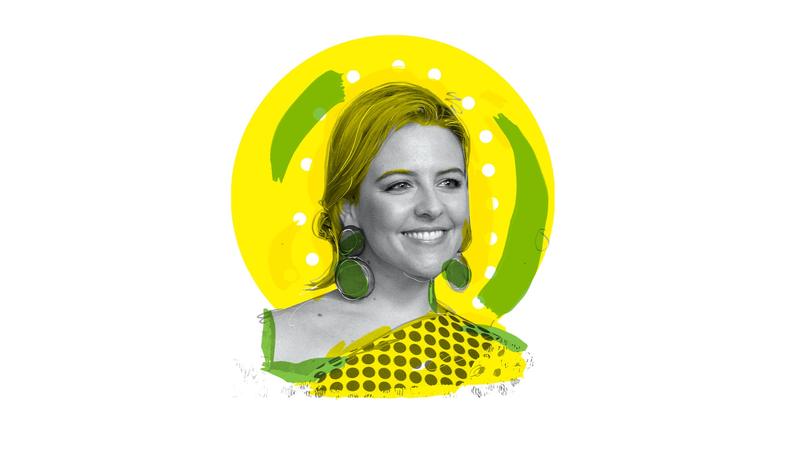
Theater audiences have known about Heléne Yorke’s outstanding comedic timing for years, and now television viewers are catching on: Her work on this spring’s breakout Comedy Central hit, “The Other Two,” was one of the highlights of a particularly strong year for new comedies. From “Saturday Night Live” vets Chris Kelly and Sarah Schneider, “The Other Two” follows two aimless siblings (Yorke and Drew Tarver) whose pre-teen brother (Case Walker) becomes an overnight pop sensation.
Yorke joined Backstage’s awards podcast, “In the Envelope,” for a frank and hilarious discussion of her stage-to-screen experience, her biggest audition choices (both those that have and haven’t booked her the gig), and much more. For more exclusive interviews with awards contenders and nominees, subscribe to “In the Envelope” wherever you get your podcasts!
How did you first get your Equity and SAG-AFTRA cards?
I got my Equity card in the ensemble of Pittsburgh Civic Light Opera in the summer of 2005. Summer stock! And I got my SAG-AFTRA card on...oh, my gosh! “Louie.”
What performance should every actor see?
The performance that everybody should see is Christine Ebersole in “Grey Gardens”—it is over, so you can’t go and see it, [but] you can probably go to the Library for the Performing Arts at Lincoln Center and watch her play Edie. People ask me this all the time, and that’s the first thing I always think of. I remember seeing that performance and thinking it was so weird and so great and so beautiful. She just touched on so many levels. She plays several ages in it, as well. She was truly incredible.
Is there a horror story that comes to mind from your early auditioning days?
I don’t have audition horror stories, I just have situations in which I was made to feel so small. That’s the worst of all, because it’s really hard to recover from. I went in for a show and they said, “Hi, hel-EEN, how are you?” And I said, “Oh, it’s actually huh-LAY-nuh!” And he said, “Yeah, I know, that’s what I said.” And I quickly recovered: “Oh! Sorry, my name is so dumb I just jump to correcting people on it, assuming it was said wrong. My bad.” I got a phone call afterward and my manager said, “What happened in there?” Well, I auditioned for an ingénue, so, clearly I was terrible; there’s that! And he said, “No, the feedback is that you’re difficult.” I have never again corrected somebody on the pronunciation of my name.
What’s the wildest thing you’ve ever done to get a role?
I think the wildest thing you do to get a role is putting yourself together for an audition. The two biggest characters I’ve created are probably the biggest things I’ve ever done for a role. When I went in—I miss doing this, actually; I want to craft a character in this way—for “Bullets Over Broadway,” I [auditioned for] Olive Neal and I created a voice and I just went for it! And for “Masters of Sex,” I created a character. Both are period pieces, which is why I think it was easy to slip into that. I really crafted something within a world I had envisioned. I think that’s the wildest thing I’ve done.
I typically, with my work, like to approach it in a bigger way. That’s sort of how I am. And I remember when I was getting into television, the handcuff that gets put on you right away, especially when you’re a theater kid, is, “Be smaller, be smaller, be smaller.” You start to feel like you’re put in this tiny, little box, and you don’t quite understand how to feel natural. I don’t think it’s “be smaller,” I think it’s being yourself the way you are in a conversation. So I try to approach things in that way: Everything is essentially a characterized version of yourself. Even an Olive Neal or a Jane Martin on “Masters of Sex,” all of it comes from you in some way.
Speaking of which, what’s your stage-to-screen advice for theater actors?
Your first time doing it is so crazy, because you don’t really understand what is going on. And auditioning for television, for kids who come out of theater schools, it feels so crazy. They really don’t [teach you that]. I did a talk at [the University of] Michigan recently, and everyone said, “I’m so worried about ‘being small, being small, being small.’ ” Well, you are small every day: every conversation you have, every time you have dinner or coffee or a drink with somebody. You are the size of what somebody wants to see [on camera]. Don’t try to be something other than yourself; if you’re going to be surprised, actually be surprised. That almost oversimplifies it, but I cannot say it enough. I believe it’s that simple! If the character is confused, what do you look like when you’re confused?
What advice would you give your younger self?
It’s going to be fine. I know that sounds so stupid, but I’m not kidding. It applies to literally every aspect of life. It’s going to be fine. Truly, it’s not only going to be fine, it’s going to be better than you could have possibly imagined. I spent so much time stressed out that this thing I wanted so badly was not going to happen. I mean, if I hadn’t stressed, who knows if things would have ended up differently? But I do know that I killed a lot of brain cells stressing out. What was the point of that?
Also: You look great, shut the fuck up. You look at pictures of yourself, going, “I thought I was fat that day? That’s crazy!” That’s work I’m doing now, I’m going to look at pictures of myself when I’m in my 40s or 50s and be like, “What a dick.” Whatever it is, it is. I like to eat cheese and drink, so this is it. And honestly, it looks pretty good for all that. [Laughs] That’s my advice. Chill out, and you look great.
This story originally appeared in the June 20 issue of Backstage Magazine. Subscribe here.
Want more stories and advice from the best in the biz? Read more from the Backstage 5 here!