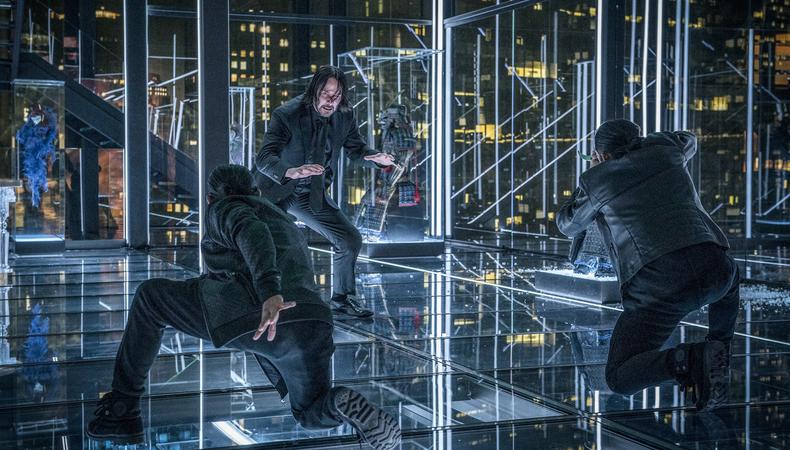
Despite their apparent naturalism, those high-intensity fight scenes that have become a trademark of Keanu Reeves’ “John Wick” franchise don’t simply come together. They require razor-sharp precision from actors, stunt performers, and fight choreographer Jonathan “JoJo” Eusebio. Ahead of the May 17 release of the third installment, “John Wick: Chapter 3—Parabellum,” Eusebio speaks with Backstage about how actors can train for fight sequences and reveals the one thing that will make or break their performance on the day of filming.
What does the role of fight choreographer entail?
A lot of it is talking to the director and figuring out what kind of fighting he wants for the movie. Then, once we’ve figured that out, we’re involved in training the actor to actually do it, as well as training the stunt people. And on top of that, it’s trying to keep it all in line with what the vibe of the movie is.
READ: What a Stunt Person Needs in a Director
Do you work closely with the director as well as the cinematographer?
Yes, all that stuff sort of works together. You can choreograph whatever you want, but ultimately, how good it looks depends on how it’s shot, how it’s edited, the story it’s trying to tell. You start from the director’s choice and what he wants to convey, and then you have to make a blueprint and figure out how to shoot it. You start collaborating with all these heads of the departments to get your vision across. Ultimately, it all starts with the director.
So, is the actor one of the last pieces of the puzzle?
Usually, when we do these fights for a movie, the actors are training way in pre-production, two or three months before we shoot. They’re already getting in the physical training, even though the outlines of the fight aren’t dialed in yet.
What is the process for figuring out what the actor will do and what the stunt person will do?
It all depends on how well we train them. We try to train the actors to do most of the fights, except for the parts that involve anything that is high-impact, or anything that would actually cause them bodily harm. We try to train them to do a lot of it, but it depends on the director’s choice. [“John Wick” director] Chad Stahelski likes to do long shots. He doesn’t want to cut if he doesn’t have to cut, so we try to teach them to do most of it.
As the fight choreographer, what’s your working relationship with actors?
We first assess their physical ability. You have to choreograph according to the actor’s attributes; otherwise, it doesn’t look believable. From there, we teach them martial arts, basically. It’s not just memorizing the choreography; their body mechanics have to look like they’ve trained. If the character’s been training for 20 years, we only have three months to make it look like they’ve been doing this for decades. Once you figure out what their style is, you give them a lot of choreo drills, exercises, things like that to accommodate what they’re getting ready to do.
Why is fight choreography precision so crucial for actors’ performances?
You have to make it precise, because they have to make the audience believe that they’re capable of these things. The audience is more savvy than ever, because they have YouTube and information from all over the world. Most people now know what real fights look like because of UFC and MMA—they have seen real knockdowns. You can’t fool the audience anymore. So, it’s important for actors to look proper in anything they do. People may be looking at the tiny details, and the actors have to know those tiny details in addition to the big movements.
Are there things actors can do on the day to make everything run more smoothly?
They can be open-minded to the fact that things will change on the day. They have to know that even though they’re learning choreography, sometimes factors change, where we don’t have enough time to shoot it, so we might add something at the last minute. It’s not just knowing the choreography but being able to adapt to changes. They’re not just going to memorize this thing, they have to know enough to change. It’s just like dialogue; sometimes it changes, and physical movement is the same thing.
Do you have any advice for someone who wants to become a fight choreographer?
I started as a stunt performer. To get into fight choreo, you have to start from the bottom. You should start with some sort of martial arts or fighting system. How can you teach a fight to look like something if you don’t know it? You also have to know the set and understand that fighting for movies is different than fighting in real life. Just because you can train someone in something doesn’t mean you’re necessarily going to be a great choreographer. For choreography, you have to know a little bit of everything. You have to know a little about editing, you have to know a little bit about cameras, you have to know a little bit about these effects now, because those go hand in hand with a lot of what you do. You have to put on a lot of hats when you do fight choreography.
Want to hear more from the best creators in film, TV, and theater? Get it right here!