From its classic depiction in John Woo’s “Hard Boiled” to a more comical version on “The Office” (U.S.), the Mexican standoff means everyone’s gunning for a killer resolution. Let’s look at what makes the Mexican standoff special, debunk common misconceptions about the trope, and look at iconic examples from film and TV.
JUMP TO
The phrase “Mexican standoff” dates all the way back to 1876, when it first appeared in print in an issue of the NYC newspaper Sunday Mercury. The phrase was coined by writer F. Harvey Smith, who used it to describe an armed altercation between an American and a Mexican in Mexico. Although the term was merely commenting on the circumstances of the standoff, the expression would go on to take a different form in storytelling many years later.
The term itself is a bit questionable—Collins Dictionary even labels the phrase as “sometimes offensive.” There certainly isn’t anything “Mexican” about a Mexican standoff, but the term is not interchangeable with a traditional standoff, and there is no exact equivalent term; thus, the phrase has stuck around for well over a century.
What’s the difference between a standoff and a Mexican standoff?
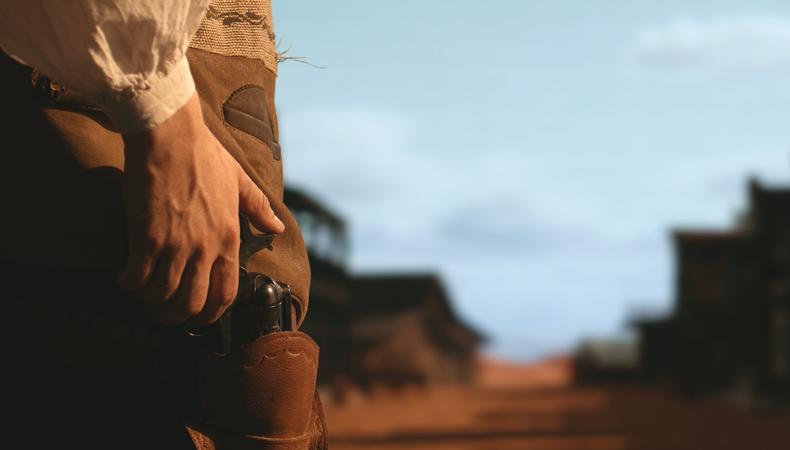
A traditional standoff relies on speed and skill to draw weapons. Seen most often in the Western genre (especially in spaghetti Westerns and neo-Westerns), a traditional standoff finds two or more participants squaring off with their firearms holstered. Each party intends to quick-draw their gun and shoot the opposition, and the victor of the standoff is determined by one’s speed and skill with their weapon. A standoff is also sometimes referred to as a “duel,” which harks back to the Western genre’s interconnected history with the samurai genre of Japanese cinema. Duels in these genres were commonplace and often followed a buildup of quiet tension with a quick release of violence.
In a Mexican standoff, weapons are already drawn. Participants already have their weapons pointed at the opposition. This distinguishing trait exchanges the skill required to win a traditional standoff for a more chaotic outcome of mutually assured destruction. A Mexican standoff might be resolved through a tense conversation, unfold like a high-stakes game of chicken, or devolve into a bloodbath. There’s no easy way for one party to come out on top after a Mexican standoff has begun; once someone has jumped the gun, they’d better stick with it, so to speak.
In either standoff, the type of weapon and the number of participants don’t matter. The Mexican standoff doesn’t necessarily require its participants to be wielding guns—any stalemate confrontation will do. As long as the circumstances ensure that no individual can walk away from the altercation clean, it’s technically a Mexican standoff. It’s for this reason that the term can be applied to non-cinematic subjects as broad as the Cold War and nuclear deterrence.
Many believe that the difference between a traditional standoff and a Mexican standoff comes down to the number of participants, with a traditional standoff involving two people and a Mexican standoff involving three people. This idea is incorrect: The number of participants has no bearing on whether a tense showdown is a traditional standoff or a Mexican one.
Though you can find countless outlets calling the climax of “The Good, the Bad and the Ugly” (1966) the quintessential Mexican standoff, it isn’t a Mexican standoff at all. It’s actually a traditional standoff in which the Man With No Name (Clint Eastwood) utilizes his clever planning and quick reflexes to cleanly come out on top. Adding a third person into the mix doesn’t turn a traditional standoff into a Mexican standoff as long as the guns remain holstered throughout the buildup and the outcome is determined by skill.
- Understand your why. Excavate the reasons your character finds themself in a standoff. Do they want the same thing (gold, drugs, and such) as the other participants? Are they seeking revenge? Or are they simply in the standoff for self-preservation? Knowing your character’s motivations will help you come in with guns blazing.
- Keep the eyeline. Be sure to look at the other standoff participants and their weapons, demonstrating your vigilance.
- Wield your weapon. Whether you’re using a prop gun or finger guns, be sure you’re holding and aiming it appropriately at your (pretend) enemy.
- Drive the tension. The Mexican standoff is a high-stakes ordeal; express the tension through your body language and facial expressions to really sell the scene.
“Hard Boiled” (1992), dir. John Woo
Woo is practically synonymous with the Mexican standoff trope, which is so prevalent in his films and those of his contemporaries that it might be better to call these types of scenes “Hong Kong standoffs” instead.
Woo’s roots are in Chinese opera, which (as opposed to the Italian opera that might come to mind) frequently centers around acrobatics and complex fight scenes with all manner of melee weapons and hand-to-hand fighting styles alongside singing. Woo translated the historically rooted style of Chinese opera and wuxia films into the modern age when he birthed “gun fu,” transmuting the swords into guns but continuing to use them in a similarly expressive way.
From “The Killer” (1989) to “Face/Off” (1997), Woo crafted a staggering number of incredible Mexican standoffs. One of his best can be found in his magnum opus, “Hard Boiled.” The lengthy warehouse set piece progresses from a massive shootout into a huge Mexican standoff with dozens and dozens of participants, then back into another gigantic shootout, before finally concluding with a second, smaller Mexican standoff between the film’s two main characters. It doesn’t get any better than this.
“True Romance” (1993), dir. Tony Scott
As depicted in “Hard Boiled,” not only can a Mexican standoff have less than three participants, it can have many, many more. The climax of this film, written by Quentin Tarantino, features a 12-way Mexican standoff with a fittingly epic conclusion.
“Reservoir Dogs” (1992), dir. Quention Tarantino
“True Romance” is far from the only film that Tarantino worked a Mexican standoff into. In fact, it’s something of a signature of his filmography and appears in nearly everything he’s written or directed. One of Tarantino’s biggest inspirations as a filmmaker was Woo, who he’s spoken of countless times, references within his own films (this scene from “Jackie Brown” (1997) name-checks Woo’s “The Killer”), and even lists Woo’s frequent leading man Chow Yun-Fat on the “inspirations” page of his screenplay for “Reservoir Dogs.” The film culminates in the iconic Mexican standoff.
“Shaun of the Dead” (2004), dir. Edgar Wright
While Mexican standoffs are most frequently found in the Western and action genres, they aren’t fenced in by any genre restrictions. For example, take this scene from the comedic zombie film that uses a Mexican standoff to hilariously drive up the stakes.
“The Office” (2009)
Yes, even the famed workplace mockumentary includes a Mexican standoff—albeit with finger guns—on the Season 6 episode “Murder.”
“Mexican Standoff (ft. Key & Peele)” (2013)
This short featuring Keegan-Michael Key and Jordan Peele depicts a meta Mexican standoff that just keeps going… and going… and going.