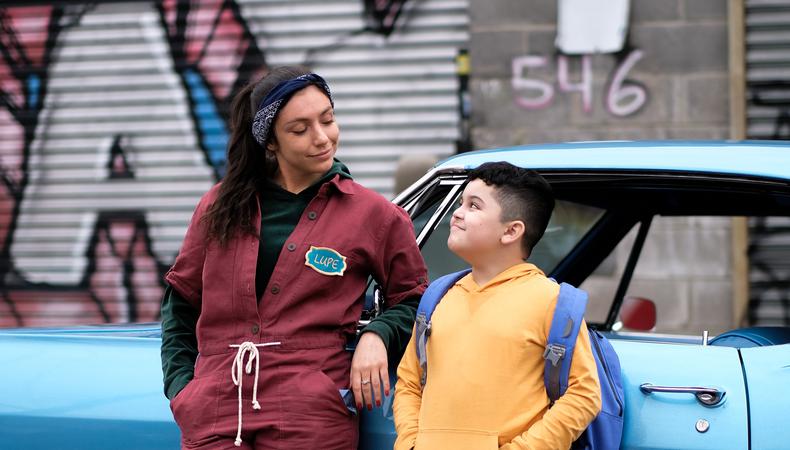
Latina filmmaker Dominique Nieves hasn’t just established herself as a filmmaker, she’s also an actor and medical professional. “When people don’t understand the connection between acting, filmmaking, and patient care, I explain it’s all about empathy.” She takes the skills she learned in her medical training, such as making patients comfortable and understanding their life circumstances, and puts it to use when she creates characters, figuring out how the character lives their daily lives, understanding how they would react in a situation, and what motivates them. While in medical school, she made her first short film “to give Latinx actors including myself more fulfilling roles.” The film was successful at festivals like Cinequest and Hollyshorts, leading Nieves to pursue film as a way to spread messages and ideas and impact other people.
Her new film “Our Lady Lupe,” which stars Backstage actors Derrick Delgado and Zoë Goslin, was similarly inspired by her background. “Latinx culture is full of superstition, mysticism, generational storytelling, piety—there’s a lot inherent to our culture that lends itself to genre,” she says. “Our Lady Lupe” incorporates the magical stories Nieves grew up hearing with her more urban reality. “I wanted to share a story of a Latinx family with a matriarchal structure and tell a realistic story that still focused on joy,” she explains. In the film, Chico, played by Delgado, faces the real-world problem of his mother having an unexpected expense and he goes on a magic-filled adventure to help her. To find the actors to bring her vision to life, Nieves posted a casting call on Backstage.
 How to Audition
 Make connections.
Having used Backstage herself as an actor and made a lot of industry connections and friends through projects she’d booked, Nieves started using Backstage to cast all her projects. “When I started my training in musical theater, teachers would always tell us stories about getting the hard copy of Backstage. It was a sort of ‘bible’ for performers of all kinds.” She’s cast two grant-funded films through Backstage and says “I’ve found some really talented artists here.”
Be willing and able to take direction.
After the initial self-tapes, Nieves did callbacks. “It’s so important for actors to be able to take direction and be flexible. Sometimes, the project grows and the direction for a character changes, sometimes we simply have no choice but to make a change on set due to logistics, and as a director, I need to feel confident the actors will be able to handle that the day of the shoot,” she says. Knowing she had a tight turnaround, she was looking for actors who would come to set completely prepared regardless of how little prep time they had.
Don’t worry if you don’t get the part.
Nieves says “Even the performers who I couldn’t cast for a particular project I kept in mind and brought on for projects afterward. I referred one actor to a reading a friend was casting with an Emmy-winning director. That’s why it’s important to always do your best work at auditions. People are always onto their next project and asking for referrals; it’s truly a business of relationships.”
Always be easy to work with on set.
When narrowing submissions, Nieves first decides based on headshot thumbnails if the actor fits the absolutely necessary criteria for the character. Then she goes straight to the actor’s reel. “I want to see your work. I look for grounded performances.” Finally, she’ll take a look at the résumé and if she sees an actor has worked with a filmmaker she knows, she reaches out to the filmmaker to ask how it was working with the actor on set. Being easy to work with is important and can lead to more work. Nieves directly reached out to Delgado, who starred in her previous film, to invite him to audition for “Our Lady Lupe.” “Our previous project was Derrick’s first starring role and now he’s gone on to have multiple network TV and studio film credits, including ‘Our Lady Lupe.’ It’s exciting to have been a part of that journey from the very beginning,” she says.
 A Casting Director’s 12 Rules for the Perfect Self-Tape
 Let your performance speak for you.
As the writer-director, Nieves had very specific ideas for how the characters would feel and sound. “At the end of the day, it was how the actors made me feel through their performances that made them stand out,” she says. “Zoë has top tier theater training and experience and it shows in her work in the best way possible. Zoë was so ready to play and live as the character.” Through her previous casting experience, she says she’s learned that the most important factor is casting the best actor. “Sometimes it’s tempting to stick with how the role was written, but if it’s not 100% necessary to the story for your actor to have a certain look, just audition the strongest actors who make sense for the role. For example, someone of smaller stature might be your most intimidating submission. The best actors will be able to convey the vibe you’re going for.”
Be adaptable.
In order to be COVID-19 safe, Nieves wasn’t able to have in-person rehearsals, so Goslin and Delgado needed to feel like mother and son without meeting in person. “I gave them exercises to build memories together as their characters and it was such a pleasure to see the joy on Derrick’s face when Zoë shared the memory she created for them. They had such a strong rapport, it was a perfect match.”
Save time.
For other filmmakers, Nieves recommends using the talent profiles to directly invite actors to audition. “I’ve ultimately cast actors who I found through the direct invite process before,” she says. She also suggests using bulk messaging: “When casting and producing, there are about fifty emails that require your immediate attention at any given time, so this was a huge time saver.”
“Our Lady Lupe” premieres on PBS July 13 at 9 p.m. EST.
Check out Backstage’s film audition listings!