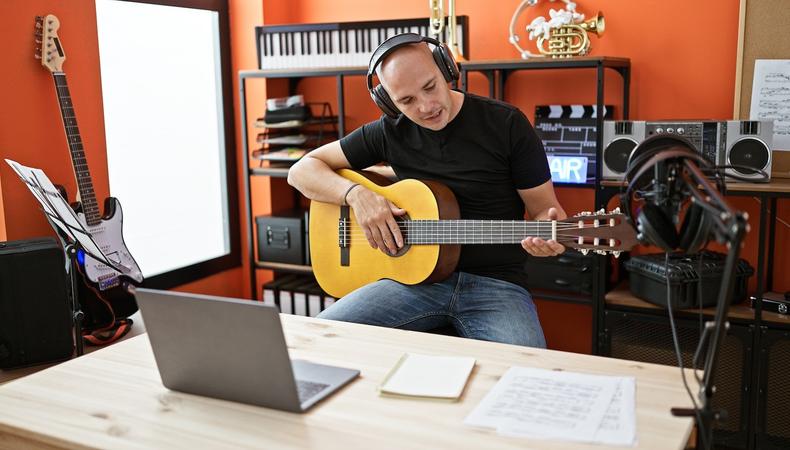
Humans have been banging out rhythms and singing melodies for as long as we’ve been around, from Paleolithic flutists to contemporary K-pop performers. So if you want to make music, the good news is it’s already in you. Let’s walk through how you can get it out.
1. Clarify your motivation.
Begin by naming why you want to make music. Are you aiming to perform live, produce tracks, express yourself privately, or write for film and other media? Different goals suggest different paths.
Someone interested in live performance should prioritize instrument technique and stage skills, while a budding producer might focus on learning a DAW (digital audio workstation) and sound design.
2. Listen with intention.
Before making music, develop active listening skills. Choose a handful of songs that move you and analyze them. Pay attention to instrumentation, arrangement, dynamics, and where the hooks land. Notice how tension builds and resolves, how the drums and bass lock together, and how vocals phrase lyrics.
Create multiple playlists: songs that inspire melodies, songs to study for production ideas, and songs with lyrical approaches you admire. Focused listening provides a palette of techniques you can adapt to your own voice.
3. Pick an entry point.
There are three common ways to begin making music: learning an instrument, developing your voice, or starting in a DAW. Each path has strengths, and most musicians combine them over time. To start, think about what you need to get your songs out.
“At the basic level, you need the ability to put your idea down in a way that’s recordable,” says musician Patton Magee. “If you hear a piano symphony in your head, but you sit down at a piano and can’t even work out the basic chords to it, that idea will probably go away before it’s been captured.”
- Learning an instrument like piano or guitar gives you immediate harmonic context; both allow you to play chords and melodies simultaneously, which helps songwriting.
- Developing your singing ability helps translate melodic ideas into full phrases and improves pitch recognition. Regular vocal practice and basic ear training accelerate songwriting and performance confidence.
- If you are drawn to electronic music or beat-making and want to land producer gigs, begin with a DAW. Ableton Live, Logic Pro, FL Studio, and GarageBand each offer accessible entry points. A DAW lets you arrange, sequence, and produce full tracks without needing a band.
Choose the path that excites you and commit to small daily habits. Ten to 30 minutes of focused practice every day beats sporadic marathon sessions.
4. Learn practical theory.
You do not need an advanced degree in music theory to create compelling music, but learning the essentials can help you solve problems. Understand major and minor scales, triads, common chord progressions, and basic rhythm techniques.
Practice transposing a chord progression into a different key and building simple melodies over those chords. Theory is a toolbox—treat it as a practical aid to expand options when a song feels stuck.
5. Start writing.
Begin writing from day one. Create simple sketches: a two-chord loop with a hummed melody, a drum beat with a bassline, or a short lyric fragment. Record ideas quickly using a phone or your DAW.
Magee explains, “It really can start a hundred different ways. The initial spark might come from a melodic hook or some chords you play that sound good next to each other; sometimes even just a drum beat that feels exciting and you start spitballing over it.”
Capture everything, even ideas that seem small. Habitually recording ideas trains your musical intuition and preserves moments you might otherwise forget.
 How to Write a Song
6. Shape ideas into structure.
Give promising ideas a form. Most popular songs use familiar structures such as verse–chorus–verse–chorus–bridge–chorus because they balance repetition and surprise. Instrumental compositions and experimental works may follow other arcs, but structure helps listeners follow and remember the song.
7. Record simple demos.
A demo’s purpose is to communicate a song’s core. You do not need perfect production—clarity and energy are most important. Export WAV files for quality and MP3s for sharing. Keep labeled versions so you can track progress across rewrites.
8. Collaborate and seek feedback.
Music is social, so collaboration accelerates growth and opens new possibilities. Work with singers, instrumentalists, producers, or friends who give honest feedback. You can find a community by attending local shows or replying to music job postings.
Accept constructive critique without letting it get you down, since revisions are intrinsic to the creative process. Credit collaborators clearly and keep communication about roles and splits professional.
9. Develop performance and arrangement skills.
If you plan to perform, rehearse as if you are onstage. Tighten transitions, practice stage banter, and consider how your movements while playing create a visual narrative. For recorded music, focus on arrangement: Decide where to introduce new instruments, how to build momentum across sections, and when to strip back for intimacy. Good arrangements make songs feel intentional and keep listeners engaged.
10. Build a release and promotion strategy.
Simple release strategies work better than chaotic ones, so take the time to plan out how you will share your music. Start by uploading a single to streaming platforms via a distributor, then create a couple of engaging social clips and set a release date.
Use an EPK (electronic press kit) or a basic website with links to your music, a short bio, and contact information. Engage with your audience by posting studio snippets, stories behind songs, and responding to comments.
11. Play live and gather data.
Performing live offers irreplaceable feedback. Pay attention to what songs get attention, when crowds respond, and which moments fall flat. Record shows for review and use those insights to refine arrangements and stagecraft. Early live performances also build confidence and help establish a following.
12. Establish sustainable habits.
Consistency is the most important ingredient when it comes to making music. Create a daily or weekly routine that combines technical practice, creative writing, and production work. Track your progress by saving dated demos so you can hear improvement over time.
Decide when to make music for yourself and when to shape it for an audience or market. Projects that prioritize personal expression often deepen your voice, while audience-focused work builds reach and viability. Alternate between both to sustain creativity and growth.
13. Embrace failure and celebrate progress.
Not every idea will succeed, but it helps to treat failures as experiments that inform your future choices. Maintain an archive of sketches, loops, and lyrics; ideas you shelved might become useful later. Iteration is the engine of musical growth.
“Just keep repeating and going through it,” Magee says. “If you keep playing with the clay, usually a shape will start to form on its own.”
Making music is a lifelong journey. Be sure to celebrate milestones like finishing a song, releasing a single, or completing a successful performance—you deserve it! Start small, stay curious, and enjoy the process of making music.