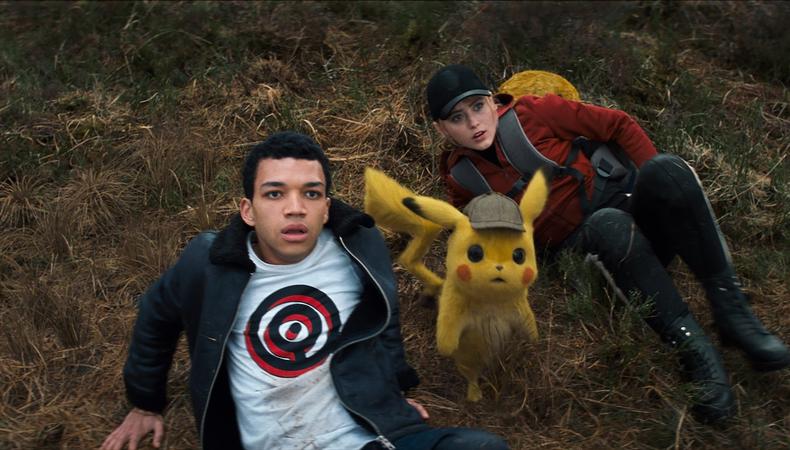
Despite the obvious differences, visual effects are just like acting in that there’s no science behind an emotionally resonant performance. Erik Nordby, visual effects supervisor for “Detective Pikachu” (in theaters May 10) explains, shares advice for how to perform opposite a visual effect, and describes what makes “Pikachu” star Ryan Reynolds such a uniquely wonderful—and watchable—actor (even when voicing a Pokemon).
What does it mean to work in visual effects?
Most of the world refers interchangeably to special effects and visual effects. Interestingly, those are two completely different disciplines. Special effects is when you blow something up on set, it’s if you need to create rain—anything you need to do practically that requires fire or water or something dangerous. Visual effects is everything that doesn’t exist on set but needs to exist in the movie. Anything that’s generated on a computer, for instance, is visual effects, and that’s my job. That job encompasses the entirety of all three phases of making a movie. You start with the director and the script, then you move into production. The role of visual effects in production is to make sure that, as you shoot the movie, you’re collecting all of the necessary information and shooting all of the shots so that I can then successfully add all of the computer-generated things in later. Then you have post, which is where we edit and put all of the visual effects into the film via computers and the artists that are making those visual effects.
READ: How to Believably Act Opposite a CGI Character
What is singular about the ‘Detective Pikachu’ visual effects?
The biggest thing is cartoon. Everything needs to be adorable and cute and colorful and bright, and so [director] Rob Letterman said, “I want to make sure I protect what the fans love about this, but I want to make a film that appeals to all audiences, so what I’m going to do is situate this extraordinarily colorful, cartoony world in the real, gritty, life-like, photo-real environment of the streets of London, and I’m going to shoot on actual film,” which no one ever does. We have all this beautiful film grain across everything in a way that swings the pendulum back to something that feels like you could reach out and grab it and touch it. It’s extraordinarily touching, funny, and Ryan Reynolds brings such an amazing angle to it all. But it feels real and it feels as though they could actually be living in it.
Speaking of Ryan Reynolds, how do you generally work with actors?
The very first thing we do before we shoot anything is to bring all of our actors into a series of scanning booths, because we have to recreate them digitally. We put them in these domes with 250 cameras, scan them, put textures on them. With Ryan, very early on we started shooting tests so we attached a camera to his head and all these cameras around him, and then he just went to town and improvised and performed the scenes with Rob. We do that before we start the movie…. The most crazy thing is that the animators are sitting at their desks all over the world, London and Montreal and Vancouver and Los Angeles and Abu Dhabi, and they are animating Pikachu with Ryan’s performance on their screen, making sure that all of that extraordinarily subtle humor that comes out of Ryan’s face also exists in Pikachu. If you go too big, the humor dies. He’s a very sarcastic, very specific type of performer, and you have to pay attention to all of that nuance.
From an actor’s standpoint, what are the biggest differences between a traditional performance and a VFX performance?
When you look at any performer we love to go see in the movies, there’s no scientific way to break down what it is we like about their performance. There’s no formula for what “good acting” is. There’s no formula of what’s a moving performance or what’s going to make someone laugh. [Similarly,] a lot of these animators have decades of experience in wrapping their heads around how to get a fully digital character—independent of voice—to emote. Ryan is very physical, so we make sure that we not only have a head camera on his face, but also a full waist-up [camera] as well as a full body, because a lot of his performances come from his shoulders and the way he holds his clavicle. Where his eyes look is a huge part of it. We would evaluate Ryan’s performance and just try to understand it. It’s a really tricky thing; it’s not something you can just put in a computer and replicate.
On the other side of that coin, what is it like for actors to perform opposite a visual effect?
At the end of the day, you’re staring at a monster on a blue screen and you have to pretend you’re scared, but it goes so much deeper than that. This movie especially is a bonding film, so [star] Justice Smith would show up on set and we’d have a series of puppeteers and we dropped a bunch of money on extraordinarily realistic-looking puppets. The first thing we would do is block the scene as if this other actor did exist, as if Pikachu did exist. And Pikachu would go through the performance, would inhabit the space. That puppeteer would understand that character almost as well as Ryan understood that character. We would actually go ahead and shoot the first take always with the puppet in it, and then we would remove the puppet and Justice would then memorize exactly where Pikachu would be, all of his eyelines memorized, and then would perform two, three, or four more takes without anything, just him and the scene. It was really remarkable; he deserves all the praise we can give him.
What would you tell someone who wants to get into visual effects?
Visual effects is quickly becoming this massive, very democratic way of filmmaking. When I got into it, you needed to drop so much money and have so much access to high-powered equipment, and it was a huge barrier. There is literally no barrier anymore. There is so much free software out there that is high-quality. If you have the drive and you have some ideas and you have a great story, there’s nothing stopping you and a group of your friends or people you want to work with from putting out something that is extraordinarily tantalizing. It is just telling the story, and you don’t need anything other than a computer and a vision.
This story originally appeared in the May 9 issue of Backstage Magazine. Subscribe here!
Want more advice from today’s top creators? Read all our interviews right here!