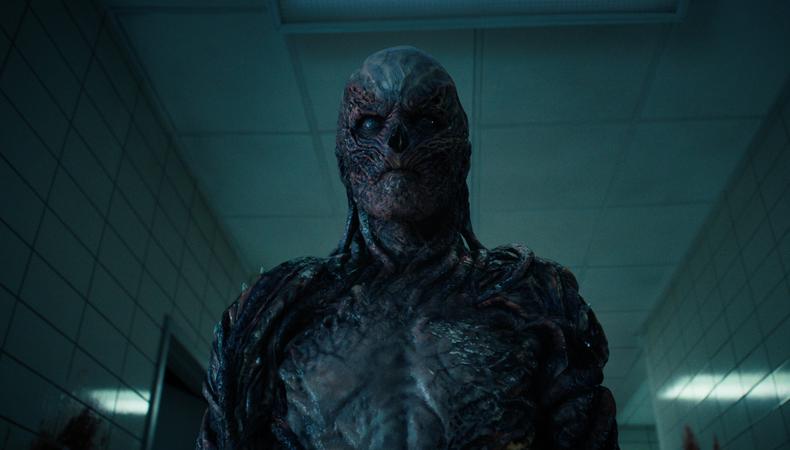
For Season 4 of “Stranger Things,” the Duffer brothers wanted an “iconic villain” to haunt the show’s Hawkins heroes. They found it in Vecna (Jamie Campbell Bower), a terrifying creature crafted by prosthetics and makeup designer Barrie Gower, who also worked on the Night King for “Game of Thrones.” Here, he takes us through the making of the Upside Down’s newest (and scariest) nightmare.
How did you land on the design for Vecna?
[Visual effects supervisor] Michael [Maher’s] concept art was pretty close to what you see in the show. We spoke to him about how this was going to be a mutated human; they wanted this large mutated left hand and thick vines wrapping around, and for the colors and textures to have a relationship to the Upside Down world. We studied all the colors and forms from the Upside Down—the look and feel of it.
We looked at a lot of anatomy, all kinds of colors and shapes from the animal kingdom and sea life. We were looking at all weird and wonderful underwater animals, bruising colors and vegetation, mushrooms, all kinds of things. The actual color palette of Vecna we honed down to about 10 colors total, and we had a makeup palette made up for our little team of those 10 colors that we could go to each day.
RELATED: How to Get Cast on 'Stranger Things'
What led to the decision to use prosthetics instead of a full suit for Vecna?
When we figured that Vecna would have a lot of movement as a character and there would be a lot of interaction with the main cast, we had to take that into consideration. Rather than putting him in an ’80s-style rubber monster suit that we could zip up the back, which would, in theory, give us a lot of buckles and create a whole load of problems, we decided that we would pretty much adhere everything to [Bower’s] skin. It was about 25 appliances in total. We had the nails, dentures, contact lenses, and a mechanical left hand, which was a Lycra glove with articulated aluminum finger extensions that went on first, with the glove over the top. Everything was all pre-painted here in the U.K., because when you’ve got a really long makeup application, you want to spend as little time as possible artworking on the day, especially when you’ve got full-body coverage. And for every day Vecna [was filming], he had a brand-new set of appliances, because by the end of the day, they’re all destroyed.
How long did it take to apply everything?
It was a seven-hour application on Jamie every day. I think we got it down to about six hours and 20 minutes—that was the quickest.

What advice would you give someone who’s getting started in the industry now?
It’s a tiny little industry, the makeup effects industry. [But] nowadays, education is a lot more accessible for doing prosthetics and makeup effects. When I started my course in 1994, it was one of two courses in London at the time. Now, there are many courses, and there are many makeup schools.
The key is to build a good portfolio before you even get into any kind of educational course. It’s practicing on your friends and yourself. There are lots of videos on YouTube where you can see the basic techniques. Once you’re on these courses, a lot of it is about networking and approaching people—the prosthetics companies and makeup designers—even seeing if you could go for a day to shadow a team and watch what they do.
This was your first season working on “Stranger Things.” How did you wind up connecting with Netflix and the Duffer brothers?
We got the call out of the blue from one of the producers, Iain Paterson. He approached us saying that the Duffer brothers were looking to do a character for the new season who would be head-to-toe covered in prosthetics. Then we had a meeting about a week later and spoke to Ross and Matt [Duffer] and their concept artist, Michael Maher, who is responsible for all their VFX on the show. Michael had done some beautiful concept art and already had the blueprint for how they imagined Vecna to be. They had a very clear vision of what they wanted from the outset.
 How to Become a Special Effects Makeup Artist
 I also read that they were interested in the work you did on “Chernobyl” and “Game of Thrones.” What context did that give you for what they were looking for?
They were talking about wanting an iconic villain for the fourth season—somebody who was in the realms of the Night King that we created for “Game of Thrones.” Matt and Ross are good friends with David Benioff and Dan Weiss, the showrunners of “Game of Thrones.” And then, because of the finish of Vecna’s skin and all his textures and coloring, they’d seen “Chernobyl” on HBO and were fans of the radiation burn victim makeup that we did with the makeup designer, Daniel Parker. I think they put two and two together and figured out it was the same group of people who did both.
Vecna’s left hand is his weapon of choice; we see all these closeups of him holding it over the heads of his victims. What went into making it work?
It was primarily going to be a fully digital left hand because of the nature of Vecna using these fingers to penetrate people’s skulls. But we figured out that we could probably make something practical with finger extensions. We worked very closely with a mechanical technician, Adam Keenum, who built these aluminum finger extensions. Originally, the fingers were probably about six to eight inches longer than what you see in the show. We did an initial makeup test in the U.K. with all the appliances on Jamie, but nothing was painted, and the Duffers loved everything they saw. About two weeks before [the final camera test], they were saying, “Could you just have a little play in the workshop using the glove and see how this works against somebody’s head?”
It was borderline comical. It was also going to prove really difficult for Jamie to orchestrate them. His movement was amazing, but to be able to orchestrate these super long fingers to get in the right position every time… So we remodeled the hand and remade the finger extensions, and everything was about six inches shorter than it originally was. We went out to Atlanta to do this final makeup test and we had both versions of the hands, but we stuck on the one with the slightly smaller fingers. That’s what we camera tested, and that’s what got signed off on. I think they were definitely right.
This story originally appeared in the Aug. 4 issue of Backstage Magazine.