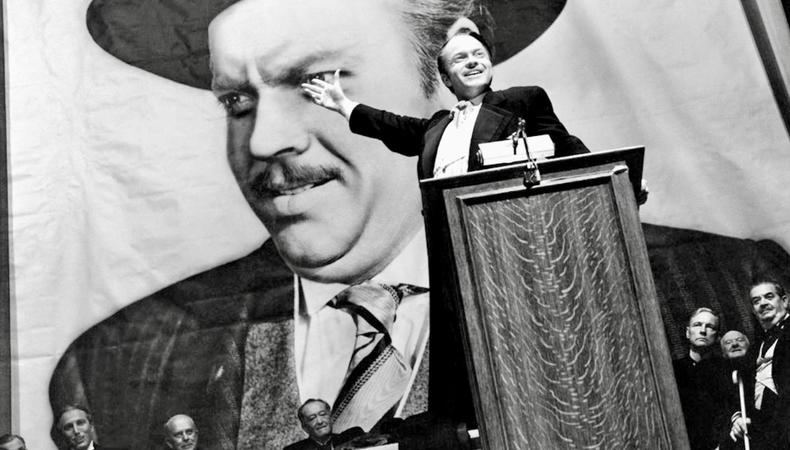
An enfant terrible of the stage and screen, Orson Welles was always likely to be its most influential outcast. His towering masterpiece “Citizen Kane” became a lightning rod for controversy even before it was released, and it only obtained its sterling reputation in the decades that followed. But the outspoken, difficult, demanding, and visionary director did more for cinema than just his most famous work. Here’s a look at how five of Welles’ movies had a landscape-shifting impact even if they weren’t immediately appreciated when they arrived in theaters.
“Citizen Kane” (1941)
“Citizen Kane” set a dubious tone for Welles’ career in that he would make a landmark work of cinema that wouldn’t be fully appreciated by contemporary audiences. With his signature bravado, Welles made a debut feature that was not only technically demanding (at one point he dug into the studio’s floor just to get the proper angle on a shot) but riled up one of the most powerful people in the world, newspaper magnate William Randolph Hearst. While much has been made of who fully deserves the writing credit between Welles and screenwriter Herman J. Mankiewicz, we should remember that film is a collaborative medium. More importantly, while Hollywood somewhat buried the movie to appease Hearst, the groundbreaking (literally and figuratively) approach Welles took to the biopic—from its expressionist-fueled visuals and deep-focus lensing to its non-linear chronology of events—has been felt for decades in epic character studies like David Lean’s “Lawrence of Arabia” and Paul Thomas Anderson’s “There Will Be Blood.”
“Macbeth” (1948)
Post–“Citizen Kane,” it becomes trickier to gauge Welles’ influence if only because he struggled to retain final cut on his pictures. For example, his 1946 feature, “The Stranger,” was historically important as the first Hollywood film to show footage from the Nazi concentration camps. However, Welles was unhappy with the picture because the studio drastically cut down on exposition scenes in this story about a Nazi hunter (Edward G. Robinson) pursuing a German commandant (Welles) in a small New England town.
But the Bard was a cornerstone of Welles’ career. Even before coming to Hollywood, he staged a landmark adaptation of “Macbeth” with an all-Black cast and reset the action in Haiti. His filmed “Macbeth” is more traditional but demonstrates the imaginative visuals he would bring to bear on his work. While Laurence Olivier’s “Hamlet” won the Oscar for best picture that year, you can see how Welles’ striking sets, intense contrasts, and willingness to tinker with the text when necessary, had a greater impact on Shakespeare adaptations, especially those of the Scottish play such as Akira Kurosawa’s “Throne of Blood,” Roman Polanski’s own “Macbeth,” and Joel Coen’s “The Tragedy of Macbeth.”
“Touch of Evil” (1958)
The oner—a shot that plays out in a single, unbroken take—has become a directorial flourish that signals tremendous skill. Yet so many sit in the shadow of the way Welles opened “Touch of Evil,” a thrilling noir about murder and corruption at the U.S.-Mexican border. As Welles demonstrates, it’s not simply a matter of precise timings and the ballet of everyone hitting their mark as the camera moves through the action; it’s also about holding tension. The scene opens with a bomb in the trunk of the car, and the audience must wait for it to go off as the car is surrounded by bystanders, oblivious to the danger they’re in. Like other Welles movies, this one had to be recut and restored over the years, but its impact as a quintessential noir that marries Welles’ technical skill with the seediness of the environment continues to reverberate.
“The Trial” (1962)
Welles’ adaptation of Franz Kafka’s novel is a prime example of a project he never could have made in Hollywood. Even as the industry was trying to climb out of the shameful haze of the Blacklist, “The Trial” is a biting, brutal, surrealist nightmare of a system that serves not the people but its own ends. American audiences of the 1950s and ’60s could swallow uplifting tales of sacrifice like Stanley Kramer’s “High Noon” and Stanley Kubrick’s “Spartacus,” but it would take later generations to embrace the caustic, mind-bending story of Josef K. (Anthony Perkins) trying to untangle the accusations against him when resolution is impossible. If you look at any kind of politically fueled piece of social horror, from Jordan Peele’s “Get Out” to Jonathan Glazer’s “The Zone of Interest,” you’ll find some DNA from “The Trial.”
“F for Fake” (1973)
How many documentaries or docuseries start these days with the subject sitting down in front of the camera before the clapper hits, reminding us we’re in a constructed story? Welles relishes the line between fact and fiction in this influential feature about a notorious hoax inspired by gleeful art forger Elmyr de Hory. While too many modern documentaries get twisted around their own inquiries, Welles’ never loses sight of how he’s exploring the ways art is a lie that tells the truth—and how that idea becomes increasingly difficult in the case of an art forger who tells you he’s forging works of art. Is his skill nothing or is art only a matter of an expert who can tell the difference? The best documentaries follow Welles’ lead by using their artifice to ask more questions rather than running out of steam and calling it ambiguity.