In the 1930s, Hollywood’s restrictive Production Code presented a serious storytelling problem to filmmakers looking to create challenging work. Onscreen, evil had to be punished, misdeeds could not be rewarded, and there had to be clear heroes and villains. Of course, real life isn’t like that. Enter film noir, which cleverly snuck between the lines of the code’s moral rigidity to turn its edicts into riveting stories of fatalism, melancholy, and despair.
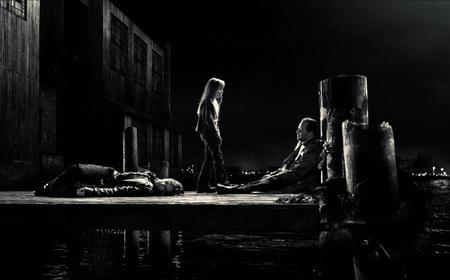
Marked by stark visual contrasts, chiaroscuro lighting, and sharp angles pioneered in German expressionism, noir plunges the viewer into morally gray situations in which good may triumph, but at a questionable cost.
The idea of noir storytelling has its roots in the hardboiled detective fiction of authors like Raymond Chandler and Dashiell Hammett. Although French critic Nino Frank coined the term “film noir” in 1946, the genre’s classic period began in the early 1940s and lasted through the 1950s.
Film noir movies, directors, and characteristics
The misanthropic morality of noir—and the visual style that accompanies it—separates it from typical crime movies.
Consider John Huston’s 1941 adaptation of Dashiell Hammett’s 1930 detective novel “The Maltese Falcon,” one of the first-ever noir films. The titular statuette may be “the stuff that dreams are made of,” but for private detective Sam Spade (Humphrey Bogart), there’s only cynicism and bitter compromises. The death of his business partner (Jerome Cowan) sends Spade into a web of intrigue, but his conclusions are about accepting what his moral code demands even if it means sacrificing any glimmer of happiness. The case is solved, but the film never feels triumphant, upending the idea that justice inherently leads to emotional catharsis.
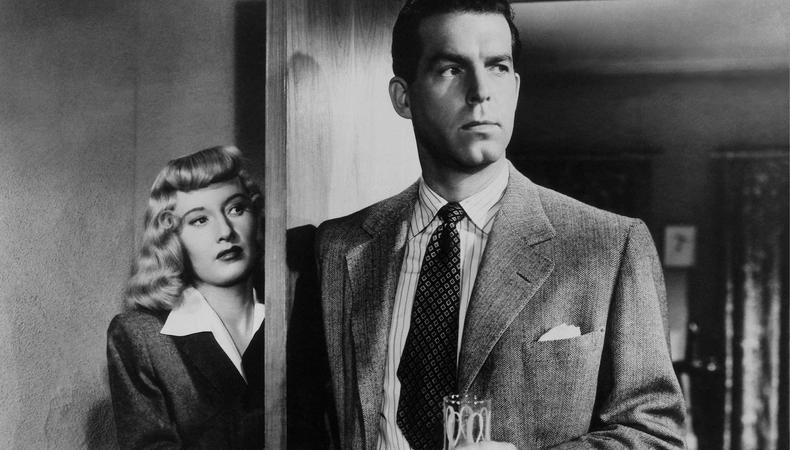
Noir can also be the story of doomed men, lured in by a femme fatale to engage their darkest impulses. In Billy Wilder’s “Double Indemnity” (1944), insurance salesman Walter Neff (Fred MacMurray) thinks he’s clever enough to help a beautiful woman (Barbara Stanwyck) murder her husband and share the life insurance payout. However, his error in judgment reveals him to be a poor sucker like every other man in her life.
 How to Use Chiaroscuro Lighting in Your Filmmaking
Similarly, in Edgar G. Ulmer’s B movie “Detour” (1945), the protagonist (Tom Neal) is beset with bad luck—a victim of circumstance whose terrible decisions only exacerbate his dire straits. The fatalism of this story lands even harder as the movie begins at the end of the tale, and viewers then learn how things got so bad for our antihero.
Jules Dassin’s terrific crime procedural “The Naked City” (1948) is hopeful about the restoration of justice through thoughtful detective work. But compare that to the filmmaker’s 1950 noir “Night and the City,” in which a desperate con man (brilliantly played by Richard Widmark) finds that his misdeeds create severe blowback as the London underworld closes in around him. It’s a world where there are no heroes, just differing shades of criminality.
While noir means “black,” savvy directors can still find their way to the genre in glorious technicolor. Look at John M. Stahl’s “Leave Her to Heaven” (1945), which focuses on an insanely jealous woman (Gene Tierney) who will go to any lengths to maintain her husband’s (Cornel Wilde) attention and affection. Even in full color, Stahl never loses sight of the protagonist’s dark, twisted psychosis. Or watch Alfred Hitchcock’s vibrant “Vertigo” (1958), which uses the framework of a detective story to explore the male gaze and the fetishes of a man (James Stewart) so infatuated with a woman (Kim Novak) that he’s desperate to recreate her visage.
Other foundational examples of the film noir genre include:
- “Shadow of a Doubt” (1943), dir. Alfred Hitchcock
- “The Woman in the Window” (1944), dir. Fritz Lang
- “The Postman Always Rings Twice” (1946), dir. Tay Garnett
- “The Big Sleep” (1946), dir. Howard Hawks
- “Dark Passage” (1947), dir. Delmer Daves
- “The Lady From Shanghai” (1947), dir. Orson Welles
- “The Third Man” (1949), dir. Carol Reed
- “Angel Face” (1952), dir. Otto Preminger
- “The Night of the Hunter” (1955), dir. Charles Laughton
- “Sweet Smell of Success” (1957), dir. Alexander Mackendrick
- “Touch of Evil” (1958), dir. Orson Welles
The end of the noir era + the rise of neo-noir
Unsurprisingly, the decline of the Production Code throughout the 1960s led to the decline of classic noir. Its transgressive ideas found their way into a new Hollywood that was looking for more morally complex characters, a change influenced by the New Wave cinema popping up across post-war Europe. The idea of moral ambiguity became a trademark of films like Arthur Penn’s “Bonnie and Clyde” (1967), Mike Nichols’ “The Graduate” (1967), John Schlesinger’s “Midnight Cowboy” (1969), and more. That’s not to say noir disappeared overnight, but rather it became subsumed into even darker, grittier films like Alan J. Pakula’s “Klute” (1971) and Roman Polanski’s “Chinatown” (1974).
This era gave way to neo-noir films, whose twisted morality existed not as a way to avoid censorious officials, but to stand out in a landscape powered by corporate desire for crowd-pleasers. Independent filmmakers found they could thoughtfully combine pulp ideas with noir visuals to reinvent them for a modern audience (as Joel and Ethan Coen did with their 1984 debut feature “Blood Simple”). They could also bring in perspectives that Old Hollywood never considered, like Black war hero and investigator Easy Rawlins (Denzel Washington) in Carl Franklin’s 1995 film “Devil in a Blue Dress.”
The rise of neo-noir helped breathe fresh life into the genre, noting its previous limitations and then expanding on them in interesting ways. While Ridley Scott’s “Blade Runner” (1982) is sci-fi first, it pulls heavily from noir with its trench coat–wearing protagonist (Harrison Ford) running through rain-soaked streets, wondering if his job putting down replicants is any better than being a paid assassin.
There was also room to be more sexually explicit as seen in films like David Lynch’s “Blue Velvet” (1986) and Paul Verhoeven’s “Basic Instinct” (1992), updating the implicit motifs in movies like “Double Indemnity” of a man whose desires lead to an exploration of his darker impulses.
Although the exact definition of “noir” will usually be up for debate, it is a genre that seeks to embrace emotional complexity and offer its audience no easy answers. These stories haunt and disturb not with monsters or gore, but by asking audiences to explore the darker sides of their psyche—asking if they’re only a few decisions away from being as desperate and depraved as the characters onscreen.
Noir came out of a moral crucible, but it refuses to offer moral uplift. With noir, you live with the darkness.