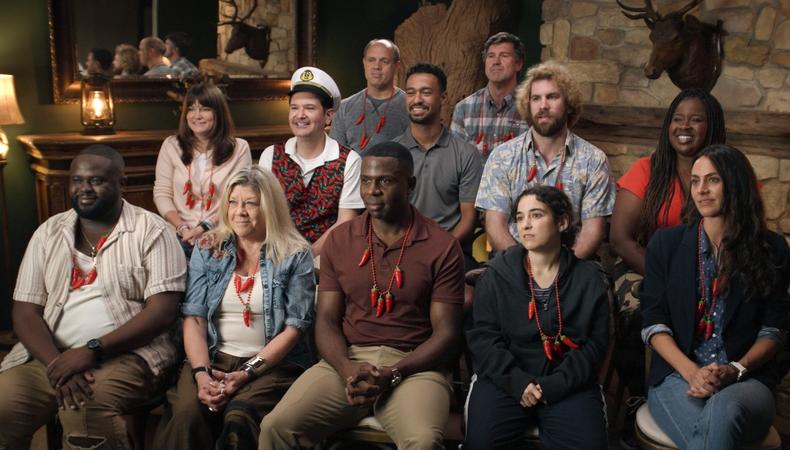
How do you build a fake company that feels 100% real? It starts by casting the perfect “employees.”
Cast members Alex Bonifer (the aimless–yet–well–meaning Dougie Womack Jr., heir to the fictional condiment brand Rockin’ Grandma’s Hot Sauce) and Stephanie Hodge (the company’s very blunt and unfiltered accountant Helen Schaffer) join longtime casting director Susie Farris to deconstruct the secret sauce behind “Jury Duty Presents: Company Retreat.” Together, they dive into the high-stakes improv required to maintain a 24/7 ruse, the surreal logistics of Sia’s cameo, and the delicate architecture of a long-form hoax.
From the endurance of staying in character for weeks to the invisible cues used to guide their “hero” (the unsuspecting and genuinely good-natured temp Anthony Norman) through a fabricated corporate nightmare, the trio reveals how they turned a staged offsite into a believable reality. Here’s how Season 2 of Prime Video’s hit series captured lightning in a bottle once again.
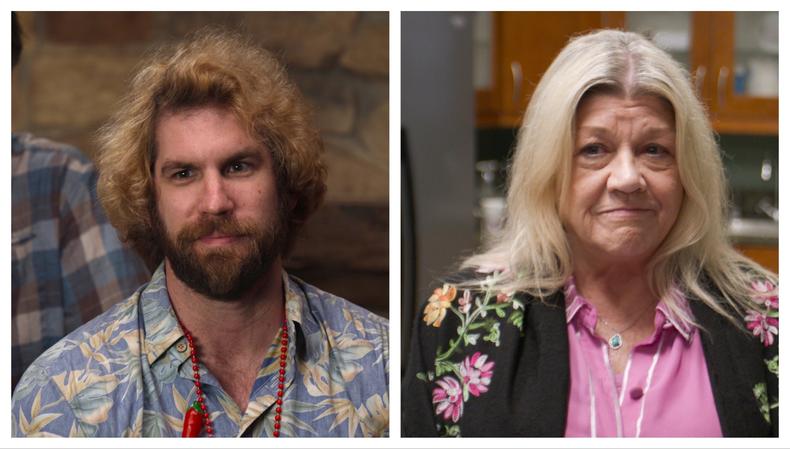
Alex Bonifer and Stephanie Hodge on “Jury Duty Presents: Company Retreat” Courtesy Prime Video
Was the casting process different for Season 2 following the success of Season 1?
Susie Farris: It was different—not because of how viral [Season 1] went, but [because] of the characters going into Season 2, and because of the larger scope of Season 2 being at a company retreat. They were much more tailored than going into the first season. On a jury, you can cast anyone and everyone, any face. And at a company retreat, it had to be way more specific. Dougie Jr. was the off-the-wall one, but you can’t have an entire company full of Dougie Jrs. So it was way more tailored [than Season 1] and sort of backing into characters, rather than the other way around.
How do you find performers who can be funny while also remaining grounded enough to be believable as a real person?
SF: That’s what the whole audition process is for. The first step is: We ask them to send in a self-tape. We give them a couple of prompts that are story-adjacent so we’re not giving everything away. Then they send in a two-minute video, and we’re looking for creativity and cleverness with what story they’re telling us. One of [the prompts] was like, “You had a really crazy weekend. Tell us about it.” So what they’re telling us has to be interesting and funny without being too outlandish and caricatured. We’re looking for grounded and funny at the same time.
So much of the show is long-form, unscripted interactions. Alex and Stephanie, how did you show that you could handle that?
Stephanie Hodge: I guess the reality of the situation is we didn’t know we could do this 24/7, because nobody had ever asked us to do 24/7 before. But you enter into it with the faith that you can do it, and you meet the other people that you’re working with, and you have the faith that they’re going to have your back. Immediately with this group, we just knew—and we spoke it to each other—that we would have each other’s backs. So if anything went wrong or haywire, or anybody got nervous or misspoke, there were other people right there that were going to pick you up out of that drowning water, shake you off, dry you up, and fix it for you. There was that security.
Alex Bonifer: Just to use an improv term and “yes, and” what Stephanie just said: It was so much about leaning on each other. Once we got going, we really did become a family, like what you see in that last episode. We worked together through the rehearsal process, building strong bonds and developing these characters, our backstories—none of that was handed to us. We got to build all of that together.
Speaking from my own experience, I started doing improv 19 years ago when I was 18, so I’ve been doing this for a very long time. In terms of building the confidence to sustain the character for the entire stretch, it really started about half an hour before my callback, my in-person audition. I went to a Vons [supermarket] wearing the suit Dougie wears at the client cookout, minus the full beard and blond hair. I was like, Is this going to feel unrealistic? Are people going to think I’m doing a bit? So I walked around Vons for about half an hour, interacting with people, asking if they knew where the bathroom was or if they liked a certain flavor of Gatorade. That gave me so much confidence to go: Oh my god—I can exist as this character in the real world.
What’s your best advice for someone trying to get better at improv?
AB: Do it. It’s an art form of 10,000 hours. If you want to get good at it, you just need repetition and practice. I teach and perform at the Groundlings Theatre, and what I tell my students is, the best way to get good at improv is to do a lot of it—to fail, to perform for five people in the back of a bar somewhere. Just get those reps. My sole focus, as it pertained to improv, was to get good at it before I got seen by anybody who would cast me. My mantra was: Get good before you get seen. That’s why I got my start a little bit later. There was a period when I thought I was going to move to Chicago and just do improv and work in finance or something. But I fell in love with this art form instantly, because I seldom feel more present than when I’m improvising.
Courtesy Prime Video
Can you share a specific scene where Anthony’s reaction was so good you had to pivot?
AB: My mind always goes to the final scene. Not that we had to pivot, necessarily—we just got to watch in awe of what he was saying to Doug [Womack Sr.], played by the one and only Jerry Hauck. It was unbelievable. You can’t script that.
SH: That final moment when he said, “You were my favorite”—just, my heart. I had such a bond with him; Alex had a tremendous bond with him. My bond was… I was like his auntie, you know? And the truth was, when I told him that he saw me, that was the absolute truth. That was a very real moment. And he saw Helen, and it was one of those things where Helen’s a character, and she’s going to say what she thinks—she’s a little rough, a little hard to take. But he just ate her up and was so kind and loving and sweet, and never once treated her like she was just the old lady. That was just so endearing. That’s just who he is. He sees everybody.
You both have some big projects under your belt. Were there any close calls where Anthony seemed to find you familiar, or did you have a backstory ready for why you looked like a TV star?
AB: The beard and the hair were initially bred out of necessity. I was on “Kevin Can F**k Himself,” which [aired] on AMC—but right when we were in the rehearsal process, it got picked up by Netflix, and my face was on the carousel. If he’s just scrolling through Netflix, he’s going to see that. I was fortunate enough to film some commercials where I look a lot more like this, so initially, it was like, “I need to hide behind something.” But the more I got into it, the more it just fit for the character. And then that’s when I approached our producer and said, “Can I actually bleach my hair, but leave the roots exposed?” Once I did that, I wasn’t too concerned about getting recognized, because I almost didn’t recognize myself.
But we did come up with a backup plan in case he was like, “Hey, look, there’s someone that’s familiar [to] you on TV. I saw him in a commercial.” Jake Szymanski, our director, and I came up with: [in Dougie Jr.’s voice] “Yeah, dude, I don’t know. I got a buddy who’s like, getting into commercials, and so I kind of just shot this, like, you know, pizza commercial. It was crazy.” So, play dumb and admit it was me, but as a non-actor who just had a buddy with a camera, basically.
Susie, was there anything that you were looking for when casting to make sure talent wouldn’t get recognized?
SF: The best part of casting the show is the element of discovery. I pull from my mental Rolodex—from every single job that I’ve ever worked on, and every comedy show I’ve ever gone to, every performance [on] Broadway. It’s the sum of the parts. It’s next to impossible to cast people who have never been seen, so we have layers of the process. I’m the first filter, and if I think someone is too recognizable, I don’t send them. But with these guys, they obviously have a body of work, but I felt that maybe with character, costume, hair, and makeup, it would work. So if I send [talent] to the producers and anybody flags it—“Oh no, that face is too familiar to me”—then they get cut.
I have to talk about Sia. How did she get involved with the series?
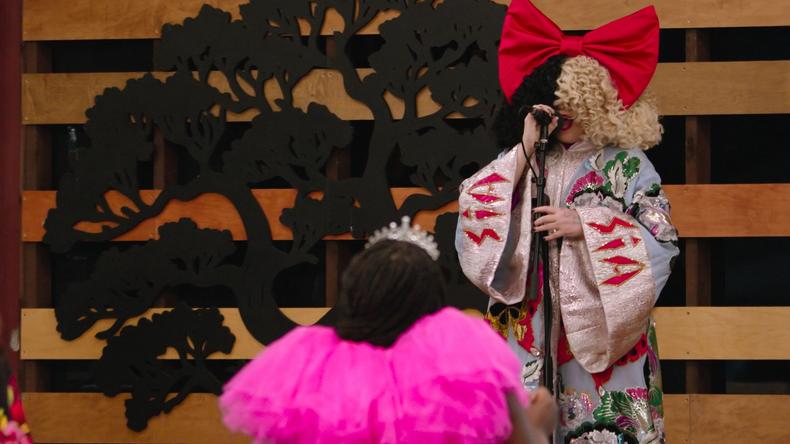
SF: She got involved through some of the producers who had a relationship with her. The tricky part about bringing in somebody famous is that there’s not a lot of leeway in terms of flexibility with shooting times; they need to be available. And so that helped, [having] a personal relationship.
What was it like sharing the screen with her?
SH: Oh, it was amazing—really pretty amazing, and startling, too, because they didn’t tell us who it was until the moment that she got there. And that was stunning. I was really happy to see her. I got to say, “Who the f**k is Sia?!” which was fun.
AB: Internally, I was freaking out. It’s one of those moments you really have to let your full body soak in that feeling, because we’re getting a private concert from one of the most talented singers of my lifetime. I love her so much. It was so challenging having to be a grumpypants about the whole thing; but meanwhile, I’m like, Oh my god, I can’t believe this is happening! So yeah, it was awesome. Once in a lifetime.
Courtesy Prime Video
The cuts to Dougie Jr. being upset are hysterical.
AB: I am glad that on the walk up the hill I had presence of mind. Because I do want Sia to know that I love her, and I don’t want her to think, “Well, everyone seemed to love it, except that one guy with the blond hair and the weird pants.” But when we were walking up the hill, I was happy that I got a little redemption.
Susie, in general, are there any deal-breakers or red flags that would make you hesitate to bring an actor back during the audition process, even if they were talented?
SF: The only deal-breaker for me is bad behavior. Everyone is putting their best foot forward. They want to do a good job; we want them to do a good job. It’s a heavy lift to see so many people for everything. So as long as your intentions are good, I’m thrilled.
What can an actor do in the audition room, beyond a great performance, to make your job as a casting director easier?
SF: Making strong choices gives me something to work with. My favorite thing about casting is that if you’re not right for something, as long as you make choices, you make an impression. And if you’re not right for this role, I will work my hardest to find the right role. I met Stephanie years ago, and I don’t know why she wasn’t on my radar, but she wasn’t. I met her on a pilot, and I was like, Who is this lady? She’s so amazing! And I kept thinking, I need to find the perfect role. So here we are.
What’s your best advice for getting cast on a show like “Jury Duty”?
SH: Don’t be afraid. That’s the most important thing. A lot of actors are tentative going into [auditions]. You ask too many questions: What do they want? What are they looking for? Well, [they want] you! You got the audition, so you’ve already crossed that battle line. So just go in and do what you can do. Don’t be afraid. And never give up.
AB: Yes, never give up. I am a man of many mantras, many sayings, and many isms. One of the things I like to tell my students, as a sports fan, is that no one hits a home run trying to bunt. Make a big choice that’s true to you, to what you find funny. [Don’t think]: I don’t want to offend or upset them. Forget all of that and swing for the fences. To Susie’s point, they’ll remember that swing. They’ll go, “That didn’t connect on this one, but that’s going to connect on something.” So that’s been my philosophy: Just go for it.
SF: Similar to what Alex just said: Always commit. Have fun and commit. When Alex came in for his callback, it was hilarious, off the charts. The commitment from the second he walked in the room was one of the best things I’ve ever seen.