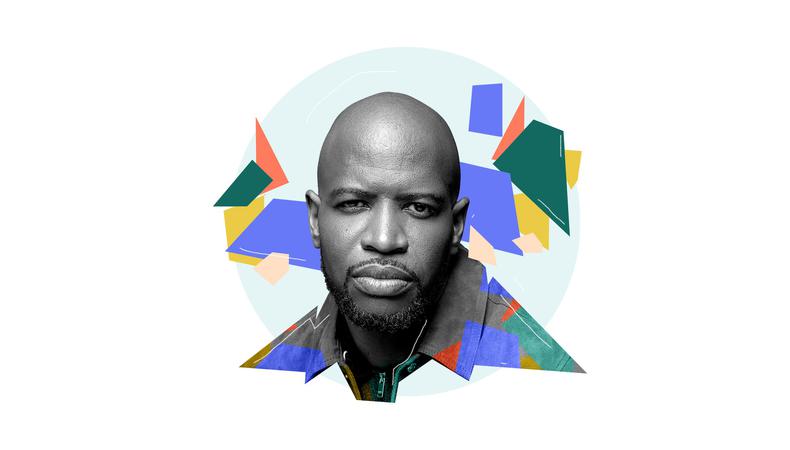
Living in Baltimore in the early 2000s provided Kwame Patterson the serendipitous opportunity to audition for HBO’s “The Wire.” His raw talent turned a two-line gig into a recurring character, Monk Metcalf, on the acclaimed series’ fourth and fifth seasons. Over the last decade, Patterson has appeared on Showtime’s “Ray Donovan,” Sony Crackle’s “The Oath,” and in screwball feature “Barb and Star Go to Vista Del Mar.” He can currently be seen on Season 2 of OWN’s “David Makes Man” as the titular David, now an adult, grappling with whether the instincts that helped him survive as a young man still serve him or it’s time to find a new way to live.
What was the moment you decided you wanted to be an actor?
I was watching friends on “The Wire” back in the day and said, “It would be cool to get a small part on that show.” One day, they were shooting in one of the neighborhoods—“The Wire” would use real people off the streets—and so I just had to send in a photo. I didn’t have a headshot at the time, so I was like, OK, let me get a photo. They had me come in and I read for two lines, got those two lines, thought that was going to be the end of it, [that] this is going to be something cool to tell my kids one day: I was on this show called “The Wire” back in the day. But those two lines turned into my character becoming a regular character on the show. From there, I was like, this is what God has planned for me. I moved to California and started taking acting classes.
 Uzo Aduba Couldn’t Get Into SAG-AFTRA Until She Booked ‘Orange Is the New Black’
Tell me about your time on “The Wire.” Was that your first time on a professional set?
Oh, yeah. I remember a lot of nerves. My hands used to shake. “I don’t want to mess up, I don’t want to forget my lines.” “The Wire” was very family-oriented. There was always a lot of love. There was always someone there to help you. Jamie Hector, who played Marlo, we’re really good friends now. Back then, I remember talking to him a lot, asking for advice, and he would just talk me through things. At that time, I had never taken acting classes—I was just being myself—so sometimes you have questions because you don’t understand certain things [about the character]. There was always someone there to help answer those questions for me.
What advice would you give your younger self?
Be more free. I was so uptight because I was nervous, because it was my first experience on a major set. I’d give myself more freedom. Live in the moment, be present.
How did your career change once you moved to Los Angeles?
I learned a whole lot. I went to audition in L.A., because I had come off “The Wire” and now I’m just auditioning. I’m going in for drug dealers. These are the same roles I just got done playing. A casting director said, “Man, you have such great natural instinct but you lack technique,” and I said, “What’s technique?” And he looked at me like, How did he just come off one of the greatest shows and [doesn’t] know what technique is? I was so green. I had to learn everything. When I started taking acting classes, I had to learn how to breathe through moments, I had to learn how to stay in my voice. I had to learn how to use substitutions. I had to learn a lot. It took me years to figure it out.
“Actors, a lot of times, we don’t realize if you focus on your strengths, that’s what’s going to book you the job. You can work on that other stuff later.”
Shout out to Lesly Kahn! Lesly Kahn’s an acting teacher in Los Angeles. She focuses on your strengths and not your weaknesses. Actors, a lot of times, we don’t realize if you focus on your strengths, that’s what’s going to book you the job. You can work on that other stuff later. Once I got that, I started working a lot more. We tapped into my strengths. One of my biggest strengths is my presence. I have a strong presence, whether it’s an audition room or when I come on screen. They say there’s power in stillness. I’m an introvert, so I’ve always been very laid-back. When [Kahn] saw that, she knew how to turn to that, to use that. She was like, “The thing that we see behind your eyes is so powerful.” I didn’t realize that’s what I was doing, but she pointed it out and I started to pay attention. I started to lean into that.
Do you think having raw talent that you needed to hone later helped you in the long run?
I think so. There were times in my life when I was really struggling, that I wished I had some formal training. Because I felt coming off of “The Wire,” coming to L.A. would’ve been easier. You’re coming from Baltimore and it’s the big fish in a small pond thing. Then you come to L.A., where a lot of people are trained at schools in New York and at Yale. When you come in with no training, as much as they say they want you to be natural and they don’t want you to look like you’re acting, they want you to act, and I had to figure that out. It’s confusing if you don’t know the business. I was so green. Now, when I look back at it, I think it was a blessing that I didn’t know anything, so it was easier for me to take in everything like a sponge.
What is your worst audition horror story?
I got an audition for “12 Years A Slave” and I went to put myself on tape with a friend of mine. I should’ve been a bit more focused, but I did that audition in a Nike Dri-FIT shirt and some velour sweatpants. For a slave audition. It was so ridiculous. When we looked back at it we were like, “They’re probably still laughing at that tape.” Man, I wish I could take that back. After that, I made sure that I paid attention to detail. So the next time I ended up doing an audition for a slave, I went to a thrift store and I got a flowy white shirt and roughed it up, made it dirty, got some drawstring pants and cut them up a little bit. It was one of those moments where you think, Cool, put this on tape, and I had no idea. I was so clueless.
 How Steve McQueen Became the Storyteller of His Generation
 What’s the wildest thing you ever did to get a role?
For the NWA movie “Straight Outta Compton,” I put together an audition tape for the role of MC Ren. I was trying to get in and they weren’t trying to see me. What I did was I found clips of MC Ren and I did a split screen and I mimicked every single thing he did so they could see that I could be him. I did his rap and my hand movements exactly how he was doing. I sent that audition tape in and literally got a phone call the same day. I made it all the way to where I was pinned for the character, but then they ended up going with Aldis Hodge. It went from them not even wanting to see me to the director telling me, “That’s the best audition tape I’ve ever seen.” I knew I had to do something outside of the box. If I just sent in a regular audition tape, that’s not going to work. I have to show them I can be him.
How did you first get your SAG-AFTRA card?
It was “The Wire.” I didn’t even know what that was, either. My third episode, casting called me and said you have to join SAG. Back then SAG was cheap. SAG and AFTRA were separate back then. I never joined AFTRA, but when they merged, I automatically got grandfathered in.
What performance should every actor see and why?
Chadwick Boseman in “21 Bridges.” He was playing this detective and his nuances are just so amazing. And it had a little bit of action and a little bit of “John Wick”–type fighting in it, as well.
Looking for remote work? Backstage has got you covered! Click here for auditions you can do from home!