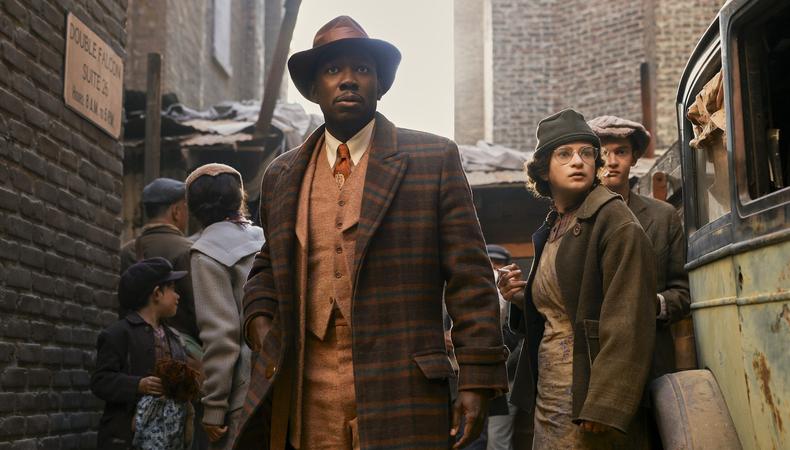
Lamorne Morris certainly isn’t an up-and-comer. He’s already played the beloved Prank Sinatra himself, Winston Bishop, across seven seasons of “New Girl.” In 2024, he won an Emmy for “Fargo” and portrayed comedy trailblazer Garrett Morriss in Jason Reitman’s “Saturday Night.” But “Spider-Noir” seems to have swung him into a new stratosphere. “I get [called] Winston a lot when I go out,” Morris tells us. “But I was at the airport two days ago, and I heard, ‘Yo, Robbie!’ ”
That enthusiastic airport attendee was referring to Robbie Robertson, the crack reporter Morris plays over the course of eight episodes of Disney+’s “Spider-Noir.” The series, from creator Oren Uziel, follows an alternate-universe Spider-Man (Nicolas Cage), known here simply as the Spider, who spends his non-crime-fighting hours as whiskey-swilling private investigator Ben Reilly.
Available to watch in either stark black-and-white or dazzling color, “Spider-Noir” takes after the morally gray, chiaroscuro-lit genre in its name, allowing Morris, Cage, and costars Brendan Gleeson, Li Jun Li, and Karen Rodriguez to toe the line between parody and pastiche, taking their cues from the Bogarts and Bacalls of old Hollywood.
Here, we sat down with Morris to talk all things “Spider-Noir,” his hopes for a second season, finding chemistry with the “unknown variable” that is Cage, and a lot more.
Congrats on “Spider-Noir.” What has it been like to watch the reaction?
It’s so crazy. I can give you a little timeline. I remember when I first started on television, it was “New Girl.” The fanfare was pretty cool, but I was kind of unknown at the time. So my junkets weren’t big, or I wasn’t requested or anything like that. I was still very grateful, and I was like, “This is it. I’ve made it.” Then I got my other show, “Woke,” for Hulu, and people really dug it, but it was during the pandemic. I never got a chance to be out in the world and experience anything. I never saw a billboard or anything.
Having [“Spider-Noir”] come out, and having traveled to other countries to promote it, seeing the reception it’s getting in real time, it’s kind of an “Oh my God, this is what it’s like” moment. Because you film something, and you never know what the reception will be. All you know is that you worked your ass off on it. You tried stuff. You see what the final edit looks like and you go, “I think it’s really good. I wonder what people will think.” But you never know.
So far, people really seem to have gotten behind it. It’s wild. I get [called] “Winston” a lot when I go out, from “New Girl.” I get, “Hey, Winston!” But I was at the airport two days ago, and I heard, “Yo, Robbie!” I didn’t turn around and look. Somebody’s running up. I look back, and the guy’s like, “Bro, you killed it! Robbie Robertson!”
Is there any word on a second season?
You never know in this day and age. Stranger things have happened. Knock on wood, I really think we would have fun doing it, and I think the fans will really dig it too. It’s out of my hands, but I would love to.
Have a lot of people been mentioning that there is a character in this show named Winston who is not played by you? Does that take some getting used to?
I felt the same way! I was like, “Why would they name him Winston?” Also, the mayor is named Mayor Morris. My mom even said the same thing. She was like, “It’s weird there’s a Winston and a Morris, and you were none of them.” But it’s funny. It’s a cool Easter egg, too, for those who have watched my past work.
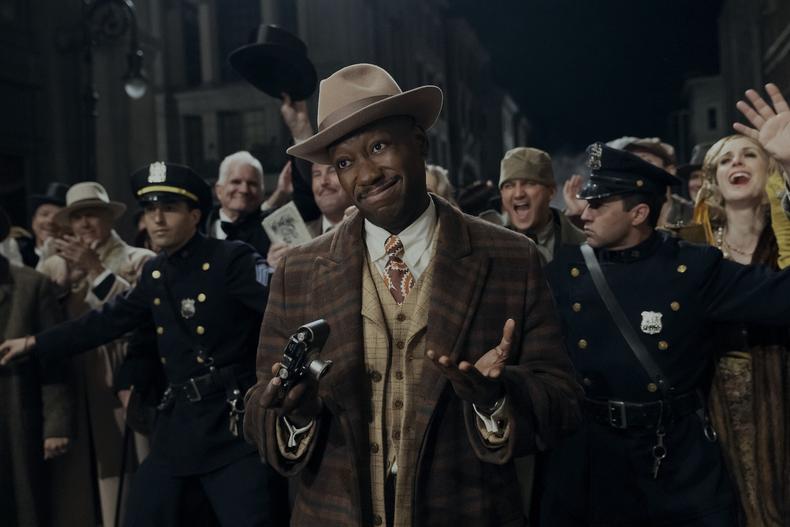
It’s such an exciting time for you, so I’d love to go back to the beginning just to chart how you got here. The first play you ever auditioned for was “Godspell” in high school. What do you remember most about that time?
The thing I remember most from the very beginning was fear. Because it’s something I haven’t been able to shake. Being onstage is the most gratifying experience a performer can have, I think. But on the flip side, if it’s not going too well, it’s just you up there. And it’s a lonely place.
For me, it was not just the fear of rejection, but the fear of vulnerability. Can I take big risks? Can I take big swings? Will people look at me weirdly? How will I be judged by the way I want to perform this? I could be way off base here. Is it cringy? All these things go through your mind. And I remember it back then, vividly. I had to sing. My mom used to always say I knew how to sing, but I was a silly singer. I did it as a joke. Having to do it there, with all these other kids who are real singers… These kids were, like, singers. And you have to do this in front of people. It was a jarring experience.
However, I did it and got in the play. So I thought, Hey, look, behind that fear is nothing. It’s not real. It’s an idea. It’s a perception. And once you’re in a room full of artists, you all have that same fear. Even the casting directors are nervous for you. It’s your time. Just go be bold. I think a lot of actors can attest to that. That initial push is that hump you have to get over. But then once you do it, it’s like riding a bike. Just use your instincts and perform.
I have to imagine there’s an added layer to those initial nerves when you’re acting across someone as embedded in pop culture as Nicolas Cage. Can you tell me about the moments when you finally settled in on “Spider-Noir” and felt like you were comfortable?
There were a few moments, because it took me maybe a full scene to get loose with him. One moment, he actually just winked at me. We were doing a scene, and he gave me a little nod and a wink, and I went, “OK, good.” I forget what I did, but I took a risk. I did something that wasn’t scripted.
He’s the most professional actor I’ve ever worked with. He knows every line of dialogue from start to finish of the series before we start shooting. He’s off book, never drops a line. Me, I drop lines all the time, because I’m gunning it. I’m trying to be loose. I like to feel it out. I can rehearse all day, and I have my acting coach, Anthony Gilardi, who’s a godsend. We break down characters, and we do all the things that we need to do.
But when you get on set and you’re opposite someone like Nic Cage, that’s the unknown variable there. What’s he gonna do? Is he gonna go full Cage all of a sudden? How do you react? How do you respond? So you’ve gotta stay loose. I intentionally stay loose with every actor unless they request [otherwise]. So with him, I remember, I think I took a pickle and ate it—something like that, which wasn’t in the script. He gave me that little approval.
Another thing is, in between takes, I liked to do bits and just ask him silly questions about his life. Try to get personal to see if he’ll open up a little bit, because that will break the ice. I started asking random questions about jewelry because he’s a watch collector. Asking him about private jets. Like, “I saw the nice car you had out there. How much did that cost?” Stuff that has nothing to do with what we’re filming. But it’s opening him up to my personality a little bit. So if I do want to get bold or take a big risk in a scene, I know I’m not going to be met with any resentment.
You get the opportunity to do your Nicolas Cage impression in the show. Was that in the script or something you brought to the table?
Nic Cage. In my house, he’s always been a thing. So me doing a bit of a Nic Cage impression has always been something I’ve done. It was in the script that I got on the phone [pretending to be the Spider], but it wasn’t that I would do his voice. I just started doing his voice. I remember there was a lot of conversation back and forth. What you saw was a tame version. Because they were like, “Dial it back a little bit. We want a happy medium. We don’t want you to necessarily try to sound like him, but you could have his essence.” So that was my more Jimmy Stewart version of Nic Cage.
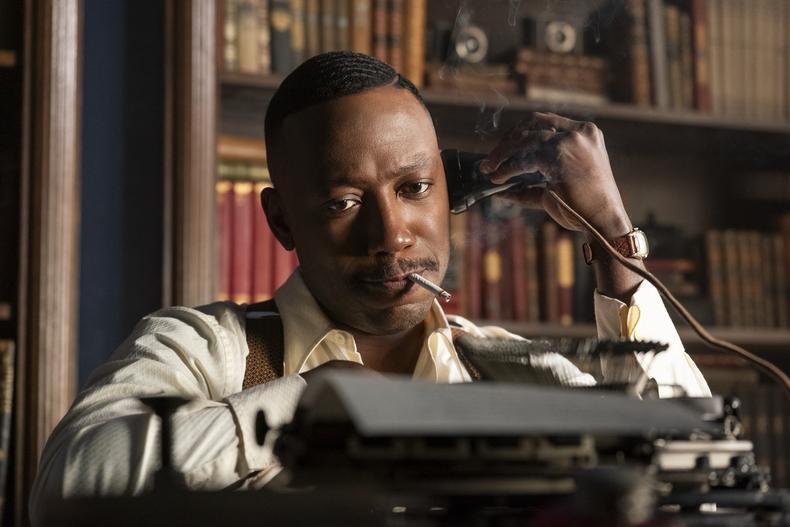
You were tossing out, like, “Face/Off” Nicolas Cage.
Oh, yeah. Castor Troy a little bit.
When a project is this committed to a genre and a style, I can imagine it’s easy to slip into something closer to an “SNL” character rather than a human being. How did you honor all the noir trademarks without it ever feeling like satire?
You workshop it. Myself and Abraham [Popoola] had to shoot the scene in the shantytown, and Whitney [Rice] and I shot a scene in a hotel, four months before production started. That was way before I had met Nic. That was way before we had a cast table read. So you’re really rehearsing; you’re finding your character in real time. [Director] Harry Bradbeer said something to me. Me and Whitney, we were just trying something. Literally getting live feedback. “How’s that work? How’s that work?” Whitney had gone big. I had gone big. Bradbeer came into the room, and his note was, “Uh, hmm, it’s not a parody.” Then he runs back to the video village. That one little line, I was like, “Ah, I totally understand it now.”
So you try way too far and then dial it back. I was watching Denzel Washington and Don Cheadle in “Devil in a Blue Dress.” I wanted to see how they played into the noir of it all. Denzel played into the genre a little bit more. Don Cheadle just played [the character]. They both worked beautifully.
You won an Emmy in 2024 for “Fargo.” Did you feel a shift at all, a “before and after” feeling? Whether that’s external in your career or internal in how you felt about yourself.
It could be different for other actors, but the shift for me was more internal. Because one of the fears—and it’s a very irrational fear—is impostor syndrome. The feeling of, “Do I belong here?” Because you grind and you grind and you grind for every job. You grind to get that gig, to get that recognition. The fans have always been there. The fans have always supported me. But sometimes you feel like, “Man, I don’t know if I’m working this year.” There are moments where you’re like, “I haven’t booked anything, and I’m coming off this great show or this big movie. Damn, what’s next?” The shift internally told me, no matter what the job is or what’s coming, what you think is coming or not coming your way, they see you. You belong here.
People ask me all the time, “Did you feel any different after you won the award? And I say, “If I walked backstage and that trophy came with a duffel bag filled with $10 million in it, then I could tell you I really felt it.”
Now, that’s a change.
That’s a change. But no, [the situation] was still, “Hey, you’ve got an audition tomorrow.” I remember M. Night Shyamalan had a movie I really wanted to do. It was after the Emmy. And it was like, “No, you’ve got to audition for it.”
“But I have this Emmy”!
Yeah. I’m good for it! I’m good to perform the way you want me to perform. He was like, “No, you’ve got to audition.” I auditioned and didn’t get it. But it was one of those things where the change has to come from within. You have to change the way you think, the way you feel about yourself. Have some more self-respect. Just because somebody didn’t cast you for a job, that isn’t a knock on you. There are a million other actors out there who are just as qualified. Somebody else got their opportunity. That’s all that is.
That’s easy for me to say, because I won the award. But you still have to keep that energy. Just because you have an Emmy doesn’t mean that you’re supposed to have every job. Just because M. Night’s making a movie doesn’t mean he has to cast you. The Emmy definitely helps. It definitely doesn’t hurt. Beyond anything, it just gave me more confidence in this business and a sense of security. Because all I want to do is perform to take care of my family. It’s the only thing that I love doing. That and now golf. But acting is the thing I love the most.
Before I let you go, I must ask: What do we have to do to get a “Game Night” sequel?
There are four people you gotta talk to. Jason Bateman. Rachel McAdams. John Francis Daley. Jonathan Goldstein. Give me five minutes in a room with them, and I feel like we’ve got a sequel coming. But it’s hard to get them all together in the same room. I see them all individually. But together, no.
This interview has been edited for clarity and length.