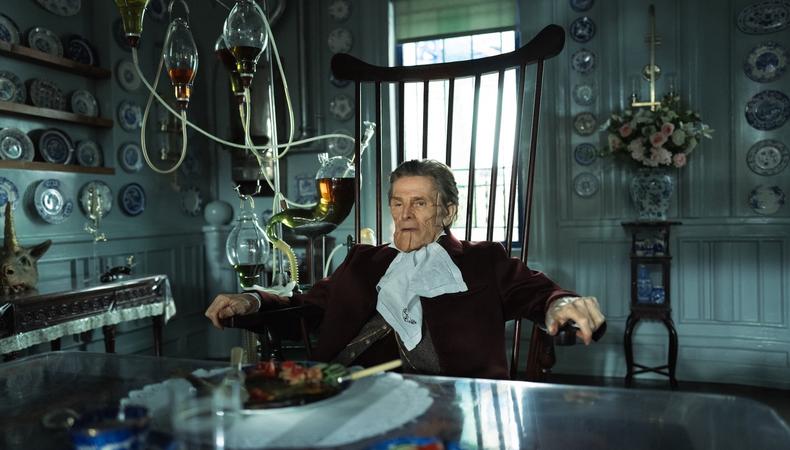
Everybody loves a goofy genius—whose elementary school didn’t feature that poster of Albert Einstein with his tongue sticking out? So it shouldn’t be any wonder that the mad scientist has fascinated us as a society for over 200 years. Although the archetype has certainly evolved over time, it remains as prevalent as ever today. If you find yourself ready to take on this role but have no idea where to begin, you’ve come to the right place. We’ll have you enthusiastically shouting “it’s alive!” in no time.
The mad scientist is a stock character defined by the following characteristics:
- Eccentric: They may be legitimately insane or just offbeat, but either way their experiments and inventions are outlandish, haphazard, and often dangerous or immoral. Wild hair, strange clothing, and unusual mannerisms accompany this character type.
- Unorthodox: This character often uses technology that would be impossible for an actual scientist to accomplish, such as reanimation, time travel, and alchemy. They may eschew scientific ethics in pursuit of their (often nefarious) goals.
- Isolated: They’re generally not an actual scientist working in a lab, but rather an odd, reclusive, disheveled person performing experiments in a basement.
- Megalomaniac: Some may develop a god complex due to their genius and ability to manipulate life—and sometimes, death. Case in point: In “Poor Things,” Dr. Godwin Baxter is literally called “God” by his creation (although Willem Dafoe balks at the notion that his character would fit into the archetype).
It seems the first agreed-upon example of a mad scientist was introduced in Mary Shelley’s 1818 novel, “Frankenstein,” though in concept only—the word “scientist” wasn’t even invented until the 1830s. It’s also worth noting that the idea of playing God (to usually disastrous results) is an ancient one. Was ancient Greece’s Daedalus a mad scientist prototype? Possibly. Though not a hard-and-fast rule, it seems that earlier examples of mad scientists are portrayed as being legitimately scary, tortured beings, while more contemporary examples portray them as cartoon-ish, non-threatening weirdos.
What narrative role do mad scientists play?
Mad scientists seem to generally be major players in the plot, rarely being relegated to side characters. That said, the mad scientist can serve any purpose from a plot standpoint: the cause of his own demise (Dr. Frankenstein), a quirky hero (Jimmy Neutron), the well-meaning friend of the protagonist (Dr. Emmett Brown), or a supervillain (Dr. Doofenshmirtz).
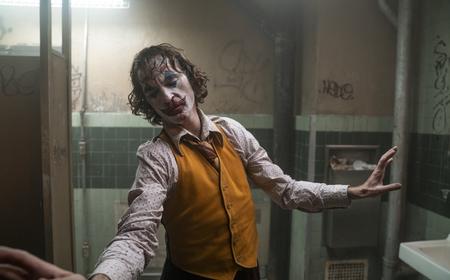 What the Best Movie Villains Can Teach You About Playing the Baddie
 Mad scientists can be found in any medium, but the best-known are so iconic that they happen to be featured across multiple mediums.
- Dr. Victor Frankenstein: Dr. Frankenstein is the original mad scientist, and with good reason: He’s ambitious, unethical, motivated by defying the laws of nature, and is ultimately destroyed because of his own creation. Frankenstein has been reimagined many times since his original appearance in the 1818 novel, being featured in countless films and a 2011 stage adaptation at the National Theatre in London. For a goofier take, check out “Young Frankenstein,” both the 1974 screen classic and the 2007 Broadway musical. Here’s Gene Wilder giving his best mad scientist in the former:
- Dr. Henry Jekyll: Also known as Mr. Edward Hyde, this poster child for the archetype takes things a step further from Dr. Frankenstein by not only creating a monster, but even becoming one. First featured in Robert Louis Stevenson’s 1886 novella “Strange Case of Dr. Jekyll and Mr. Hyde,” Dr. Jekyll’s influence has also stood the test of time. The novel has been adapted over 100 times in films, onstage, and even as a musical. This clip, taken from the 2015 “Jekyll and Hyde” TV series, demonstrates the twisted path a mad scientist is willing to take in the pursuit of discovery:
- Dr. Emmett Brown: Featured in three films and now a new musical, the “Back to the Future” role made famous by Christopher Lloyd is the quintessential goofy take on the stock character. He’s scattered, brilliant, and a little bit mysterious (where did Marty meet him? We may never know). Peep the eccentric behavior in this clip:
Female mad scientist characters are hard to come by. The film “Birth/Rebirth” reimagines the “Frankenstein” story with a woman doctor who reanimates a child. The 2023 “Camelot” revival portrays the (often cut) character of the sorceress Morgan Le Fay as a mad scientist of sorts, although whether or not she is mad or simply misunderstood is left up to interpretation. Many similar characters, such as Grandmama from the “Addams Family” franchise and Miss Eglantine Price from “Bedknobs and Broomsticks,” seem to be a better fit for the crone/hag archetype than the mad scientist. If you’re a playwright or screenwriter looking for an untapped market, maybe this is your potential in.
This archetype has been around for centuries, so how do you make your portrayal stand out? Here are a few things to consider.
- Study the archetype. Seek out characters that embody the eccentric brilliance of the archetype. Beyond the legends already mentioned, consider Dr. Strangelove, Dr. Emilio Lizardo, Dr. Seth Brundle, Dr. Bunsen Honeydew, and Dr. Walter Bishop. Note the acting choices made
- Look the part. Try out different clothing choices, accessories, and hairstyles that reflect the character’s eccentricity and interests. Use body language such as a hunched-over walk or exaggerated gestures to physicalize your character’s madness.
- Embrace chaos. If you’re playing a mad scientist, you’re going to have to bring the “mad” into the equation. This is generally where we’d say “make it your own, without it becoming over-the-top,” but, let’s be honest, if your piece features a mad scientist, chances are things should at least be a tiny bit over-the-top. Find the character’s eccentricities and run with them.
- Find a human core. To offset all that wackiness, it’s important to figure out this character’s why. What made them the way they are? Perhaps your mad scientist has only the best intentions, or perhaps they’re seeking revenge. Either way, it’s important to figure out the underlying motivations of the character to make sure they are fully fleshed-out, instead of just kooky. This character will always be a huge part of driving the action of the story they’re in, so their stakes must be as real as everyone else’s.
- Make it your own. The mad scientist is so immediately recognizable that it’s extra important you’re able to make it your own. You may be the latest in a long lineage to take on Dr. Frankenstein, so what do you bring to the role that nobody else can? Go over your own peculiar mannerisms, habits, and obsessions and let them help craft a memorable, complex version of the character.