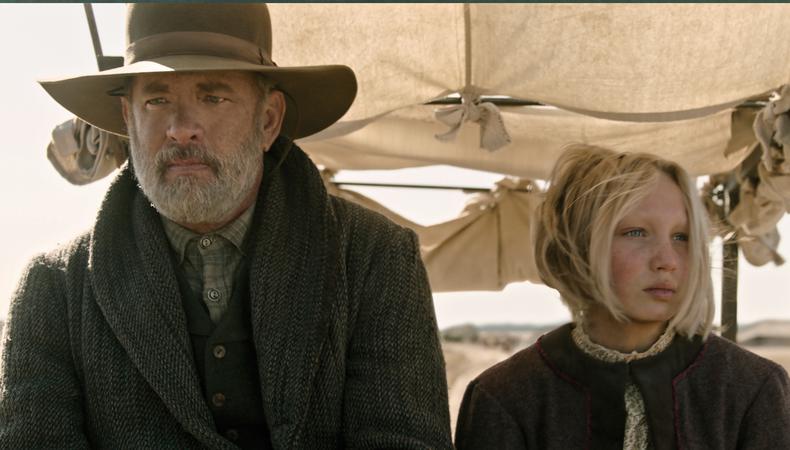
With its commentary on anti-Black racism and seemingly irreparable divides between neighbors, “News of the World” is among the year’s most relevant films. That it is set in the 1870s is not beside the point; according to director and co-writer Paul Greengrass, it is exactly the point.
The script is based on the 2016 novel of the same name by Paulette Jiles, set in post–Civil War Texas. When he read an early draft of the book, Greengrass thought that “it felt like it was about our time now.” He adds, “It was about healing and the search for home, with Kidd and Johanna being characters who are lost, searching for connection [and] a place to belong.”
 20 On-the-Rise Performers You Need to Know in 2021
 Now playing in select theaters and on demand, the film reunites Greengrass with his “Captain Phillips” leading man, Tom Hanks, playing a different sort of captain here: Jefferson Kyle Kidd, a forlorn Civil War veteran who travels from town to town sharing local and national news stories with the people he meets. In his travels, he comes upon an orphaned girl who’s been kidnapped by the Kiowa tribe. So begins a sort of reverse-engineered journey to bring her home.
The girl, Johanna, is given equal storytelling weight as Hanks’ Kidd. It’s a tall order for any actor, let alone one who’s 11 years old, as Helena Zengel was when they shot the film.
“I definitely thought, going into this film, that the biggest uncertainty was going to lie in choosing the young girl to play Johanna,” Greengrass recalls. “I thought it was going to be an agonizing process, and that every day working on set with whoever that young girl was going to be would be anxious-making for me, because she was going to have to act head-to-head with Tom Hanks.”
Oh, and the young actor would also need to speak German, as dictated by the part; bonus points if she was comfortable on horseback. A producer tipped Greengrass off to Zengel thanks to her work in the 2019 German hit “System Crasher.” They met and ran through a couple of scenes, and she got the gig.
READ: Why Tom Hanks (Finally) Agreed to
Play Mr. Rogers
Still, Greengrass admits, you can’t be sure until you start filming. But “I never thought about her with anxiousness from that day on,” he says. “The very first scene [the actors] did together was the scene where they first meet in the woods. Tom came up to me after and said, ‘She’s absolutely terrific.’ ”
Throughout shooting, Zengel displayed an intuitiveness and awareness of on-camera performance that many adult actors do not possess. In one scene in particular, when Johanna must wordlessly relive a past trauma, Greengrass recalls, chuckling, that “someone gave her a note after the first take, and she said to me, ‘Oh, you mean just before I turn, when I want the camera to really see the emotion on my face?’ That is one heck of a sophisticated understanding of performance and technique.”
It also speaks to the broader scope of the film; Greengrass opted not to use explicit flashbacks, as he thought it would cheapen the intent. “It would diminish the acting rather than inform it. I wanted them to be experiencing, in the moment, what had happened in the past in order to move beyond it in the future,” he says.
The film also gave Greengrass his first chance to make a classic Western—a genre in which journeying is basically intrinsic, and one that allowed him to call upon a slew of fantastic character actors to play fantastic character roles.
“A journey necessarily means you’re meeting new characters and then leaving them, which gives [you] the opportunity to have all these wonderful actors come in and play these parts,” he says. “Whether it’s Michael Covino playing the bad guy or Elizabeth Marvel playing the hotel owner or Bill Camp playing the childhood friend, those characters inform the journey and inform the relationship between the two central characters.”
This story originally appeared in the Jan. 7 issue of Backstage Magazine. Subscribe here.
Looking for remote work? Backstage has got you covered! Click here for auditions you can do from home!