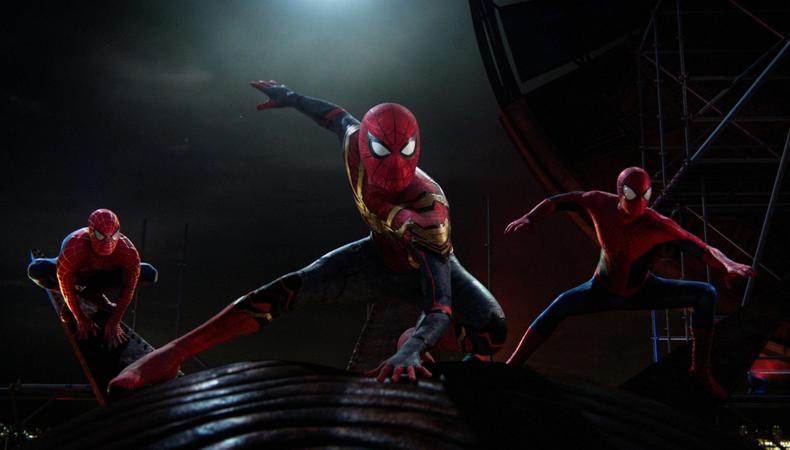
Although comic book films existed prior to the release of Sam Raimi’s “Spider-Man” in 2002, the superhero boom as we know it began when that movie became the first ever to gross over $100 million in a single weekend. The titular webhead, despite never making it to the big screen before, was already so beloved that audiences couldn’t wait to get a look at his first feature adventure.
Across live-action, animation, and video games, countless actors have since taken on the part. But these six actors faced sky-high expectations, whether the project was a debut, a reboot, or a modern take. Here’s how each succeeded in leaving a distinctive mark on the role.
Tobey Maguire: “Spider-Man” trilogy (2002–2007) and “Spider-Man: No Way Home” (2021)
Some may find Raimi’s movies dated now, but the director had a clear vision: a four-color, Silver Age comics vibe transplanted into a modern New York City. The film is set in 2002, but its tone feels firmly in line with what Stan Lee and Steve Ditko created with the character in 1962. Maguire followed suit, providing a “gosh, gee willikers” attitude to his portrayal of Peter Parker, aka Spider-Man.
RELATED: How to Get Cast in a Spider-Man Movie
Although the film quickly moves Peter to adulthood (he’s out of high school by the time the first act is over), Maguire plays the role with a lot of wide-eyed naiveté. There’s nothing “cool” about his Peter, even when he gets the alien symbiote suit in “Spider-Man 3” that’s supposed to make him more powerful. Instead, he just becomes dorkier, because this Peter has no idea what cool is supposed to be. As Spider-Man, Maguire leans more into the burden of heroism rather than the charming rapid-fire quips of his comics counterpart.
Yet the character’s unironic earnestness allows the dramatic beats to thrive. “Spider-Man 2” skillfully adapts Lee’s 1967 “Spider-Man No More” arc to show what it means for Peter to give up his dreams and fully accept the responsibility of being Spider-Man. There’s levity in Maguire’s take, but the films also make good use of his ability to nail the dramatic weight of the character.
Andrew Garfield: “The Amazing Spider-Man” (2012), “The Amazing Spider-Man 2” (2014), and “Spider-Man: No Way Home” (2021)
If you were to pluck Garfield and Emma Stone out of these movies, you’d have something magical. The comedic and romantic chemistry between the costars as Peter Parker and Gwen Stacy is electric; and if there’s anything that works in these movies, it’s the central bond between them.
The problem is that they’re saddled with some truly dreadful scripts, as well as trying to work in a darker tone that never quite clicks. Marc Webb’s “The Amazing Spider-Man” attempts to reboot the series with a more serious, mythology-laden angle—likely inspired by the success of Christopher Nolan’s “The Dark Knight” a few years earlier. Webbs’ movies also try to make Peter genuinely cool (he’s a skateboarding photographer!). And when he’s out for vengeance, his quips are borderline cruel. He spends nights stalking the rooftops to find Uncle Ben’s killer, but then the movie needs him to also fight a giant lizard, and his spider powers are somehow related to his father’s disappearance.
 How to Get Cast in the Marvel Cinematic Universe
 It’s a credit to Garfield that he’s able to keep his performance as light and endearing as it is. Part of that is he’s simply one of the more sympathetic actors working today (you still feel for the guy even when he plays a child-punching goon in “Under the Silver Lake”). He knows how to play Peter as both winning and a little lost. “The Amazing Spider-Man 2” rights the ship slightly, but again, Garfield’s performance as a winning and charming Peter is in spite of the material (which includes a troll-headed Harry Osborn asking for his blood) rather than because of it.
Tom Holland: Marvel Cinematic Universe (2016–present)
What makes Holland’s take stand out is how happy his Peter is to be Spider-Man. Whereas earlier iterations wrestle with the burden of responsibility, this Peter can’t wait to enjoy all his powers and be the big hero. In the MCU, the character is both a colleague and a fan of superheroes, and from the moment he’s swinging around the Russo brothers’ “Captain America: Civil War,” you can feel the joy radiating through Holland’s performance. Jon Watts’ “Spider-Man: Homecoming” (2017), the first solo outing for Peter in the MCU, carries this feeling forward by letting Holland contrast the character’s steadfast morality with a typical high school setting. Dramatizing the choice between something as simple as going to prom and becoming an Avenger is tailor-made for a screen performer as easily earnest as Holland.
Where things get a bit trickier is integrating Peter into the wider MCU. The enthusiasm always comes across, and Holland clearly has a blast playing the inexperience of the character as a polite young man who’s trying to save the world. But the need to make Spider-Man play with other MCU characters means there’s far less of the “How am I going to pay my rent?” Spider-Man, and far more of Tony Stark’s protégé. This means loading up the young superhero with technology even though “Homecoming” does a good job of explaining why this Peter could still succeed even in a homemade suit.
There’s also the underlying sense that the personal growth of this character is hamstrung by the complicated rights issues between Sony Pictures and Marvel Studios. As adept as Holland is at dialing Peter’s sincerity up and down, his performance still feels bent toward the narrative demands of why Spider-Man can or cannot show up in certain Marvel movies. For example, the conclusion of Watts’ “Spider-Man: No Way Home” saw the world forget Peter existed thanks to Doctor Strange’s magic. It’s an ending that feels less like a sign of the character’s maturation, but a way to keep him on ice for a while. It’ll be interesting to see how much space Holland has in the future to play character growth instead of adapting to the latest franchise development.
Shameik Moore: “Spider-Man: Into the Spider-Verse” (2018) and “Spider-Man: Across the Spider-Verse” (2023)
In a film universe full of Spider-Men, there’s only one Miles Morales, and that’s made Moore’s take on the character such a thrill to watch in the animated “Spider-Verse” movies. Maguire, Garfield, and Holland can be compared to each other, but for the time being, Moore gets to set the path for his own young Spider-Man. He’s done a beautiful job of not only finding the warmth and love in this character, but also being part of a larger universe where the story’s stakes revolve around his identity and fate.
What defines bravery for this Spider-Man isn’t his willingness to get into a fight—all Spider-Men have that. Instead, his courage is from embracing an identity that may not fit neatly into what people expect and demand from Spider-Man. He’s not Peter Parker, and he’s not a typical Spider-Man—although he deals with the same issues of taking on too much responsibility for a teenager. Instead, Miles is someone who is constantly questioning not only himself, but the nature of being Spider-Man.
We don’t know yet how the “Spider-Verse” saga will wrap, but Moore’s voice work as Miles has been impeccable. He knows how to nail the comic beats and Miles’ insecurities while also being cool and collected when showcasing the character’s growing confidence. For a character who is relatively recent (his first appearance in comics was in 2011) and has never been seen in live-action, Moore’s vocal performance has helped Miles come alive for audiences, further cementing Miles as a Spider-Man for a new generation.
Yuri Lowenthal and Nadji Jeter: “Spider-Man” (2018), “Spider-Man: Miles Morales” (2020), and “Spider-Man 2” (2023)
Over the last 15 years or so, actors have been able to make a character their own within a video game thanks to technological advances. Motion and facial capture allow developers to blend an actor’s performance with what players see onscreen, and these advances have allowed Lowenthal and Jeter to leave their mark on the legacies of Peter and Miles, respectively, in the series of “Spider-Man” games for PlayStation 5.
RELATED: ‘Spider-Man’ Voice Actor Yuri Lowenthal on How to Break Into Video Games
For Lowenthal, playing Peter is particularly impressive, given he’s an actor in his 50s playing a character in his late 20s. But such is the beauty of VO work. In his voice acting, Lowenthal retains all the youthfulness and affability of Peter, dishing out streams of one-liners that the movies sometimes don’t have time to deliver. While Jeter is closer in age to his role, that doesn’t take anything away from how he’s made the character his own with a gentler, more subdued portrayal of Miles.
The big challenge for Lowenthal and Jeter is how much time you’re going to spend with them. Film actors need to hold your attention for a couple hours, but the “Spider-Man” video games take dozens of hours to complete (especially if you’re reaching 100%). You wouldn’t want to spend that time with actors who don’t make the characters come alive. Lowenthal and Jeter fit into these roles so seamlessly that you forget these are performers at all. They simply are Spider-Man.