
Whether it’s Joaquin Phoenix transforming his Joker from awkward party clown into highly disturbing villain, or Margot Robbie’s Barbie growing more complex and cognizant with every new challenge (not least of all, setting boundaries with Ken), the best performances are delivered by actors who understand their characters’ story arcs. For writers and filmmakers, narrative arcs are fundamental; for actors, they help transform a good performance into an incredible one.
Also known as a narrative arc or plot arc, a story arc is the chronological construction of plot within a narrative—the emotional roadmap that gives a story its momentum and keeps the audience immersed.
What are the essential elements of a story arc?
While stories and plots can vary wildly, from intimate character studies to sprawling epics, story arcs generally share several key components:
- Exposition: This is where we first encounter our protagonist and their world, including other characters, the setting, and the primary conflicts.
- Inciting incident: There’s an event that kicks off the story’s main conflict, setting everything in motion.
- Midpoint: Here’s the point at which the story takes a significant turn, propelling the action forward. Often, this involves a major revelation or change in direction.
- Rising action: This is a series of events that increase tension and move the narrative toward the climax. These are the obstacles and challenges that test our characters.
- Climax: At this point, tension is at an all-time high, and the story has gone all-in on the conflict, often making it a very memorable scene.
- Falling action: These are the events that follow the climax and begin to resolve the story’s conflict.
- Resolution: This is the conclusion, where loose ends are tied up and the story comes to a satisfying close.
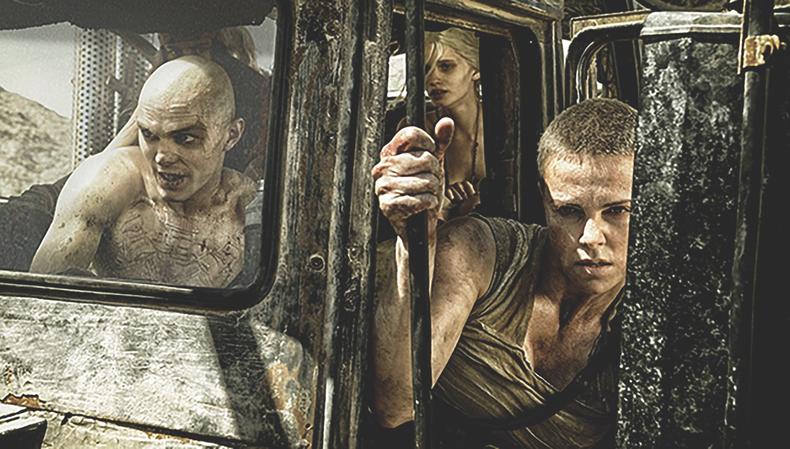
“Mad Max: Fury Road” Courtesy Warner Bros.
Story arc example
The success of George Miller’s “Mad Max: Fury Road” (2015)—a high-octane action thriller that still manages to hit you with all the emotional beats of a drama—is directly linked to its tightly structured story arc, as follows (spoilers ahead!):
- Exposition: In a post-apocalyptic wasteland, Max Rockatansky (Tom Hardy) is a lone wanderer haunted by his past. The world is ruled by tyrannical warlord Immortan Joe (Hugh Keays-Byrne), who maintains control through his monopoly on water and a devoted army. Max is captured by Joe’s War Boys and used as a “blood bag” for one of them, Nux (Nicholas Hoult). The Citadel, Joe’s fortress, is where he keeps his most prized possessions, including a group of women known as the Five Wives, whom he uses to produce heirs.
- Inciting incident: Imperator Furiosa (Charlize Theron), one of Joe’s trusted lieutenants, betrays him by fleeing the Citadel with the Five Wives hidden in her war rig. Her plan is to seek sanctuary in her childhood home, the Green Place. As the war rig races across the desert, Nux joins the chase, bringing Max along as his necessary blood bag, chained to the front of his war rig vehicle.
- Midpoint: Though reluctant at first, Max joins forces with Furiosa after a brutal sandstorm that frees him from Nux. They fight off Joe and his forces as they move toward the Green Place (and become less distrusting of one another). They reach the Vuvalini, a group of matriarchal warriors from Furiosa’s past, only to learn that the Green Place has become a barren swamp.
- Rising action: Realizing there’s no home to return to, Furiosa and Max decide their best chance for survival is to seize the Citadel itself (which is now vulnerable) using the war rig.
- Climax: Furiosa confronts Immortan Joe in a super-intense battle. After lots (and lots!) of violence and destruction, she manages to rip off his oxygen mask. He dies, but Furiosa and the rig are badly injured.
- Falling action: Joe’s army disbands, and Max saves Furiosa by giving her a transfusion of his blood. They return to the Citadel.
- Resolution: The oppressed citizens at the Citadel are happy to hear of Joe’s downfall. Though Furiosa remains in hopes of providing better leadership, Max disappears into the crowd…to be seen again? Only the sequels will tell.
1. Developing complex characters
Understanding a story’s arc illuminates your character’s background, motivations, and ultimate fate. This insight allows you to portray transitions convincingly, in a fluid, believable way.
When Furiosa is still Joe’s trusted lieutenant, for instance, she side-eyes her mirrors and tightens her jaw whenever he speaks. Theron threads these tiny moments of defiance carefully through the film’s opening, but they only make sense later, when we learn she’s been planning her escape all along. By understanding her character’s full journey, Theron turns what could have been a shocking betrayal into something that feels earned.
 Character Motivation: Why It Matters for Actors & Writers (and How to Find It)
2. Creating consistency in performance
Imagine shooting the final gut-wrenching scene of a breakup on Monday, then having to play the couple’s first meeting on Tuesday. That’s the reality of screen acting—it’s like doing a jigsaw puzzle in random order. But understanding the story arc allows you to keep the full picture crystal clear in your mind.
When filming the series “Normal People,” Paul Mescal often had to shoot scenes in nonchronological order. But he explained in an interview on the Team Deakins podcast that knowing the story and its arc helped make it make sense: “If you prep correctly and you know the story... It takes two minutes in the morning when you’re sitting in your trailer to go: OK, this is what preceded it; this is what’s required dramatically from the scene. OK, let’s go.”
3. Improving collaboration
Understanding the full story lets you play the invisible threads between characters, allowing you to work with costars in a way that feels natural.
In Jonathan Demme’s “The Silence of the Lambs” (1991), every conversation between Hannibal Lecter (Anthony Hopkins) and Clarice Starling (Jodie Foster) is a masterful game. When Hopkins delivers the famous “quid pro quo” line, he’s not just playing the moment. He knows that ultimately Lecter will help Clarice, but he’s savoring the psychological dance of getting there.
4. Mastering tone
Knowing the story arc helps actors align their performance with a film’s intended tone, which emerges from the harmony of all its creative elements (such as cinematography, writing, direction, production design, and performance).
Consider the tone difference between “The Big Lebowski” (1998) and “No Country For Old Men” (2007). Though both films are by the Coen brothers and focus on characters who must face mounting disasters, their tones differ wildly. The story arc for the Dude (Jeff Bridges) supports comic absurdity, while the arc for Llewelyn Moss (Josh Brolin) is filled with mounting dread.
5. Navigating the narrative
The story arc is what allows you to really tell your character’s story—not just hitting the emotional beats, but understanding how they flow into each other, and how they build and break and build again. It’s the compass to follow when telling any great story.