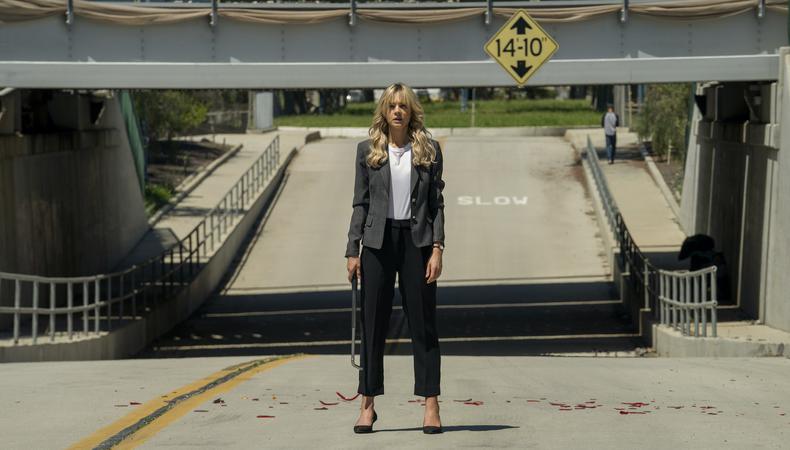
In a late 2020 twist no one saw coming, Paris Hilton’s 2006 single “Stars Are Blind” reentered the cultural consciousness in a big way thanks to Emerald Fennell’s revenge thriller “Promising Young Woman”—and it’s thanks to music supervisor Susan Jacobs. As the film continues to garner heated discussion—as well as award nominations—Jacobs chats with Backstage about using music to “dress up” a muted acting performance, and the mind-blowing lesson she taught the late Philip Seymour Hoffman while working on “Jack Goes Boating.”
“My job is to tell you that there are really two points of view: You’re either playing the interior of the character, or you’re playing the exterior.”
For someone who doesn’t know, what is the role of a music supervisor?
I’m really the producer of the music elements of the film. I control the budgets and creative ideas, and pushing [elements] as they all come together. Anything having to do with music will fall under my umbrella as the department head of music. So, it’s: helping a director find a composer, helping the director choose songs, licensing songs, figuring out how to get the songs they want. Every film is really different, but it’s really making sure that it’s legal, affordable, and going to work for the film.
At what point in the production process do you usually board a project?
I usually come on in post, when people have, you know, gotten in trouble, which happens a lot. People don’t realize how complicated music is and how expensive, and music rights are complicated. So I do get a lot of calls like, “Hi, we’ve made this movie, and we’re in trouble, and we’re stuck.” But if I’m working from the ground up, like I did with “Promising Young Woman,” then I come on before they start shooting. And if I have directors that I work with often, they’ll call me, and I’ll start at script level with them. If we’ve built a relationship and are on our fifth or sixth film together, then I’m coming in early.
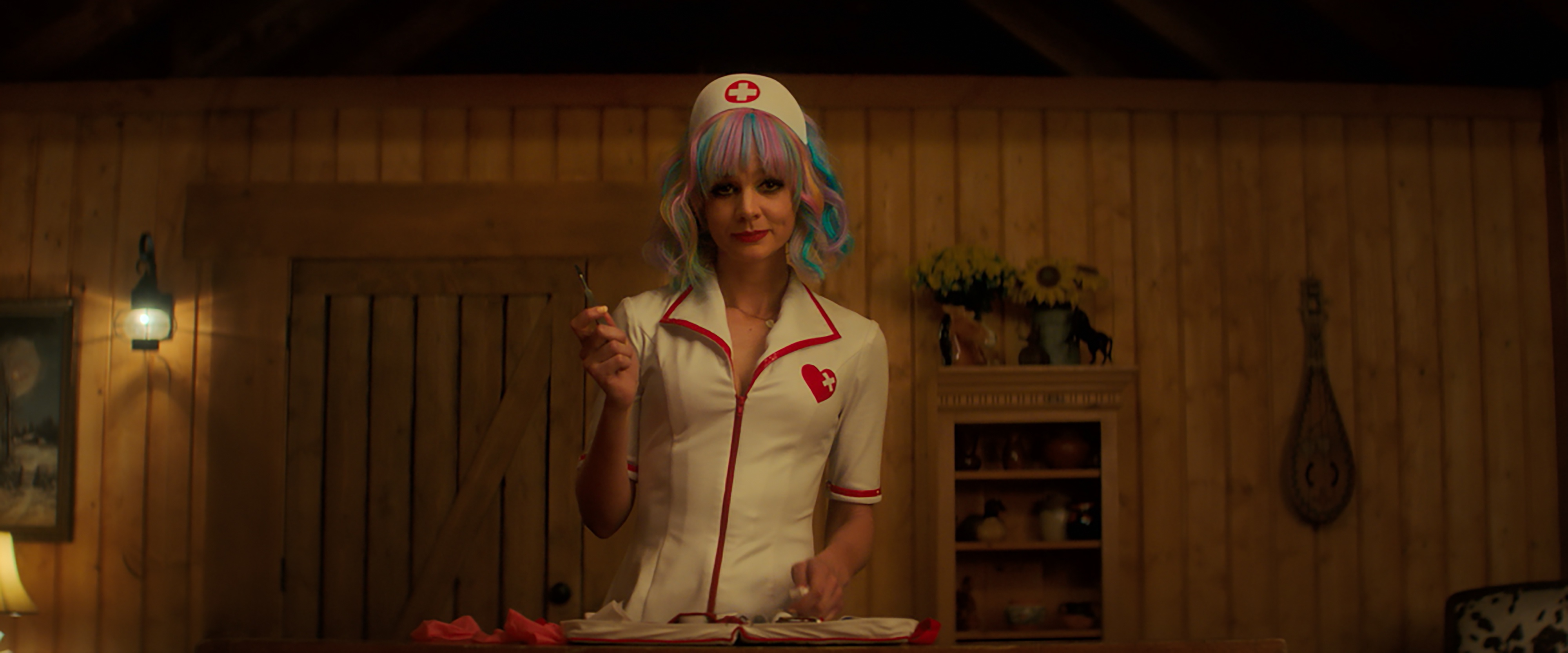 Emerald Fennell Reimagines the Revenge Fantasy With ‘Promising Young Woman’
 Music is hugely important in “Promising Young Woman,” and is, in one instance, even diegetic. What sort of conversations did you have with Emerald early on?
The first conversation [was]: “We have no money, and you want to do pop.” I think our music budget could afford us two songs. That was it! We knew that we had this huge problem, and then that becomes, for me, an architecture thing. In our first conversation, we talked about Paris Hilton [and her song “Stars Are Blind”]—Paris Hilton was over half our music budget. Music is underfunded anyway, and when you have these little independent films, it’s really underfunded. When people say they have a $40,000 music budget, that’ll get you a song and a half.
Emerald talked to me about her love of pop in a real way: “It’s not ironic; this is what I really listen to.” And that’s where it sparked my idea about: OK, if we really are gonna make a pop record, I’ll make a soundtrack album. That’s how we solved our problems, but that requires a director who is going to allow me the real estate. And that’s really hard for directors to do—hard for people to trust that you’re going to be bringing them quality music that is going to fit with their film.
What are some of the ways that you, as the music supervisor, are thinking about how music can help land a moment?
I was talking to a young artist and director just yesterday who I will begin working with in a few months. She’s really new, and I said, “You know, music is just a point of view. And my job is to tell you that there are really two points of view: You’re either playing the interior of the character, or you’re playing the exterior and you’re watching what’s happening.” I had this wonderful conversation with Philip Seymour Hoffman when I was working with him on a film he directed called “Jack Goes Boating.” There was a very important scene in that film that had a lot of people in the room. I said, “Do you want to be in [one character’s] head, or do you want to be watching the whole room?” He didn’t know what I meant, so I said, “Well, I’m only here to tell you that’s your choice as a director. Where do you want the point of view?” And I put two songs on, and one was in her head—we were right with that character, and even though the room’s crowded and you haven’t moved anything, you are tracking everything that she’s looking at and doing, because the song has a certain intimacy. And then I put on something that was: You’re standing at a window, and you’re just watching the scene. You’re watching everything go down. My job really is [to say,] “Here are your points of view.” And thank God I’m not a director, because I don’t have to make that decision—but they do.
“I’ve been doing this [for] 30 years and never get bored of what a piece of music does to a particular scene. There is no one way to do anything, ever.”
Is music always meant to reveal something about the character?
There are some times that music is just literally a tempo getting you through a scene: We need information, we’ve got to know that they met, they died, this happened, and we’re just getting you through this information, then we’re going to go back to our story. But most music should be thought of as a point of view. I love when a director understands that. Even Phil Hoffman, who was a great actor and had been doing this for so long—it kind of blew his mind when he saw two pieces of music on the same scene do something so utterly different. I’ve been doing this [for] 30 years and never get bored of what a piece of music does to a particular scene. There is no one way to do anything, ever—no one song. I don’t care what anybody says; it’s always an option. There are times where I’ll be sitting, putting stuff up, going, “Damn! Isn’t that amazing? I never even noticed that kid in the background way over there,” because suddenly I’ve done something in the music that brought deep background into the foreground. That’s a step that still makes me so excited, because perspective and points of view are the art of the storytelling.
READ: Emerald Fennell Manifested Her
Role on ‘The Crown’
Is your work as the music supervisor influenced by the performance of the actor?
It can be. There was a film I worked on many, many years ago with a young actress, and if you took all the music off of the film, you would look at her and go, “Her expression really never changes.” The music could internally change what she was thinking, even though her expression never changed. You’re looking at somebody kind of scowling 90% of the time, but when we put the music on, all of a sudden, we could make excitement. We could dress her up in whatever we wanted, because the music was telling you what it was. What’s harder is if somebody’s overanimated. It’s hard to pull a performance back. You kind of just have to get out of its way. If somebody is super hyped-up and the director wishes that would calm down, that’s a little harder. It’s hard to put something on top of something that’s already moving so fast. That’s why jazz can be very hard in film, because it’s got so much of its own personality.
Is music usually noted in the script, or do you fill in the blanks after the fact?
It depends if you’re working with a writer or a writer-director. Everybody’s really different. I’ve worked with M. Night Shyamalan for 20 some–odd years, and he just says, “And we’re gonna have music,” and then we’ll discuss that in a sidebar. I’m working on “The Sopranos” prequel right now with David Chase, and he loves music, but there wasn’t anything in the script. That guy knows music really well, but he didn’t write in songs. Emerald knew that she wanted “Stars Are Blind.” She was listening to music as she was writing the script. I think Tarantino does that a lot, so it all depends. With Jean-Marc [Vallée], who is very much working with music at script level, we’ll start together on those things. Some editors love to cut with music and some editors go, “I don’t want to put in any music until I have the whole cut of the film.” There’s no one way to do this, and it also depends on somebody’s comfort with music. When you’re working with someone who loves music, they tend to write in a lot more music than will ever be able to be used. It’s not just about money; you need a lot of room to have a song.
This story originally appeared in the March 11 issue of Backstage Magazine. Subscribe here.
Looking for remote work? Backstage has got you covered! Click here for auditions you can do from home!