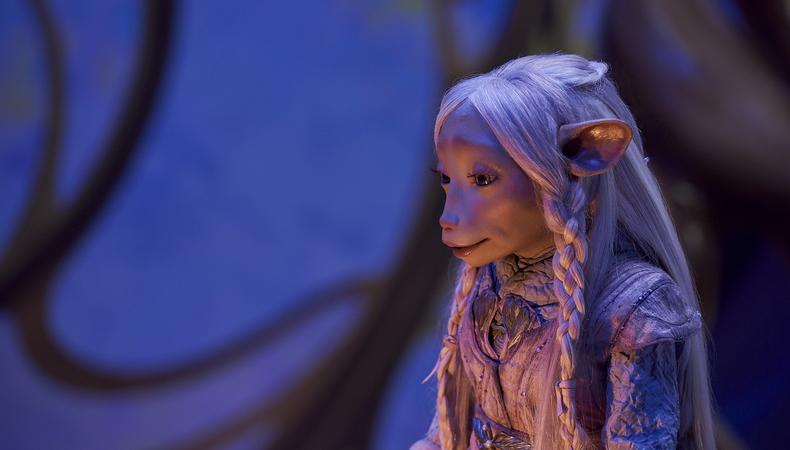
Netflix’s upcoming series “The Dark Crystal: Age of Resistance,” streaming in full on Aug. 30, is a prequel to the 1982 Jim Henson film—and it has the iconic puppetry to show for it. Each creation is a real character, thanks to design supervisor Toby Froud. Froud, whose father, Brian Froud, worked on both the original film and this follow-up, was omnipresent during both the design process and shooting to ensure every puppet was brought to life to look and feel just like any other actor.
“Design supervisor” casts a wide net; what does your position actually entail?
My role really is making sure that the creatures and the characters and the puppets feel right, feel on-style, and feel like they live in the world that my father, Brian Froud, and Jim Henson created on the original film. It’s making sure we have the same quality and ideas behind both the new characters and the rebuilds of the original ones, guiding the team through the ideas of look and feel and texture and color. But it’s also actually building with them and being on set and making sure everything looks right for the camera and for [director] Louis Leterrier to get his shot.
READ: Working With Puppets Can Make You a Better Storyteller
So your work is in design as much as it is the gritty tactile?
Yes, on both ends. I was there from the beginning. My father started designing and drawing the new designs, and I went to work sculpting and doing samples and paint and fabric tests, just to get a feeling for, “Do we have the Froudian look and Froudian quality and feel that the characters of the original had?” As we got the team of sculptors going, we would look at them and start working on the quality of their costumes. And then, as we went through that process, it was working with the teams to do the actual builds, to make sure that we not only make these puppets move, but also look good on-camera at the same time. When we got to England to shoot, I flew over and I was there on set every day and in the workshop, moving back and forth, making sure that as we continued building, I was either building myself and guiding where I could, or I was on set with brushes and wire and tape, along with the amazing wranglers that just held everything together every day with these puppets.
Is there a negotiation between creating the design you love while also making sure it can actually move and look excellent on-camera?
There is always a consideration for that. The design is only the first step, the inspiration, and that’s the nice thing about this process; the people involved in making the puppets—the costumers and the fabricators and sculptors—they all get to be creative and actually add how they feel something should look. It’s creatively a community effort for the team, and that was really cool. People don’t always get to do that when they’re creating for film, which made this feel different for everybody. Each character takes on its own life as we create them and build them. So you end up with something that’s far greater than the design ever was. We just make sure that every character has some energy and life to it.
So are you thinking of these puppets in some ways as the actors?
Absolutely. They are our actors. They have to look good, and they have to move properly. There are two levels to that, because we have the puppeteer, the actual source of the movement that is the actor underneath it, who has to emote through the character you’re seeing onscreen—it’s a double actor you’re dealing with onscreen. It’s really cool and fascinating to see. The puppeteers go through amazing amounts of either pain or discomfort to be able to make something like that move and emote. It’s a huge credit to them, and they do it beautifully. They get you to go with that puppet and make it a character in front of you. You forget that you’re watching a puppet. Even on set, that is the amazing thing: When the puppet starts moving and the camera isn’t rolling yet, it’s creepy. It’s a real character coming to life in front of you, and you forget that there’s someone inside of it [operating it].
How do these puppeteers operate the puppets? Do they wear them or is it an external device?
They are sort of wearing them: It’s a backpack rig that the core puppeteer goes into and they are encased from the waist up, at least. They have a monitor [through which] they can see what the camera sees, and we also have a witness camera so they can see the spacial awareness and know where they can go in the area where they’re filming. It’s very interesting, because they’re blocked off from most things apart from a little monitor and a little earpiece to be able to talk to the other actors and other puppeteers on set and then the director and production crew. They’re very much there and present within these characters. We have wranglers and dressers for each character on set, and we get them in and out and give them breaks and that is a big consideration because they are performing, they are acting. We have to be able to get them in and out of the puppets and get a puppet off of someone’s hand quickly to give them rest and time between takes or shot set-ups because, yes, they are acting.
I’m curious about scenes between actors and puppets; what is that shooting process like for both parties?
The interesting thing is, they’re not puppets anymore. They are the actors. Louis treats them as such. We treat them as such on the production team. When I say “wranglers,” I mean we actually have hair and makeup people for the puppets. They will go and fix the hair and face makeup of the puppet between each shot. The eye-lines, you treat them just as you would with human actors. They’re looking at each other and they’re talking to each other. It’s exactly the same. The only difference is that you’re 4 feet off the ground. So you’ve got one level, which is where the actors are, and then you’ve got a whole other level of puppeteers and monitors and equipment, who are also actors. When you’re interacting with one of the characters, you will forget they’re a puppet. You’ll talk to the puppet like an actor. That’s the beauty of it, because the puppeteer will talk through the puppet, and as soon as that puppet “goes up,” you forget there’s a puppeteer there. That’s pure magic. It’s very funny sometimes to see people’s reaction when they come on set, because you don’t quite know where to look, and you’ll have conversations with these puppets and then from the inside or underneath you’ll have another voice that says, “Hi! I’m still here!” It’s a very strange process that has many levels when it comes to acting, but we have to make sure of the same safety standards for puppeteers. We are as careful as can be with regard to their health and time and safety because they have to be able to perform, like any actor.
What advice would you give someone who wants to pursue puppeteering?
Puppeteering is hard, especially when it comes to something a little more serious like this. It’s not Muppet-style puppetry, where you can just bounce around and flex your arm. The puppeteers have to go through a mental process of having to move the puppets in a very realistic manner while also acting. They have to keep their arms up in the air, and the puppets aren’t light at all. I just read a quote from one of our producers, which was fascinating and true: If you want to be a puppeteer, you should raise a melon above your head for five minutes and do a Shakespearean recital. Put your arms down for 30 seconds, and then put your arms right back up again with the melon and do another Shakespearean monologue, and then keep going. See how that feels, because that’s the sort of idea of being a puppeteer. You’re holding weight above your head for multiple minutes at a time, for 10 hours a day—all while you’re acting. It’s hard, but it’s very rewarding to bring something to life and emote. That’s the beauty of puppetry and puppeteering. The hand becomes the heart of the puppet. You’re able to emote and bring a creature to life through a single appendage of your body. You have to sell it and make people believe that what they’re seeing is real. Just as an actor does everything they can, a puppeteer will use absolutely anything they can to make sure you believe it.
This story originally appeared in the Aug. 29 issue of Backstage Magazine. Subscribe here.
Ready to get to work? Check out Backstage’s voiceover audition listings!