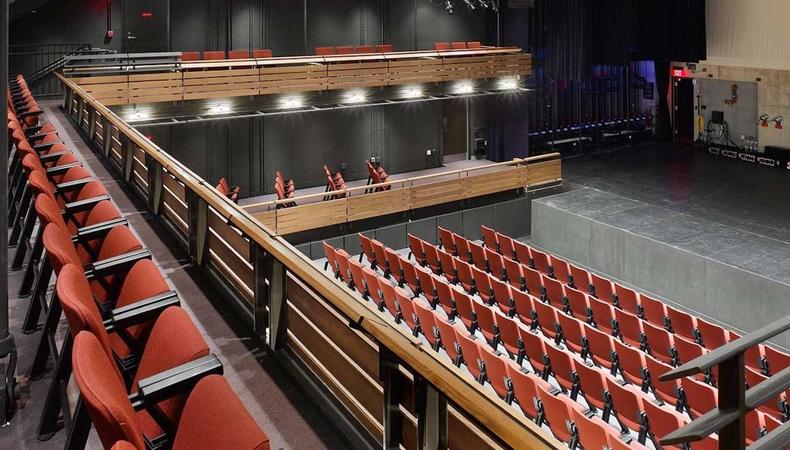
Talking about college musical theater programs is all the rage. For every young student trying to figure out where they want to train, there are dozens of articles telling them where to go and what to look for and what to avoid. Some of those articles rank schools officially, others don’t.
This isn’t one of those articles.
Instead, I’m here to talk about where I think the majority of MT programs fall short: teaching their students about the importance of new works. Many programs don’t have a formal avenue for students to participate in new work development at all and even at the ones that do, it’s very much second fiddle to the big-title once-a-semester productions. While it’s certainly important for young performers to study the canon, it’s a disservice to not train them equally in how to tackle new works because it is a different process.
I’m a playwright and lyricist, and my partner and I debuted our musical through the new works series at the university where I was getting my MFA. Although the administration supported us every step of the way, the vibe we got from the students in the department was a different matter entirely and it’s because of the general attitude about new works in college musical theater programs in general.
Here’s the thing: this is an issue that’s mostly exclusive to the MT world. College students training in film or non-musical theater are accustomed to acting in new works, often those created by other students. But MT students rarely have the same opportunities. And, when new musicals are available, they’re mostly relegated to “new works” series. This makes sense financially—an established show will definitely sell more tickets than an unknown new work and MT programs need to survive. The problem is when this mentality begins to teach the students that canonical works are varsity and only JV players will be relegated to new works.
READ: 8 Original Film Songs to Belt at Your Next Audition
Not all students have this attitude, of course. My experience was remarkably positive, with the students in our show taking it very seriously and pouring a lot of passion and hard work into a tricky score and wholly original story. But in the auditions, which we shared with the semester’s mainstage show, there were definitely some students who turned their nose up when asked if they’d like to be considered for the new work as well. It was a sense that the new work was a consolation prize for those who couldn’t hack it in the mainstage production.
That’s not a good attitude for students to have when their professional career (especially the early part) is likely to involve a lot of readings of new works. Colleges should be training students on the importance of new works, actively encouraging them to participate as they do in established mainstage work.
It’s not just a matter of practicality and attitude; it’s a matter of skills, too. Many of the students with whom I worked weren’t used to asking questions about character, plot, motivation, etc. because their entire training had taught them that a text is a fixed point that cannot and should not be altered. In the realm of new work development, however, those questions are beyond crucial for the creative team: we need to have that back-and-forth to find the gaps and what does and doesn’t work.
For actors, getting the chance to create characters from scratch is also a valuable skill that doesn’t get taught. Yes, it’s the same basic toolbox of skills that are generally taught but they’re applied differently when you have a completely blank slate and no predecessors whose performance can color your (or the director’s) interpretation. It’s pure text interpretation, plus a higher degree of collaboration, given that it’s a work-in-progress. That’s something young actors should feel comfortable with so they don’t limit themselves in career opportunities. Starting out with new work can be intimidating but it’s also definitely more exciting than your sixth community theater production of “The Music Man” or “Annie.”
So what can we do, practically speaking? Educators can and should make new works a more integral part of college programs and implement a system that doesn’t turn new works into a second-tier program. If the goal is to simulate the real industry in a controlled environment, then new works are every bit as important to that. Students need the chance to learn how to be part of a new process where things change rapidly and where they can create something without a precedent. They need to learn to weigh the value of these opportunities fairly and reasonably. When the college system sets new works up as second-class citizens, students internalize that and that’s not good for anyone.
Instead, imagine colleges with musical theatre programs opening their doors to new works. Sure, as readings, but maybe also as fully staged productions. Students are encouraged and rewarded for being part of these shows, plus they get a new kind of avenue to apply their skills and test their mettle. Writers get a relatively low stakes place to develop new work and everyone gets to network.
I don’t know about you, but to me, that sounds like a pretty great way to push musical theater forward.
Check out Backstage’s musicals audition listings!
The views expressed in this article are solely that of the individual(s) providing them,
and do not necessarily reflect the opinions of Backstage or its staff.