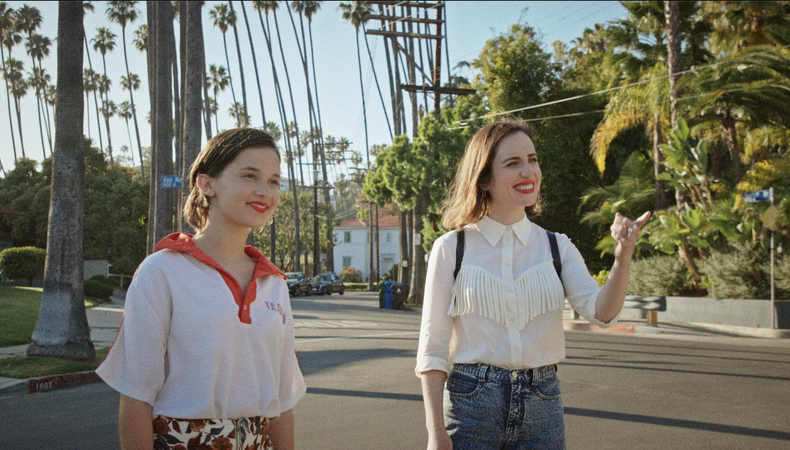
In the spring of 2020, while most of us were doing nothing more than binge-watching television with periodic breaks for panicking, Zoe Lister-Jones was at work inventing a new genre: the feel-good apocalypse movie. Her indie feature “How It Ends,” which premiered at this year’s Sundance Film Festival and will hit theaters July 20, tells the tale of humankind’s last day on Earth before an asteroid strikes—and everyone knows it’s coming.
“I think it was so nourishing and sort of life-affirming—at the risk of sounding hyperbolic—to show ourselves that we could laugh and be funny and have a sense of play amidst the real-life apocalypse that we were facing,” says Lister-Jones, who co-wrote and co-directed the film with her frequent collaborator Daryl Wein.
 How to Make an Indie Film
 Lister-Jones stars in the feature, too, along with Cailee Spaeny; there are also cameo performances from Fred Armisen, Olivia Wilde, Nick Kroll, Ayo Edebiri, Helen Hunt, Bobby Lee, Paul W. Downs, and many others, most of whom are friends with the filmmaker.
As such, the casting process looked more like placing a few phone calls and asking actors if they would be up for doing something experimental, “in which we are leaving the door open to bring whatever emotional baggage you have to the set,” Lister-Jones recalls. “There was some apprehension on some cast members’ parts, because for most of them, this was their first time in front of the camera since quarantine [began]—and it was a comedy. I think the bleakness of what we were all facing was a difficult thing to reconcile with—like, ‘Can I be funny today?’ Part of the intention of the story we chose to tell was: You can be wherever you are.”
In addition to her multihyphenate role behind the camera—“How It Ends” is her third outing directing a feature—Lister-Jones has also worked steadily as an actor, having starred on “New Girl” and “Life in Pieces,” among many other series and films. And while she calls being at the creative helm both “rewarding and a real means of catharsis,” she also relishes wearing only the actor’s hat—in part, she notes succinctly, “because making movies is hard as hell.”
But acting, she adds, also feeds every aspect of her filmmaking, and vice versa. “Writing, directing, producing, and acting are all so mutually informative, because the more you know as an actor about what’s happening behind the camera, [it’s] really helpful to self-guide one’s performance,” she says. “Even with producing—because as an actor you tend to live in a bubble and complain about how long something is taking. Once you’re on the other side of it, you’re like, ‘Oh, shit, I understand why this is taking so long.’ ”
That isn’t to say expertise in one area is instantly transferable to another. When she was making her directorial debut, 2017’s “Band Aid,” Lister-Jones admits to not having known quite a lot. But—she cannot stress it enough—that is completely fine.
READ: What NOT to Do Your First Time on an
Indie Film Set
“I think, as a woman, especially, there is this idea that serves as a barrier that is like: I don’t want to do something unless I’m perfect at it,” she says. “This perpetual impostor syndrome that stops us from actually taking those next steps. I started to watch myself do that, and I was like, I gotta stop that. I’m not going to be perfect, and there’s still stuff I have to learn, but I’m just gonna fucking do it.”
One practical solution to nip those doubts in the bud? In Lister-Jones’ case, she hired an all-female crew. “It’s not that there can’t be shitty women, too, but I think, because the decks are so systematically stacked against women behind the camera and on crews, I just wanted to see what that would feel like for all of us,” she says. “It was about fostering an environment where women could feel encouraged in a way that, even if [it was] unintentional, I just wanted to take that condescension off the table.”
Ultimately, gender very much aside, no matter how experienced a director may be, Lister-Jones insists that every project will have a learning curve to some extent in that it will teach them something new. And to admit as a filmmaker that you still have things to improve upon “is a real sign of confidence.”
“Everyone feels like an impostor,” she says. “My advice for people who might feel nervous, especially for women, would be to not be afraid to ask questions. It’s OK to say, ‘I don’t know what that means,’ because I think there’s a lot of fear that if you admit that, then you should not be here…. You have to allow yourself to play every day without being motivated by the fear.”
This story originally appeared in the July 15 issue of Backstage Magazine. Subscribe here.
Looking for remote work? Backstage has got you covered! Click here for auditions you can do from home!